
Close Menu
    Facebook X (Twitter) Instagram
    SciTechDaily
    • Biology
    • Chemistry
    • Earth
    • Health
    • Physics
    • Science
    • Space
    • Technology
    Facebook X (Twitter) Pinterest YouTube RSS
    SciTechDaily
    Home»Space»Newly Released Herschel Image of Spiral Galaxy M33
    Space

    Newly Released Herschel Image of Spiral Galaxy M33

    By European Space AgencyJuly 28, 2014No Comments2 Mins Read
    Facebook Twitter Pinterest Telegram LinkedIn WhatsApp Email Reddit
    Share
    Facebook Twitter LinkedIn Pinterest Telegram Email Reddit
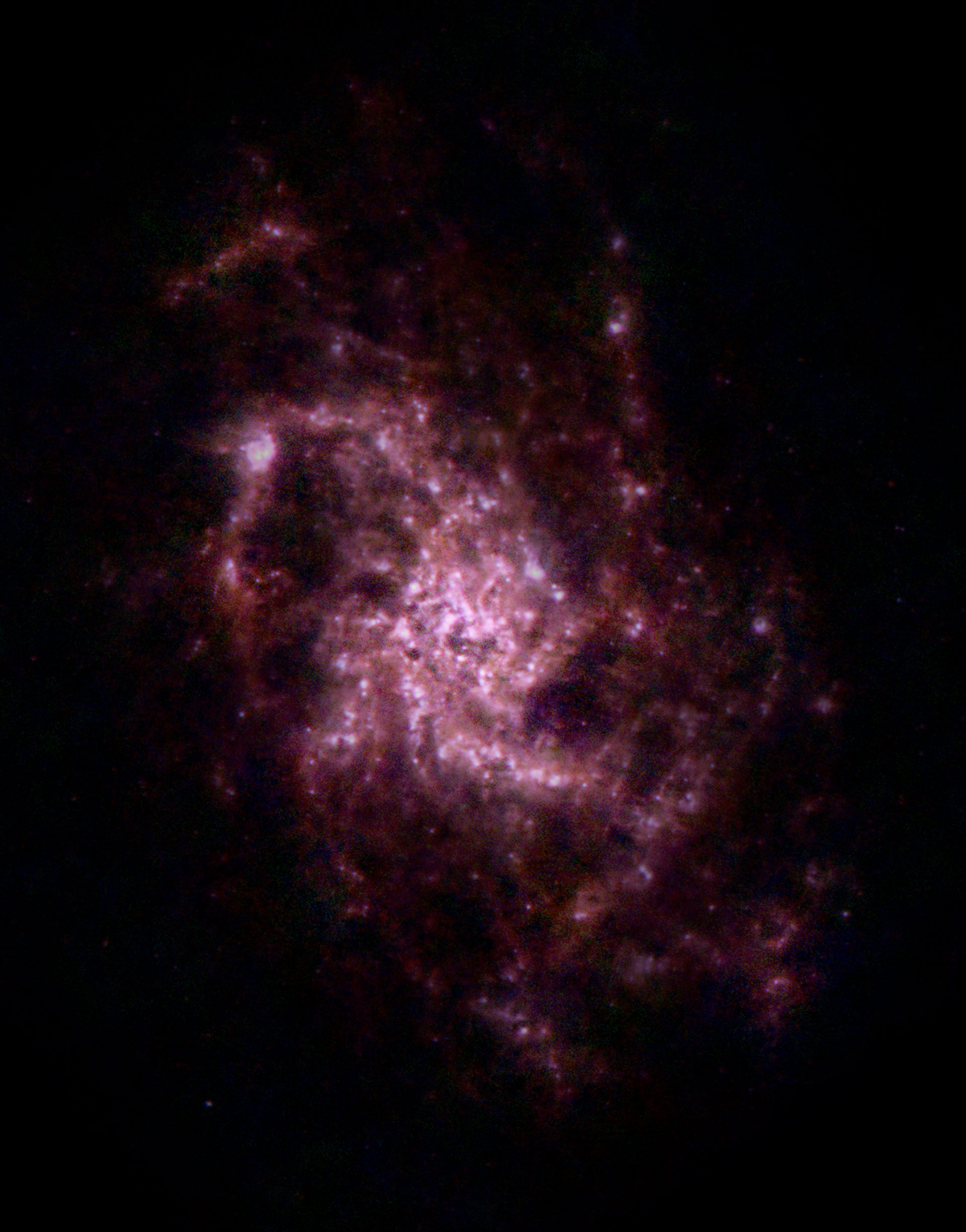
    Herschel Views the Triangulum Galaxy
    The Triangulum Galaxy, M33, is home to approximately forty billion stars and is situated three million light-years away from Earth. Credit: ESA/Herschel/PACS/HerM33es Key Programme/C. Kramer/M. Boquien

    This newly released image from ESA’s Herschel Space Observatory shows the Triangulum Galaxy, which is home to some forty billion stars and is located three million light-years away.

    The spiral galaxy M33, also known as the Triangulum Galaxy, is one of our closest cosmic neighbors, just three million light-years away. Home to some forty billion stars, it is the third largest in the Local Group of galaxies after the Andromeda Galaxy (M31) and our own Milky Way.

    M33 is popular with astrophotographers and from exceptionally dark sites it can even be seen with the naked eye. Thanks to its orientation, we can enjoy a face-on view of the beautiful spiral structure of the galaxy’s disc.

    This image, from ESA’s Herschel Space Observatory, shows M33 in far-infrared light, revealing the glow of cosmic dust in the interstellar medium that permeates the galaxy. The patchy, disorganized structure of M33’s spiral arms resembles a tuft of wool, leading astronomers to classify it as a flocculent spiral galaxy.

    The brightest spots sprinkled along the spiral arms are dense pockets of gas and dust where massive stars are born. The most prominent of these is NGC604, visible in the upper left spiral arm. This is an enormous star-forming region where hundreds of thousands of stars are taking shape.

    The image is a composite of the wavelengths: 70 microns (blue), 100 microns (green), and 160 microns (red). At the shortest wavelengths, astronomers trace warmer dust, revealing individual regions of star formation and parent clouds. At longer wavelengths, they detect emission from colder dust, outlining some of the cool dust reservoir along the galaxy’s winding spiral arms. This is where stars may be born in the future.

    The image spans about one degree on each side; north is up and east is to the left. The data were collected with Herschel’s PACS instrument as part of the Herschel M33 extended survey Key Program to study the star formation in the Triangulum Galaxy.


    Never miss a breakthrough: Join the SciTechDaily newsletter.
    Follow us on Google and Google News.

    Astronomy European Space Agency Popular
    Share. Facebook Twitter Pinterest LinkedIn Email Reddit

    Related Articles

    Webb Reveals What Happens When a Sun Like Ours Dies

    Hubble’s Newest Discovery Isn’t a Star, It’s a Window Into the Dark Universe

    Scientists Watch Black Hole Create Near Light Speed Winds in Hours

    This Red Dwarf Just Launched a Planet-Killing Blast Into Space

    New XDF Image, The Deepest-Ever View of the Universe

    Hubble Zooms in on the Center of M4

    Hubble Image of Peculiar Galaxy Pair Arp 116

    Images From ESA’s Mars Express Reveals the Features of Ladon Basin

    Herschel Image of the Vela C Region

    Leave A Reply Cancel Reply

    • Facebook
    • Twitter
    • Pinterest
    • YouTube

    Don't Miss a Discovery

    Subscribe for the Latest in Science & Tech!

    Trending News

    Scientists Warn That This Common Pet Fish Can Wreck Entire Ecosystems

    Scientists Make Breakthrough in Turning Plastic Trash Into Clean Fuel Using Sunlight

    This Popular Supplement May Interfere With Cancer Treatment, Scientists Warn

    Scientists Finally Solved One of Water’s Biggest Mysteries

    Could This New Weight-Loss Pill Disrupt the Entire Market? Here’s What You Should Know About Orforglipron

    Earth’s Crust Is Tearing Open in Africa, and It Could Form a New Ocean

    Breakthrough Bowel Cancer Trial Leaves Patients Cancer-Free for Nearly 3 Years

    Natural Compound Shows Powerful Potential Against Rheumatoid Arthritis

    Follow SciTechDaily
    • Facebook
    • Twitter
    • YouTube
    • Pinterest
    • Newsletter
    • RSS
    SciTech News
    • Biology News
    • Chemistry News
    • Earth News
    • Health News
    • Physics News
    • Science News
    • Space News
    • Technology News
    Recent Posts
    • The Most Effective Knee Arthritis Treatments Aren’t What You Expect
    • Scientists Develop Bioengineered Chewing Gum That Could Help Fight Oral Cancer
    • Popular Weight-Loss Drugs Found To Cut Heart Attack and Stroke Risk
    • After 37 Years, the World’s Longest-Running Soil Warming Experiment Uncovers a Startling Climate Secret
    • NASA Satellite Captures First-Ever High-Res View of Massive Pacific Tsunami
    Copyright © 1998 - 2026 SciTechDaily. All Rights Reserved.
    • Science News
    • About
    • Contact
    • Editorial Board
    • Privacy Policy
    • Terms of Use

    Type above and press Enter to search. Press Esc to cancel.