
Close Menu
    Facebook X (Twitter) Instagram
    SciTechDaily
    • Biology
    • Chemistry
    • Earth
    • Health
    • Physics
    • Science
    • Space
    • Technology
    Facebook X (Twitter) Pinterest YouTube RSS
    SciTechDaily
    Home»Space»Newly Released Hubble Image of Galaxy NGC 6861
    Space

    Newly Released Hubble Image of Galaxy NGC 6861

    By Hubble Space TelescopeJanuary 12, 201512 Comments2 Mins Read
    Facebook Twitter Pinterest Telegram LinkedIn WhatsApp Email Reddit
    Share
    Facebook Twitter LinkedIn Pinterest Telegram Email Reddit
    Hubble Image of Galaxy NGC 6861
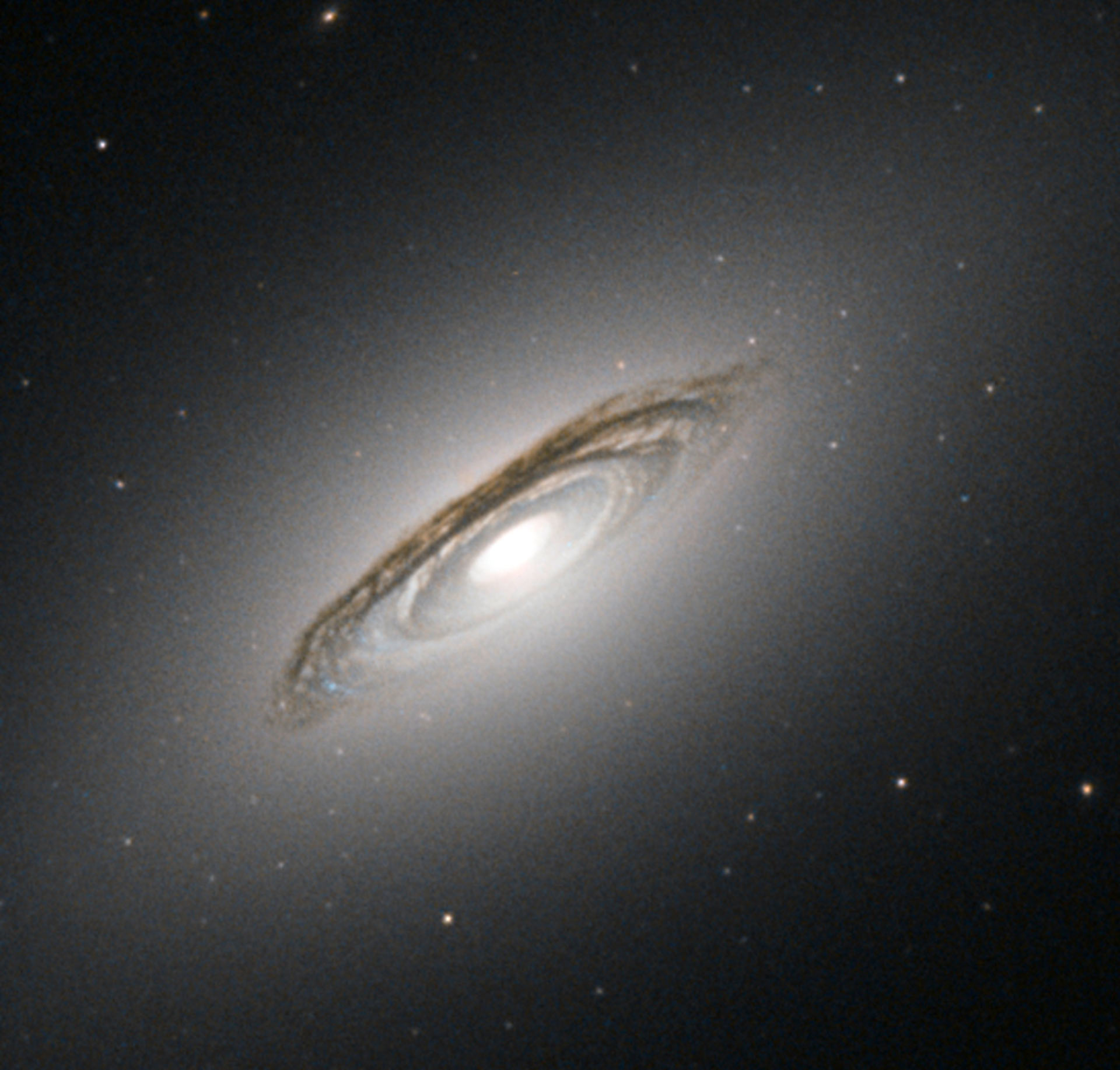
    NGC 6861 is the second brightest member of a group of at least a dozen galaxies called the Telescopium Group in the small constellation of Telescopium (The Telescope). Credit: ESA/Hubble & NASA; Acknowledgement: J. Barrington

    First discovered in 1826, this newly released Hubble image shows galaxy NGC 6861.

    The subject of this image is NGC 6861, a galaxy discovered in 1826 by the Scottish astronomer James Dunlop. Almost two centuries later we now know that NGC 6861 is the second brightest member of a group of at least a dozen galaxies called the Telescopium Group — otherwise known as the NGC 6868 Group — in the small constellation of Telescopium (The Telescope).

    This NASA/ESA Hubble Space Telescope view shows some important details of NGC 6861. One of the most prominent features is the disc of dark bands circling the center of the galaxy. These dust lanes are a result of large clouds of dust particles obscuring the light emitted by the stars behind them.

    Dust lanes are very useful for working out whether we are seeing the galaxy disc edge-on, face-on or, as is the case for NGC 6861, somewhat in the middle. Dust lanes like these are typical of a spiral galaxy. The dust lanes are embedded in a white oval shape, which is made up of huge numbers of stars orbiting the center of the galaxy. This oval is, rather puzzlingly, typical of an elliptical galaxy.

    So which is it — spiral or elliptical? The answer is neither! NGC 6861 does not belong to either the spiral or the elliptical family of galaxies. It is a lenticular galaxy, a family which has features of both spirals and ellipticals.

    The relationships between these three kinds of galaxies are not yet well understood. A lenticular galaxy could be a faded spiral that has run out of gas and lost its arms, or the result of two galaxies merging. Being part of a group increases the chances for galactic mergers, so this could be the case for NGC 6861.

    A version of this image was entered into the Hubble’s Hidden Treasures image processing competition by contestant Josh Barrington.


    Never miss a breakthrough: Join the SciTechDaily newsletter.
    Follow us on Google and Google News.

    Astronomy Hubble Space Telescope
    Share. Facebook Twitter Pinterest LinkedIn Email Reddit

    Related Articles

    A Morphing Spiral Galaxy Amongst Friends

    Hubble Views Magnificent Lopsided Galaxy NGC 2276

    Hubble Captures Fantastic Detail of Eponymous Spiral Galaxy NGC 691

    Spectacular Image Captured by Hubble Shows a Strangely Contorted Spiral Galaxy

    A Distant Spiral in Virgo: Extraordinary Detail Seen in a Galaxy 150 Million Light-Years Away From Earth

    Magnetic Monsters: Hubble Tracks Down Location of Mysterious Radio Signals From Intergalactic Space

    A Menagerie of Galaxies: Hubble Captures a Cluster With Galaxies of All Shapes and Sizes

    How Habitable Are Planets That Orbit Red Dwarfs – The Most Common Type of Stars in the Galaxy?

    Cosmic Silver Lining: Hubble Spots V565 Surrounded by Four Prominent Diffraction Spikes

    12 Comments

    1. Michael on January 12, 2015 2:55 pm

      I wasn’t aware that Hubble was creating images in 1826, but I’m certainly glad they discovered it 😉

      Reply
      • james on January 12, 2015 9:05 pm

        Man them are really nice pictures-its really cool knowing that stuff is out there-

        Reply
    2. Marclar on January 12, 2015 3:17 pm

      Good god. How about a real image. This composite has some many pastes, it does not have a spot that has not been pasted into.

      Reply
    3. Martianice on January 12, 2015 3:43 pm

      It looks like a hurricane in the “Space Ocean”. A hurricane of matter and energy much like the water vapor, water droplets, ice crystals, and lighting of the atmospheric analog. Is there such a named galaxy? The Hurricane or Typhoon Galaxy? I’ve heard of the Whirlpool Galaxy. That would be an aquatic analog.

      Reply
    4. Kenny S on January 12, 2015 4:05 pm

      How does one discover a galaxy in 1826 is my first question

      Reply
      • Armus on January 12, 2015 11:31 pm

        First you need a telescope with a large aperture, photographic equipment and Dark skies. As the Earth moves around the sun, stars in this galaxy will shift slightly. It’s called parallax. When something doesn’t move,it’s probably not local – very far away. But considering its magnitude (brightness), even someone in the 1820s could theorize the object was a galaxy. At the very least, the object, most likely too dim to see with the naked eye, could be discovered even if no one knew what it was.

        Reply
        • Armus on January 12, 2015 11:34 pm

          Error 1820s probably no photography. Objects would have to be plotted on paper. Still don’t knock the expertise of people long ago to do things extraordinary

          Reply
      • Dan S. on January 13, 2015 4:58 am

        They Googled it silly! 🙂

        Reply
      • Patrick B on January 13, 2015 5:49 am

        Telescopes existed in 1826.

        Reply
      • Percy D on January 13, 2015 12:57 pm

        By telescope my friend.

        Reply
    5. justme on January 13, 2015 1:13 am

      Its shown upside down. It should call it the fried egg galaxy.;)

      Reply
    6. Bobby on January 13, 2015 7:34 am

      Why do “scientists” label galaxies as elliptical or spiral when they only appear as an “ellipse” bcoz it sits at an oblique angle from our perspective.
      Surely they’re aware that everything in the universe is created with perfection and that these celestial systems are self organizing but require millions of years to develop and as we discover them, they lie in various stages of development.
      You don’t crack an egg into a frying pan and say, “its a chicken”, when its only an embryo.

      This Galaxy appears to be relatively young indicated by the expansion of illuminated gas in the center which has yet to attract the lighter density gases into the nucleus which will eventually coalesce and ignite as the central Sun.

      Reply
    Leave A Reply Cancel Reply

    • Facebook
    • Twitter
    • Pinterest
    • YouTube

    Don't Miss a Discovery

    Subscribe for the Latest in Science & Tech!

    Trending News

    Scientists Warn That This Common Pet Fish Can Wreck Entire Ecosystems

    Scientists Make Breakthrough in Turning Plastic Trash Into Clean Fuel Using Sunlight

    This Popular Supplement May Interfere With Cancer Treatment, Scientists Warn

    Scientists Finally Solved One of Water’s Biggest Mysteries

    Could This New Weight-Loss Pill Disrupt the Entire Market? Here’s What You Should Know About Orforglipron

    Earth’s Crust Is Tearing Open in Africa, and It Could Form a New Ocean

    Breakthrough Bowel Cancer Trial Leaves Patients Cancer-Free for Nearly 3 Years

    Natural Compound Shows Powerful Potential Against Rheumatoid Arthritis

    Follow SciTechDaily
    • Facebook
    • Twitter
    • YouTube
    • Pinterest
    • Newsletter
    • RSS
    SciTech News
    • Biology News
    • Chemistry News
    • Earth News
    • Health News
    • Physics News
    • Science News
    • Space News
    • Technology News
    Recent Posts
    • Kratom Use Explodes in the US, With Life-Changing Consequences
    • Scientists Uncover Fatal Weakness in “Zombie Cells” Linked to Cancer
    • World-First Study Reveals Human Hearts Can Regenerate After a Heart Attack
    • Why Your Dreams Feel So Real Sometimes and So Strange Other Times
    • Scientists Debunk 100-Year-Old Belief About Brain Cells, Rewriting Textbooks
    Copyright © 1998 - 2026 SciTechDaily. All Rights Reserved.
    • Science News
    • About
    • Contact
    • Editorial Board
    • Privacy Policy
    • Terms of Use

    Type above and press Enter to search. Press Esc to cancel.