
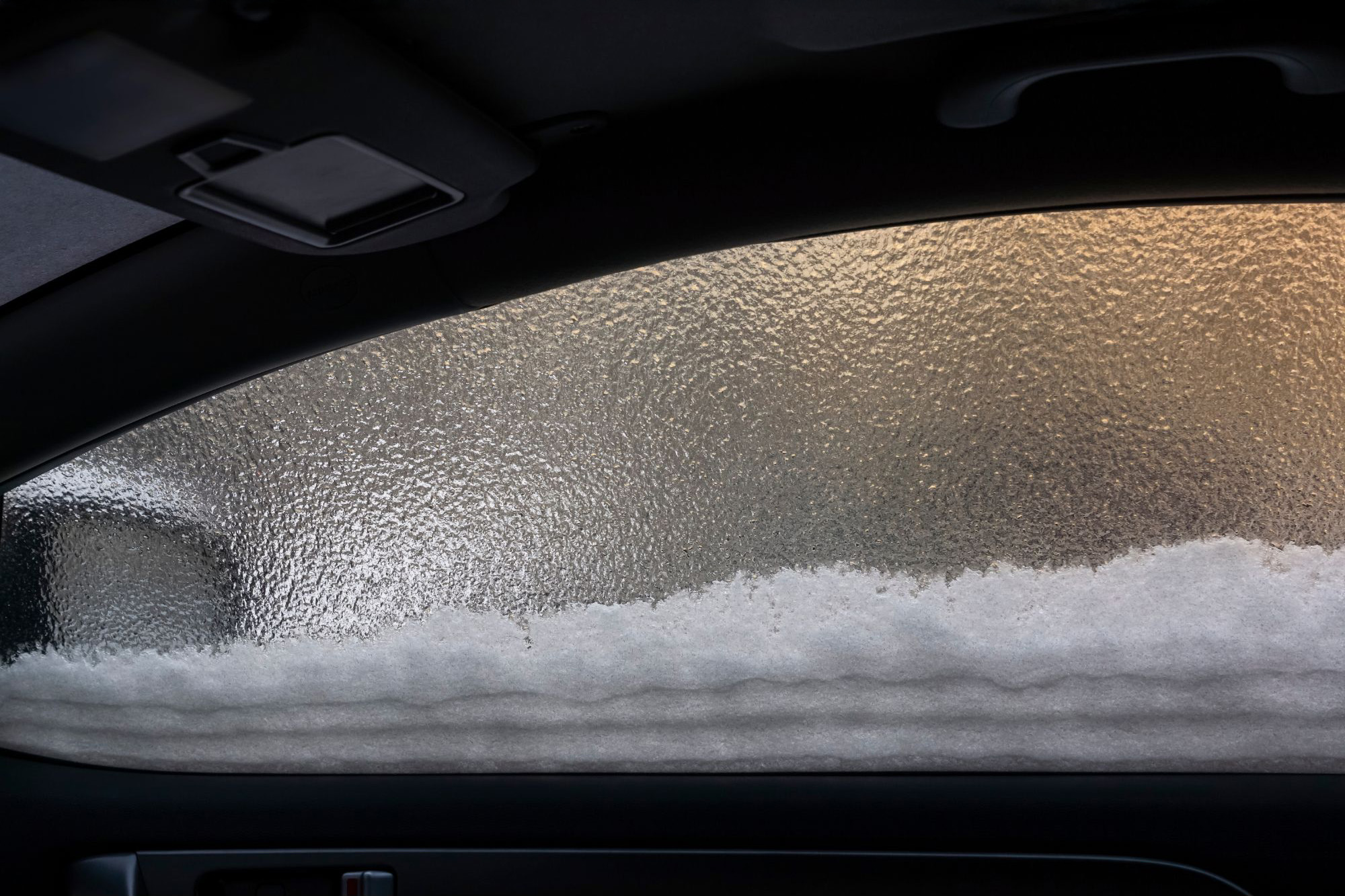
The optimized surface completely prevents frost formation on flat areas for up to one week.
One day, we might finally say goodbye to defrosting freezers or scraping frost off slippery surfaces. Engineers at Northwestern University have developed a new strategy to prevent frost formation before it even starts.
In a new study, the researchers discovered that tweaking the texture of any surface and adding a thin layer of graphene oxide prevents 100% frost from forming on surfaces for one week or potentially even longer. This is 1,000 times longer than current, state-of-the-art anti-frosting surfaces.
As an added bonus, the new scalable surface design also is resistant to cracks, scratches, and contamination.
By incorporating the textured surface into infrastructure, the researchers imagine companies and government agencies could save billions of dollars per year in averted maintenance costs and energy inefficiencies.
The research was recently published in the journal Science Advances.
“Unwanted frost accumulation is a major concern across industrial, residential, and government sectors,” said Northwestern’s Kyoo-Chul Kenneth Park, who led the study. “For example, the 2021 power crisis in Texas cost $195 billion in damages, resulting directly from frost, ice, and extreme cold conditions for more than 160 hours. Thus, it is critical to develop anti-frosting techniques, which are robust for long periods of time in extreme environmental conditions. It is also necessary to develop anti-frosting methods which are easy to fabricate and implement. We designed our hybrid anti-frosting technique with all of these needs in mind. It can prevent frosting for potentially weeks at a time and is scalable, durable, and easily fabricated through 3D printing.”
Park is an assistant professor of mechanical engineering at Northwestern’s McCormick School of Engineering and a faculty affiliate of the Paula M. Trienens Institute for Sustainability and Energy and the International Institute for Nanotechnology.
Leaf-inspired discovery
The new study builds upon previous work from Park’s laboratory. In 2020, Park and his team discovered that adding millimeter-scale textures to a surface theoretically reduced frost formation by up to 80%. Published in the Proceedings of the National Academy of Sciences, the research was inspired by the rippling geometry of leaves.

“There is more frost formation on the convex regions of a leaf,” Park said at the time. “On the concave regions (the veins), we see much less frost. People have noticed this for several thousands of years. Remarkably, there was no explanation for how these patterns form. We found that it’s the geometry — not the material — that controls this.”
Through experimental work and computation simulations, Park and his collaborators found that condensation is enhanced on the peaks and suppressed in the valleys of wavy surfaces. The small amount of condensed water in the valleys then evaporates, resulting in a frost-free area.
Graphene-oxide trapping power
In the previous study, Park’s team developed a surface featuring millimeter-scale peaks and valleys with small angles in between. In the new study, Park’s team added graphene oxide on flat valleys, which reduced frost formation by 100% in those valleys. The new surface comprises tiny bumps, with a peak-to-peak distance of 5 millimeters. Then a thin layer of graphene oxide, just 600 microns thick, coats the valleys between peaks.
“Graphene oxide attracts water vapor and then confines water molecules within its structure,” Park said. “So, the graphene oxide layer acts like a container to prevent water vapor from freezing. When we combined graphene oxide with the macrotexture surface, it resisted frost for long times at high supersaturation. The hybrid surface becomes a stable, long-lasting, frost-free zone.”
When compared to other state-of-the-art anti-frosting surfaces, Park’s method was the clear winner. While superhydrophobic (water repelling) and lubricant-infused surfaces resisted 5-36% of frost formation for up to 5 hours, Park’s surface resisted 100% of frost formation for 160 hours.
“Most other anti-frosting surfaces are susceptible to damage from scratches or contamination, which degrades surface performance over time,” Park said. “But our anti-frosting mechanism demonstrates robustness to scratches, cracks, and contaminants, extending the life of the surface.”
Why it matters
This hybrid macrotexture-graphene oxide surface offers a promising solution for preventing frost formation in various applications. Most people only worry about frost when it coats their car windshield or kills their outdoor plants. But frost is more than a nuisance.
Frost on airplane wings can create drag, making flights dangerous or even impossible. When accumulating inside freezers and refrigerators, frost greatly reduces energy efficiency in appliances. Frost can add too much weight to power lines, leading to breakage and, ultimately, power outages. It also can impair sensors on vehicles, harming their ability to accurately detect objects.
“Developing new anti-frosting techniques is crucial to preventing costly mechanical failures, energy inefficiencies, and safety hazards for critical operations,” Park said. “There currently is no ‘one-size-fits-all’ approach because every application has specific needs. Although airplanes only require seconds of frost resistance, powerlines operating in cold environments might require days or weeks of frost resistance, for example. With our new insights, we could design powerlines and airplane wings with reduced ice adhesion. These types of alterations would greatly reduce yearly maintenance costs.”
Reference: “Robust hybrid diffusion control for long-term scalable frost prevention” by Christian Machado, Benjamin Stern, Haiyue Huang, Asma Ul Hosna Meem, Jiaxing Huang and Kyoo-Chul Kenneth Park, 30 October 2024, Science Advances.
DOI: 10.1126/sciadv.adq8525
The study was partially supported by the National Science Foundation (grant number CBET-2337118) and the Korea Institute for Science and Technology (grant number 2E32527).
Never miss a breakthrough: Join the SciTechDaily newsletter.
Follow us on Google and Google News.
2 Comments
climate change is real. Develop agents that assist in frost formation and put it on rooftops and parking lots.
It’s always been “real.”