
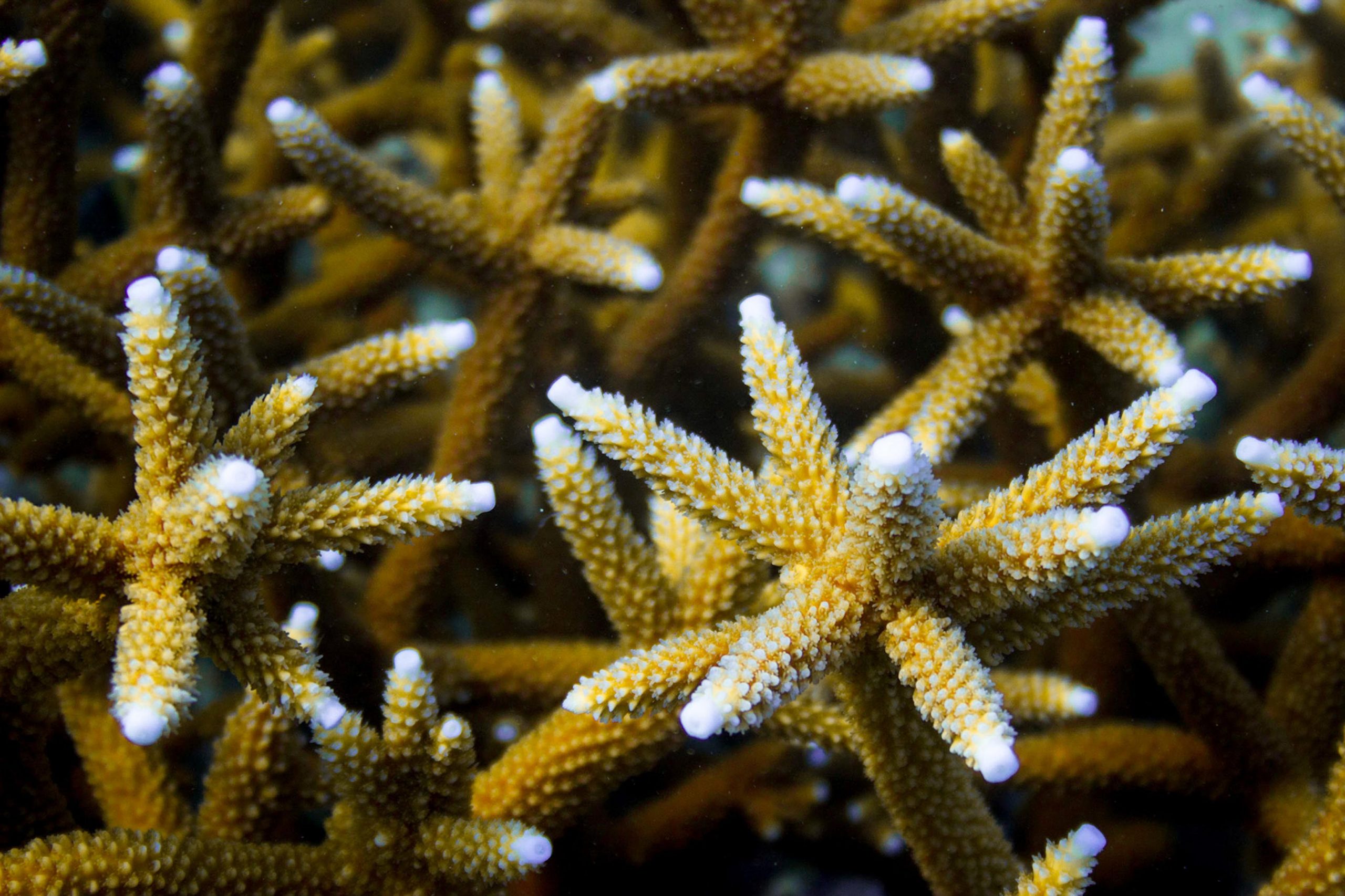
Florida Tech research shows climate change will suppress reef growth from north and south.
Warming seas are driving many species of marine life to shift their geographic ranges out of the tropics to higher latitudes where the water is cooler. Florida’s reefs will not be able to make that northward move, however, as they will be caught between intolerably hot tropical waters and increasingly frequent water-cooling cold snaps, according to new findings from Florida Institute of Technology, the U.S. Geological Survey, and several other institutions to be published today (June 22) in Nature’s Scientific Reports.
Populations of the main species of reef-building corals are already in dire condition, to the extent that they are listed under the Endangered Species Act. With no where to go, the corals will decline even more drastically.
Corals are colonies of animals related to sea anemones. They have single-celled algae living inside them that feed them with carbohydrates the algae make by photosynthesis.
The coral colonies lay down limestone to make reefs that protect shorelines from storm waves and provide habitat for fish that feed half-a-billion people worldwide.
In Florida, spiny lobster, snapper, and grouper find shelter, food, and breeding sites in coral reefs, which NOAA estimates generate $4.4 billion in local sales in the Sunshine State and more than 70,000 related jobs.
Now climate change is raising temperatures and disrupting the tight, symbiotic relationship between the corals and their algae, to the point that corals are dying all over the world. One common prediction is that corals will simply migrate north and build reefs where the water is cooler. But more frequent freezes in Florida will prevent corals from escaping north and re-establishing reefs away from the tropics.
“It’s just not as simple as predicting the corals will move north,” said lead author Lauren Toth. Toth, who received her Ph.D. at Florida Tech in 2013, is a research scientist at the U.S. Geological Survey’s St. Petersburg Coastal and Marine Science Center in St. Petersburg, Fla. “Thousands of years ago, corals and coral reefs moved north along Florida’s east coast when the climate warmed, but things are different now. Rapid climate change looks to be increasing the number of cold fronts from the polar vortex that are dipping down into Florida.”
Co-author Richard Aronson, a marine scientist at Florida Tech and Toth’s doctoral advisor, said, “All of us on the Eastern Seaboard know the jet stream is wobbling more and dipping southward more frequently, bringing us bad winter storms and bitterly cold weather. The corals along Florida’s east coast will be hammered from the north by freezes on the anvil of rising temperatures in the south. They won’t be able to shift locations from the Florida Keys to the east coast.”
William Precht, co-author and a marine biologist at the Florida-based consulting firm Dial Cordy and Associates, Inc., pointed out that beyond their essential ecological role, coral reefs’ economic contribution to Florida’s economy means their loss could have a wide-ranging impact. “That is a very obvious reason why Floridians–and everyone else for that matter–should be concerned about the impacts of climate change on corals,” he said.
Reference: “Climate and the latitudinal limits of subtropical reef development” by Lauren T. Toth, William F. Precht, Alexander B. Modys, Anastasios Stathakopoulos, Martha L. Robbart, J. Harold Hudson, Anton E. Oleinik, Bernhard M. Riegl, Eugene A. Shinn and Richard B. Aronson, 22 June 2021, Scientific Reports.
DOI: 10.1038/s41598-021-87883-8
The research was funded by the U.S. Geological Survey and the National Science Foundation. Scientists from Florida Atlantic University, Nova Southeastern University and the University of South Florida collaborated on the study.
Never miss a breakthrough: Join the SciTechDaily newsletter.
Follow us on Google and Google News.