
Close Menu
    Facebook X (Twitter) Instagram
    SciTechDaily
    • Biology
    • Chemistry
    • Earth
    • Health
    • Physics
    • Science
    • Space
    • Technology
    Facebook X (Twitter) Pinterest YouTube RSS
    SciTechDaily
    Home»Health»Nonsurgical Implant Could Help Overcome Obesity by Killing Cells Producing Ghrelin, the “Hunger Hormone”
    Health

    Nonsurgical Implant Could Help Overcome Obesity by Killing Cells Producing Ghrelin, the “Hunger Hormone”

    By American Chemical SocietyApril 6, 20221 Comment3 Mins Read
    Facebook Twitter Pinterest Telegram LinkedIn WhatsApp Email Reddit
    Share
    Facebook Twitter LinkedIn Pinterest Telegram Email Reddit
    Nonsurgical Implant Could Help Overcome Obesity
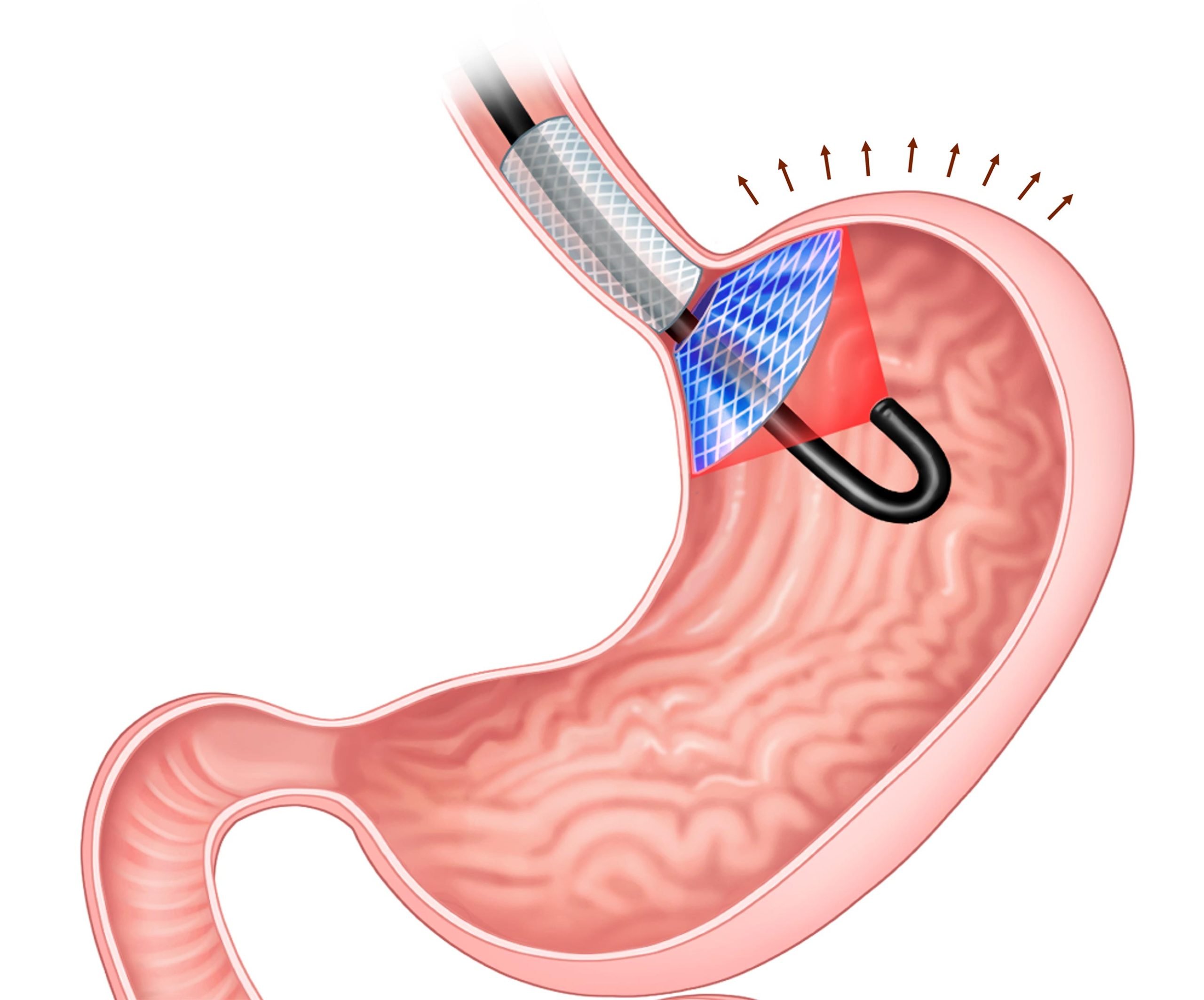
    In this illustration, an implant (blue and gray) creates a feeling of fullness by pressing on the stomach and, when activated by a laser (black), killing cells that produce the hunger hormone. Credit: Adapted from ACS Applied Materials & Interfaces 2022, DOI: 10.1021/acsami.2c00532

    A laser-activated implant that reduces ghrelin production by killing specific cells has shown promising results in reducing weight gain in pigs, offering a new minimally invasive method for treating obesity.

    When dieting and exercise aren’t enough, weight-loss surgery can be an effective obesity treatment. But people who don’t want surgery have other options, including insertion of an appetite-suppressing balloon or other implant in the stomach. Now, researchers report in ACS Applied Materials & Interfaces that they have augmented that procedure in laboratory animals by coating an implant with a laser-activated dye that kills cells producing ghrelin, the “hunger hormone.”

    Implants can be inserted in the stomach through the mouth after local anesthesia. In 2019, Hwoon-Yong Jung, Jung-Hoon Park and colleagues designed a new type of implant. The “intragastric satiety-inducing device” (ISD) consists of a stent — which lodges in the lower esophagus — attached to a disk that rests in the opening to the stomach. The disk has a hole in the center to let food through. Tests in pigs showed that the ISD lowered food intake and weight gain by enhancing the feeling of fullness and reducing levels of ghrelin, which is produced by cells near the top of stomach. But the device caused complications, including acid reflux and migration into the stomach. In their latest project, Jung, Park, Kun Na, and colleagues wanted to find out if they could suppress ghrelin even more by coating the ISD’s disk with a compound that, with a shot of laser light, could kill some of the ghrelin-producing cells. The implant could then be removed to avoid the side effects associated with the initial design.

    In this preliminary study, the team coated ISDs with methylene blue — an FDA-approved drug — and then placed them in the stomachs of young pigs. When exposed to laser light, the coating released singlet oxygen, an energized form of oxygen that killed nearby ghrelin-producing cells in the pigs’ stomachs and then rapidly disappeared. After one week, the treatment reduced ghrelin levels and body weight gain by half compared with an untreated pig, though these differences declined in the following weeks unless the light treatment was repeated. With further development, the simple procedure could become a new type of minimally invasive treatment to help obese patients lose weight, the researchers say.

    Reference: “Photodynamic methylene blue-embedded intragastric satiety-inducing device to treat obesity” by Sanghee Lee, Ji Won Kim, Jinhwan Park, Hee Kyong Na, Do Hoon Kim, Jin Hee Noh, Dae Sung Ryu, Jae Myung Park, Jung-Hoon Park, Hwoon-Yong Jung and Kun Na, 6 April 2022, ACS Applied Materials & Interfaces.
    DOI: 10.1021/acsami.2c00532

    The authors acknowledge support from the Korea Medical Device Development Fund grant funded by the Korean government (Project number: KMDF_PR_20200901_0036).

    Never miss a breakthrough: Join the SciTechDaily newsletter.
    Follow us on Google and Google News.

    American Chemical Society Obesity Popular Weight Loss
    Share. Facebook Twitter Pinterest LinkedIn Email Reddit

    Related Articles

    Weight Loss Breakthrough: Scientists Develop Edible “Fat Sponges” From Green Tea and Seaweed

    Cheaper and More Effective: New MIT Breakthrough Could Improve Popular Weight Loss Drugs Such As Ozempic

    New Obesity Treatment Delivers Dramatic Weight Loss – Benefits of Gastric Bypass Without Surgery

    Scientists Discover a Gene to Stay Thin – Protects Against Diet-Induced Obesity

    New Evidence for Using Testosterone Therapy to Treat Obesity – Mean Weight Loss of 50 Pounds

    Lipoic Acid Supplements Help Overweight People Lose Weight in Clinical Trial

    New Remote Weight-Loss Method Helps Slash Pounds – Maximum Weight Loss for the Lowest Cost

    Scientific Studies Show Drinking Green Tea May Help You Lose Weight

    Burn Twice as Many Calories: Eat a Big Breakfast Rather Than a Large Dinner

    1 Comment

    1. Abbi Abbi on April 6, 2022 6:27 am

      Abbiethu

      Reply
    Leave A Reply Cancel Reply

    • Facebook
    • Twitter
    • Pinterest
    • YouTube

    Don't Miss a Discovery

    Subscribe for the Latest in Science & Tech!

    Trending News

    1.4-Million-Year-Old Footprints Reveal a Giant Human Relative

    Astronomers May Have Found the First Moon Beyond Our Solar System

    Underwater Cameras Expose the Secret Lives of Whale Sharks

    Why Dreaming Leaves the Brain Running Low on Energy

    CERN Experiments Detect Signs of the Universe’s Primordial Matter

    Study Finds a Surprising Link Between Gut Microbes and Aging

    Frequent Cannabis Users Wake Up With More “Stress Hormone”

    Scientists Reveal Hidden DNA Traces in the Shroud of Turin

    Follow SciTechDaily
    • Facebook
    • Twitter
    • YouTube
    • Pinterest
    • Newsletter
    • RSS
    SciTech News
    • Biology News
    • Chemistry News
    • Earth News
    • Health News
    • Physics News
    • Science News
    • Space News
    • Technology News
    Recent Posts
    • Alzheimer’s May Scramble the Genome’s 3D Architecture Inside Brain Cells
    • Researchers Find a Way To Make Pancreatic Cancer Visible to the Immune System
    • Brain Waves Once Dismissed As Noise May Help Build Our Reality
    • Scientists Expose Hidden Quantum Identity of a Superconductor
    • Black Holes May Not Be the Bottomless Pits We Imagined
    Copyright © 1998 - 2026 SciTechDaily. All Rights Reserved.
    • Science News
    • About
    • Contact
    • Editorial Board
    • Privacy Policy
    • Terms of Use

    Type above and press Enter to search. Press Esc to cancel.