
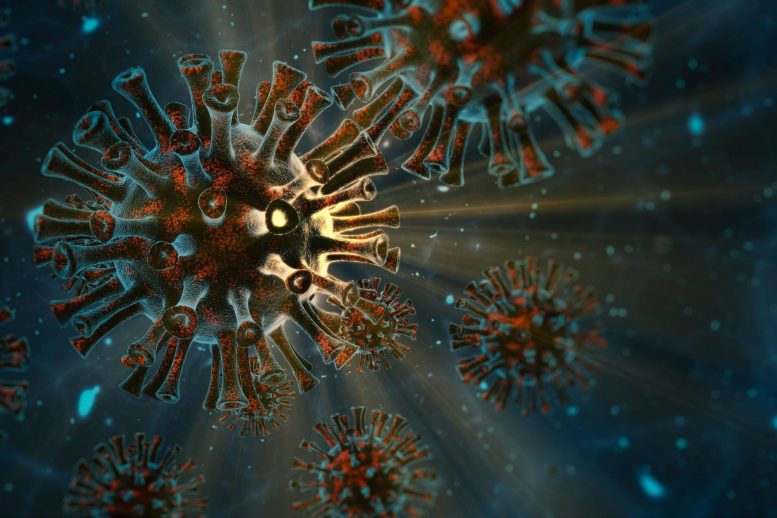
UC Riverside experts share their thoughts on the new COVID-19 variant.
The heavily mutated variant of COVID-19, named Omicron by the World Health Organization, or WHO, has been detected in several countries. How worried should we be about this variant? Dr. Anthony Fauci, chief medical officer to President Biden, has said it would take a couple of weeks before Omicron’s threat could be judged. Meanwhile, experts at the University of California, Riverside, share their thoughts on this new variant of SARS-CoV-2.
Karine Le Roch
Director, Center for Infectious Disease and Vector Research
“Mutations in the spike protein can affect transmission and the severity of the disease but can also affect vaccine efficacy.”
Le Roch
What is Omicron and how is it different from other variants?
All viruses, including SARS-CoV-2, the virus that causes COVID-19, mutate over time. Omicron is a new SARS-CoV-2 variant that has been identified in South Africa a few days ago. It has been described as variant of concern by the WHO Technical Advisory Group on SAR-CoV-2 Virus Evolution, or TGA-VE. Several mutations in the Omicron genome have been identified, including 32 variations in the spike protein, a protein essential for the virus to infect host cells and cause infection. It is also the protein that has been used to design vaccines against COVID-19. Mutations in the spike protein can affect transmission and the severity of the disease but can also affect vaccine efficacy. While it will take days or weeks to determine if these mutations significantly affect transmission and disease severity, it is important to reduce the spread of COVID-19 virus: Avoid crowded spaces, wear a mask, keep a physical distance from others, and get fully vaccinated as existing vaccines are still likely to offer protection from severe illness and death. It will also be critical to strengthen surveillance, including testing if we want to better understand the characteristics of the Omicron strain of the coronavirus.
Dr. David Lo
Distinguished professor of biomedical sciences, School of Medicine
“Individuals given the available vaccines are still very likely to have significant protection from severe disease and death.”
Lo
How worried should we be about Omicron? Is it more transmissible than the Delta variant?
While it is still too early to know a lot of the details on the Omicron variant, emergence of a new variant like this was to be expected given the relatively low vaccination rates globally, as well as in regions of the United States. The sequence data suggests that this novel variant acquired a lot of new mutations that took time to accumulate, possibly in an unimmunized patient. Its rapid spread — and known presence in multiple countries around the world — is certainly going to be further enabled by the large number of unvaccinated individuals around the world. Early data suggests that it might be more transmissible than previous variants, but as of today, the numbers may be too low yet to know exactly how much more transmissible it may be. In any case, despite the number of mutations, there appear to be enough conserved sequences so that individuals given the available vaccines are still very likely to have significant protection from severe disease and death.
Will more people getting vaccinated help us all against Omicron?
Yes. Higher rates of vaccination will clearly help reduce the severity of infections and reduce transmission from infected individuals. It will also help prevent newer variants emerging. We can also anticipate that in the next few years there will be updated vaccines that are designed based on scientists’ understanding of how the new variants look.
Richard M. Carpiano
Professor, School of Public Policy
“When it comes to an infectious disease pandemic, the fates of people all over the globe are interlocked.”
Carpiano
How might vaccine hesitancy and global vaccine inequity have contributed to the emergence of Omicron?
Recent news about the emergence of the Omicron variant is concerning because it comes at a time in the pandemic when vaccinations have been rolling out for nearly a year. Millions of people in the U.S. and other high-income countries have already been vaccinated and thus may believe that the pandemic is nearly over. But the latest concern about Omicron forces us to recognize yet another way that vaccine inequity — for example, due to access, supply, and distribution — and the related situation of vaccine hesitancy (due to misinformation among the public and efforts by bad faith actors to spread disinformation about vaccines and COVID-19) are global public health threats that affect all of us and not just other parts of the world thousands of miles away. Both inequity and hesitancy leave millions of people unprotected and thus vulnerable to being exposed to the coronavirus and transmitting it to others. That is tragic and unacceptable. Further, by helping create the conditions for variants to spread, vaccine inequity and hesitancy can also create opportunities for the emergence of coronavirus variants of high concern, as we saw with Delta — variants for which existing vaccines may not work as effectively as they did against previous variants. Thus, the emergence and spread of the Omicron variant (and variants that came before it) highlight how, when it comes to an infectious disease pandemic, the fates of people all over the globe are interlocked — regardless of whether they live in countries with high vaccination access and coverage. Ultimately, international collaborations to make vaccine supply more accessible, fight harmful misinformation and disinformation, and better promote vaccination coverage worldwide must be top priorities.
Brandon J. Brown
Associate professor and epidemiologist, School of Medicine
“With new variants of concern emerging, it’s better to be safe with a mask than sorry without one.”
Brown
How can people protect themselves against Omicron?
We know so little about the new variant at this point, but one thing we do know is that face coverings prevent the transmission of respiratory viruses, including SARS-CoV-2. In this country, we have access to COVID-19 vaccines including booster doses, so we should all get those as well as our annual flu vaccine in preparation for what many experts believe will be a difficult winter. Many people who received the COVID-19 vaccine are no longer wearing face coverings inside or outside in public spaces, but with new variants of concern emerging, it’s better to be safe with a mask than sorry without one.
Never miss a breakthrough: Join the SciTechDaily newsletter.
Follow us on Google and Google News.