
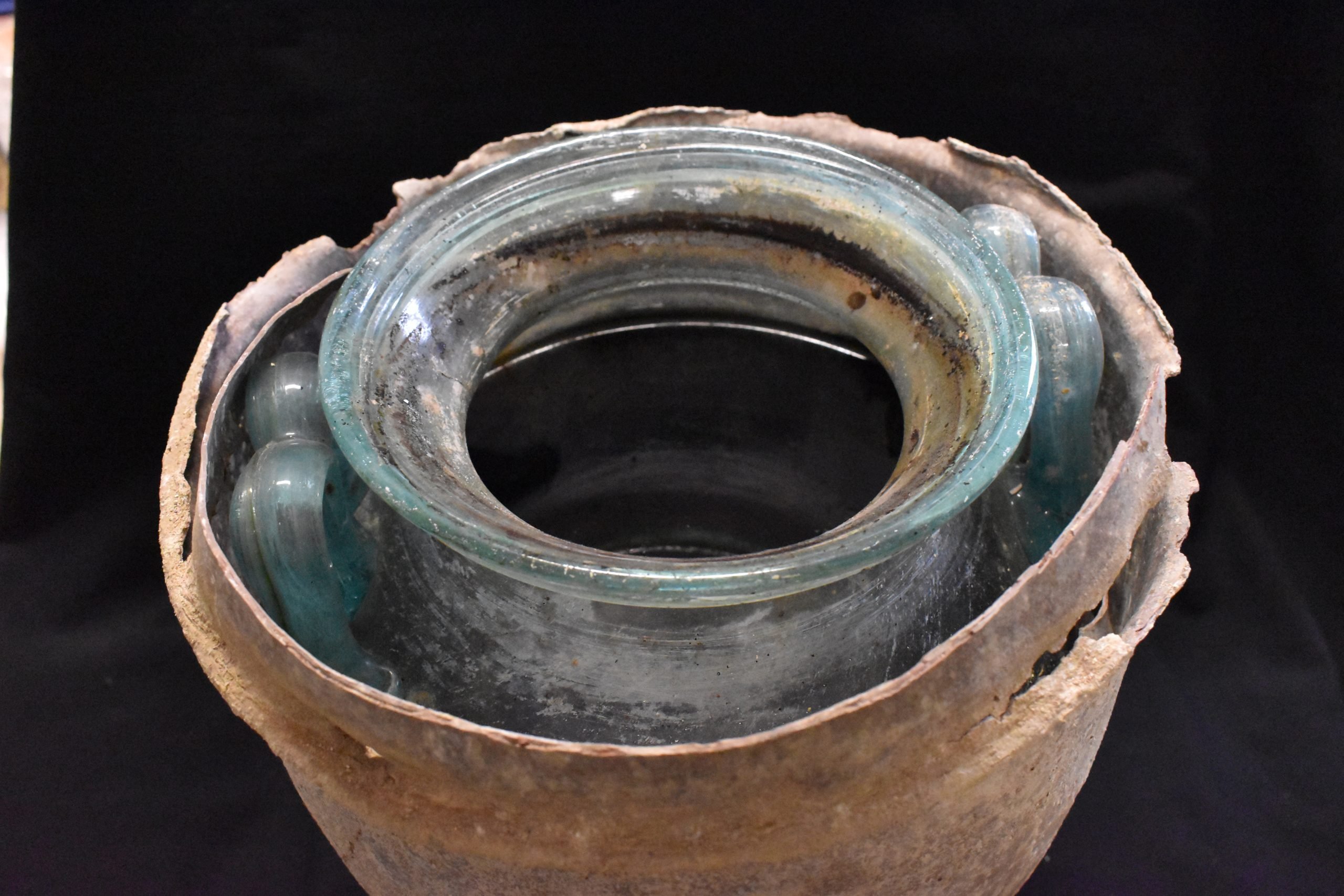
The oldest wine ever discovered, originating from Andalusia, is a white wine over 2,000 years old.
A 2019 excavation in Carmona revealed the oldest wine ever discovered, preserved in a man’s tomb for 2,000 years, highlighting significant aspects of Roman funerary rituals and societal gender norms.
In 2019, a Roman tomb in Carmona was uncovered, revealing the remains of six individuals—Hispana, Senicio, two other men, and two women, whose names remain unknown. These inhabitants from 2,000 years ago likely never envisioned their funerary rituals gaining significance in the modern era. During one such ritual, the skeletal remains of one of the men were submerged in a liquid contained within a glass funerary urn.
This liquid, which over time has acquired a reddish hue, has been preserved since the first century AD, and a team with the Department of Organic Chemistry at the University of Cordoba, led by Professor José Rafael Ruiz Arrebola, in collaboration with the City of Carmona, has identified it as the oldest wine ever discovered, thus topping the Speyer wine bottle discovered in 1867 and dated to the fourth century AD, preserved in the Historical Museum of Pfalz (Germany).
“At first we were very surprised that liquid was preserved in one of the funerary urns,” explains the City of Carmona’s municipal archaeologist Juan Manuel Román. After all, 2,000 years had passed, but the tomb’s conservation conditions were extraordinary; fully intact and well-sealed ever since, the tomb allowed the wine to maintain its natural state, ruling out other causes such as floods, leaks inside the chamber, or condensation processes.
The challenge was to dispel the research team’s suspicions and confirm that the reddish liquid really was wine rather than a liquid that was once wine but had lost many of its essential characteristics. To do this they ran a series of chemical analyses at the UCO’s Central Research Support Service (SCAI) and published them in the Journal of Archaeological Science: Reports. They studied its pH, absence of organic matter, mineral salts, the presence of certain chemical compounds that could be related to the glass of the urn, or the bones of the deceased; and compared it to current Montilla-Moriles, Jerez, and Sanlúcar wines. Thanks to all this they had their first evidence that the liquid was, in fact, wine.
But the key to its identification hinged on polyphenols, biomarkers present in all wines. Thanks to a technique capable of identifying these compounds in very low quantities, the team found seven specific polyphenols also present in wines from Montilla-Moriles, Jerez, and Sanlúcar. The absence of a specific polyphenol, syringic acid, served to identify the wine as white. Despite this, and the fact that this type of wine accords with bibliographic, archaeological, and iconographic sources, the team clarifies that the fact that this acid is not present may be due to degradation over time.
Most difficult to determine was the origin of the wine, as there are no samples from the same period with which to compare it. Even so, the mineral salts present in the tomb’s liquid are consistent with the white wines currently produced in the territory, which belonged to the former province of Betis, especially Montilla-Moriles wines.
A question of gender
The fact that the man’s skeletal remains were immersed in the wine is no coincidence. Women in ancient Rome were long prohibited from drinking wine. It was a man’s drink. And the two glass urns in the Carmona tomb are elements illustrating Roman society’s gender divisions in its funerary rituals.
While the bones of the man were immersed in wine, along with a gold ring and other bone remains from the funeral bed on which he had been cremated, the urn containing the remains of the woman did not contain a drop of wine, but rather three amber jewels, a bottle of perfume with a patchouli scent, and the remains of fabrics, with initial analyses seeming to indicate that they were of silk.
The wine, as well as the rings, the perfume, and the other elements were part of a funerary trousseau that was to accompany the deceased in their voyage into the afterlife. In ancient Rome, as in other societies, death had a special meaning and people wanted to be remembered so as to remain alive in some way. This tomb, actually a circular mausoleum that probably housed a wealthy family, was located next to the important road that connected Carmo with Hispalis (Seville). It was formerly marked with a tower, which has since disappeared. Two thousand years later, and after a long time in oblivion, Hispana, Senicio, and their four companions have not only been remembered, but have also shed a lot of light on the funerary rituals of ancient Rome while making it possible to identify the liquid in the glass urn as the oldest wine in the world.
Reference: “New archaeochemical insights into Roman wine from Baetica” by Daniel Cosano, Juan Manuel Román, Dolores Esquivel, Fernando Lafont and José Rafael Ruiz Arrebola, 16 June 2024, Journal of Archaeological Science: Reports.
DOI: 10.1016/j.jasrep.2024.104636
Never miss a breakthrough: Join the SciTechDaily newsletter.
Follow us on Google and Google News.
1 Comment
Yeah, that’s a fine vintage… for spending the entire day face down in the toilet