
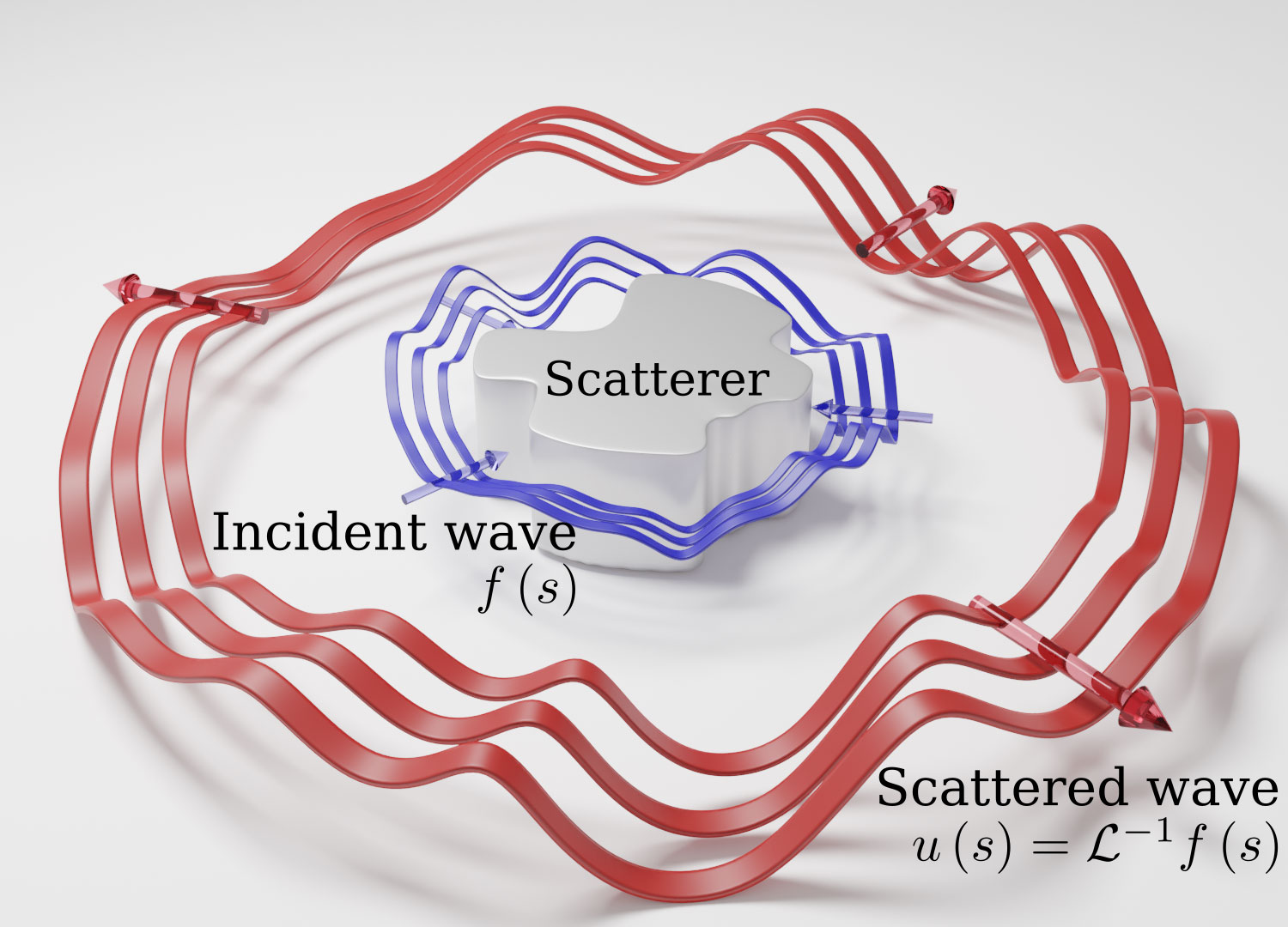
The work is a significant step toward realizing a new generation of ultra-compact, low-energy-use computers capable of complex mathematical computation.
Computers are an indispensable part of our daily lives, and the need for ones that can work faster, solve complex problems more efficiently, and leave smaller environmental footprints by minimizing the required energy for computation is increasingly urgent. Recent progress in photonics has shown that it’s possible to achieve more efficient computing through optical devices that use interactions between metamaterials and light waves to apply mathematical operations of interest on the input signals, and even solve complex mathematical problems. But to date, such computers have required a large footprint and precise, large-area fabrication of the components, which, because of their size, are difficult to scale into more complex networks.
Breakthrough in Nanomaterials and Light-Wave Interactions
A newly published paper in Physical Review Letters from researchers at the Advanced Science Research Center at the CUNY Graduate Center (CUNY ASRC) details a breakthrough discovery in nanomaterials and light-wave interactions that paves the way for development of small, low-energy optical computers capable of advanced computing.
“The increasing energy demands of large data centers and inefficiencies in current computing architectures have become a real challenge for our society,” said Andrea Alù, Ph.D., the paper’s corresponding author, founding director of the CUNY ASRC’s Photonics Initiative and Einstein Professor of Physics at the Graduate Center. “Our work demonstrates that it’s possible to design a nanoscale object that can efficiently interact with light to solve complex mathematical problems with unprecedented speeds and nearly zero energy demands.”
In their study, CUNY ASRC researchers designed a nanoscale object made of silicon so that, when interrogated with light waves carrying an arbitrary input signal, it is able to encode the corresponding solution of a complex mathematical problem into the scattered light. The solution is calculated at the speed of light, and with minimal energy consumption.”
“This finding is promising because it offers a practical pathway for creating a new generation of very energy-efficient, ultrafast, ultracompact nanoscale optical computers and other nanophotonic technologies that can be used for classical and quantum computations,” said Heedong Goh, Ph.D., the paper’s lead author and a postdoctoral research associate with Alù’s lab. “The very small size of these nanoscale optical computers is particularly appealing for scalability, because multiple nanostructures can be combined and connected together through light scattering to realize complex nanoscale computing networks.”
Reference: “Nonlocal Scatterer for Compact Wave-Based Analog Computing” by Heedong Goh and Andrea Alù, 18 February 2022, Physical Review Letters.
DOI: 10.1103/PhysRevLett.128.073201
About the Graduate Center of The City University of New York
The CUNY Graduate Center is a leader in public graduate education devoted to enhancing the public good through pioneering research, serious learning, and reasoned debate. The Graduate Center offers ambitious students nearly 50 doctoral and master’s programs of the highest caliber, taught by top faculty from throughout CUNY — the nation’s largest urban public university. Through its nearly 40 centers, institutes, initiatives, and the Advanced Science Research Center, the Graduate Center influences public policy and discourse and shapes innovation. The Graduate Center’s extensive public programs make it a home for culture and conversation.
About the Advanced Science Research Center at the CUNY Graduate Center
The Advanced Science Research Center at the CUNY Graduate Center (CUNY ASRC) is a world-leading center of scientific excellence that elevates STEM inquiry and education at CUNY and beyond. The CUNY ASRC’s research initiatives span five distinctive, but broadly interconnected disciplines: nanoscience, photonics, neuroscience, structural biology, and environmental sciences. The center promotes a collaborative, interdisciplinary research culture where renowned and emerging scientists advance their discoveries using state-of-the-art equipment and cutting-edge core facilities.
Never miss a breakthrough: Join the SciTechDaily newsletter.
Follow us on Google and Google News.