
Close Menu
    Facebook X (Twitter) Instagram
    SciTechDaily
    • Biology
    • Chemistry
    • Earth
    • Health
    • Physics
    • Science
    • Space
    • Technology
    Facebook X (Twitter) Pinterest YouTube RSS
    SciTechDaily
    Home»Space»Supersonic Outflows Contain a Million Times the Energy of an Exploding Star
    Space

    Supersonic Outflows Contain a Million Times the Energy of an Exploding Star

    By CSIROJanuary 4, 20133 Comments3 Mins Read
    Facebook Twitter Pinterest Telegram LinkedIn WhatsApp Email Reddit
    Share
    Facebook Twitter LinkedIn Pinterest Telegram Email Reddit
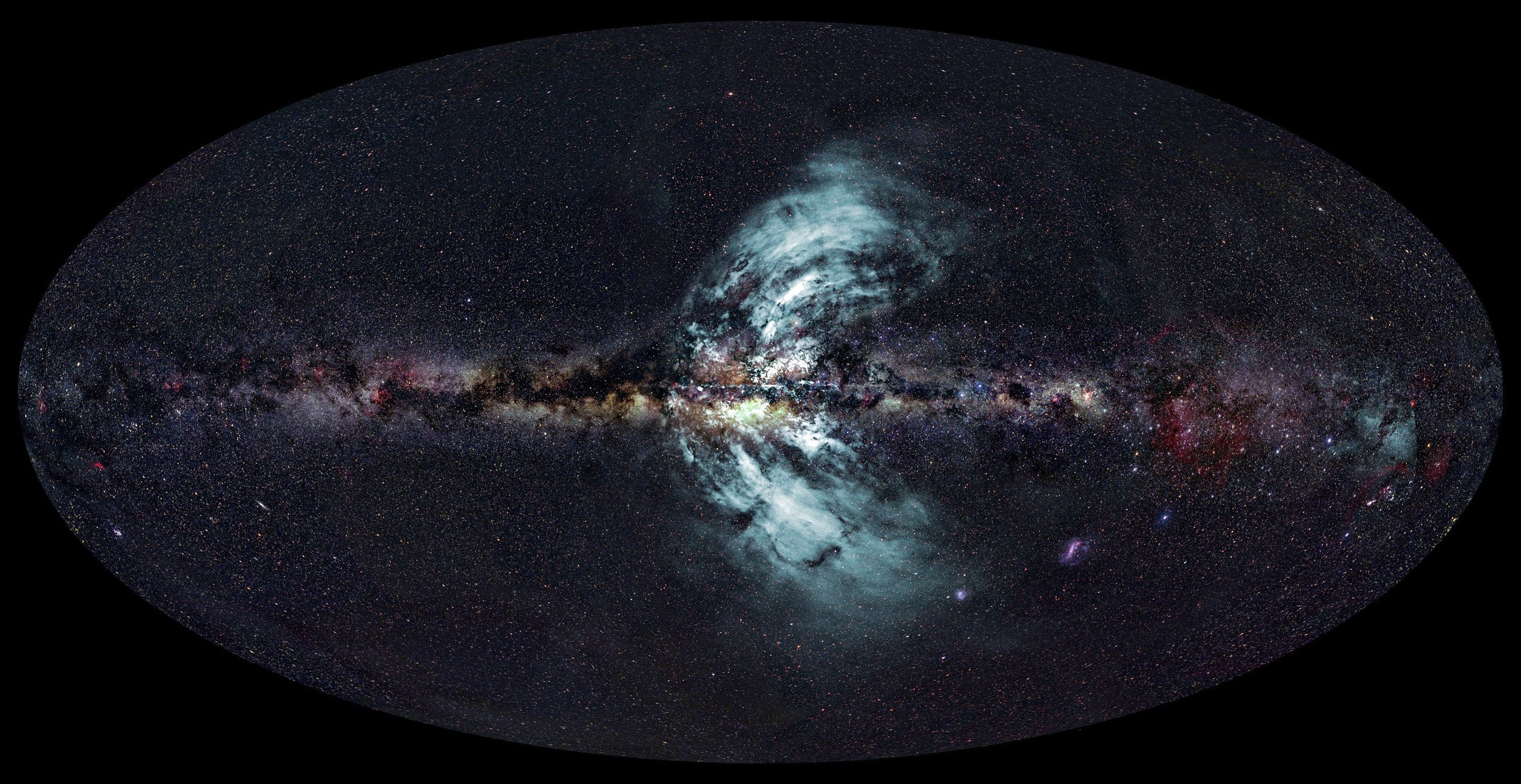
    outflows of charged particles from the center of our Galaxy
    The new-found outflows of particles (pale blue) from the Galactic Center. The background image is the whole Milky Way at the same scale. The curvature of the outflows is real, not a distortion caused by the imaging process. Credit: Ettore Carretti, CSIRO (radio image); S-PASS survey team (radio data); Axel Mellinger, Central Michigan University (optical image); Eli Bressert, CSIRO (composition)

    In a newly published study, an international team of astronomers describe how they detected and mapped outflows of charged particles from the center of our Galaxy. These outflows contain about a million times the energy of an exploding star and are moving at supersonic speed, about 1000 kilometers a second.

    The outflows were detected by astronomers from Australia, the USA, Italy, and The Netherlands. They report their finding in today’s issue of Nature.

    “These outflows contain an extraordinary amount of energy — about a million times the energy of an exploding star,” said the research team’s leader, CSIRO’s Dr Ettore Carretti.

    But the outflows pose no danger to Earth or the Solar System.

    The speed of the outflow is supersonic, about 1000 kilometers a second. “That’s fast, even for astronomers,” Dr. Carretti said.

    “They are not coming in our direction, but go up and down from the Galactic Plane. We are 30,000 light-years away from the Galactic Center, in the Plane. They are no danger to us.”

    From top to bottom the outflows extend 50,000 light-years (five hundred thousand million million kilometers) out of the Galactic Plane.

    That’s equal to half the diameter of our Galaxy (which is 100,000 light-years — a million million million kilometers — across).

    Seen from Earth, the outflows stretch about two-thirds across the sky from horizon to horizon.

    The outflows correspond to a “haze” of microwave emission previously spotted by the WMAP and Planck space telescopes and regions of gamma-ray emission detected with NASA’s Fermi space telescope in 2010, which were dubbed the “Fermi Bubbles”.

    The WMAP, Planck, and Fermi observations did not provide enough evidence to indicate definitively the source of the radiation they detected, but the new Parkes observations do.

    “The options were a quasar-like outburst from the black hole at the Galactic Center, or star-power — the hot winds from young stars, and exploding stars,” said team member Dr. Gianni Bernardi of the Harvard-Smithsonian Center for Astrophysics, in Cambridge, Massachusetts.

    “Our observations tell us it’s star-power.”

    In fact, the outflows appear to have been driven by many generations of stars forming and exploding in the Galactic Centre over the last hundred million years.

    The key to determining this was to measure the outflows’ magnetic fields.

    “We did this by measuring a key property of the radio waves from the outflows — their polarization,” said team member Dr Roland Crocker of the Max-Planck-Institut fuer Kernphysik in Heidelberg, Germany, and the Australian National University.

    The new observations also help to answer one of astronomers’ big questions about our Galaxy: how it generates and maintains its magnetic field.

    “The outflow from the Galactic Center is carrying off not just gas and high-energy electrons, but also strong magnetic fields,” said team member Dr Marijke Haverkorn of Radboud University Nijmegen in The Netherlands.

    “We suspect this must play a big part in generating the Galaxy’s overall magnetic field.”

    Reference: “Giant magnetized outflows from the centre of the Milky Way” by Ettore Carretti, Roland M. Crocker, Lister Staveley-Smith, Marijke Haverkorn, Cormac Purcell, B. M. Gaensler, Gianni Bernardi, Michael J. Kesteven and Sergio Poppi, 2 January 2013, Nature.
    DOI: 10.1038/nature11734

    Never miss a breakthrough: Join the SciTechDaily newsletter.
    Follow us on Google and Google News.

    Astronomy Astrophysics CSIRO Fermi Gamma-ray Space Telescope Popular
    Share. Facebook Twitter Pinterest LinkedIn Email Reddit

    Related Articles

    Gigantic Bubbles at Center of Milky Way Caused by Powerful Jet of Energy From Supermassive Black Hole

    Mysterious Cosmic “Spider” Found To Be Source of Powerful Gamma-Rays

    Black Holes Have Tantrums, and Scientists Have Finally Captured the Gamma Rays From Such Ultra-Fast Outflows

    NASA’s Fermi Spots a Weird Pulse of High-Energy Radiation Racing Toward Earth

    World’s Most Powerful Telescopes Unite in Unprecedented Observations of Famous Black Hole

    NASA Spacecraft Unmask High-Energy Blast That Swept Through the Solar System – Magnetar Eruption in Nearby Galaxy

    A Star Dying Soon After the Beginning of the Universe Could Be Disrupting Mobile Phone Reception Today

    Mysterious, Repeating Radio Burst Identified in Our Own Galaxy for the First Time

    Galactic “Mystery Source” of Gamma Rays Identified: Record-Setting “Black Widow” Pulsar

    3 Comments

    1. Aarthi on January 4, 2013 11:58 am

      The scale of the outflows indicates the existence of an extremely powerful source i.e. a black hole in this case at the galactic center.

      Reply
    2. mick on December 20, 2013 3:17 pm

      or maybe the Galaxy is moving through something that grabs these particles and pulls them from our galaxy

      Reply
    3. Madanagopal.V.C on December 24, 2013 7:24 am

      The physical movement of the outflow extending about half the diameter of Milky Way galaxy is spectacular. It indicates that the galactic center is the engine generating that million times force. If so every galactic center is having either a black hole or more likely to be a dark matter which alone has got the energy to send apart galaxies in fantastic speeds in the ever expanding universe we observe. Thank You.

      Reply
    Leave A Reply Cancel Reply

    • Facebook
    • Twitter
    • Pinterest
    • YouTube

    Don't Miss a Discovery

    Subscribe for the Latest in Science & Tech!

    Trending News

    Scientists Discover 132-Million-Year-Old Dinosaur Tracks on South Africa’s Coast

    Scientists Uncover the Secret Ingredient Behind the Spark That May Have Started Life on Earth

    Physicists Observe Matter in Two Places at Once in Mind-Bending Quantum Experiment

    Stanford Scientists Discover Hidden Brain Circuit That Fuels Chronic Pain

    New Study Reveals Why Ozempic Works Better for Some People Than Others

    Climate Change Is Altering a Key Greenhouse Gas in a Way Scientists Didn’t Expect

    New Study Suggests Gravitational Waves May Have Created Dark Matter

    Scientists Discover Why the Brain Gets Stuck in Schizophrenia

    Follow SciTechDaily
    • Facebook
    • Twitter
    • YouTube
    • Pinterest
    • Newsletter
    • RSS
    SciTech News
    • Biology News
    • Chemistry News
    • Earth News
    • Health News
    • Physics News
    • Science News
    • Space News
    • Technology News
    Recent Posts
    • Python Blood Could Hold the Secret to Weight Loss Without Side Effects
    • Naturally Occurring Bacteria Completely Eradicate Tumors in Mice With a Single Dose
    • The Ideal Temperature for Storing Mangoes Isn’t What You Think
    • Groundbreaking Enzyme Atlas Rewrites Decades of Biology Research
    • New “Nanozyme Hypothesis” Could Rewrite the Story of Life’s Origins
    Copyright © 1998 - 2026 SciTechDaily. All Rights Reserved.
    • Science News
    • About
    • Contact
    • Editorial Board
    • Privacy Policy
    • Terms of Use

    Type above and press Enter to search. Press Esc to cancel.