
Close Menu
    Facebook X (Twitter) Instagram
    SciTechDaily
    • Biology
    • Chemistry
    • Earth
    • Health
    • Physics
    • Science
    • Space
    • Technology
    Facebook X (Twitter) Pinterest YouTube RSS
    SciTechDaily
    Home»Technology»Overcoming Long-Held Limitations: Korean Scientists Unveil Next-Generation Energy Storage Technology
    Technology

    Overcoming Long-Held Limitations: Korean Scientists Unveil Next-Generation Energy Storage Technology

    By National Research Council of Science & TechnologyJune 22, 2025No Comments5 Mins Read
    Facebook Twitter Pinterest Telegram LinkedIn WhatsApp Email Reddit
    Share
    Facebook Twitter LinkedIn Pinterest Telegram Email Reddit
    Solar Supercapacitor Art Concept
    Researchers have created a next-generation supercapacitor by engineering a unique nanoscale fiber structure combining carbon nanotubes and a conductive polymer. This innovation significantly enhances energy storage performance while paving the way for faster, more durable, and flexible energy systems. (Artist’s concept.) Credit: SciTechDaily.com

    Developing next-generation energy storage technologies that can deliver both high power and high capacity at the same time.

    A research team led by Dr. Bon-Cheol Ku and Dr. Seo Gyun Kim from the Carbon Composite Materials Research Center at the Korea Institute of Science and Technology (KIST), along with Professor Yuanzhe Piao of Seoul National University (SNU), has developed a high-performance supercapacitor that may represent the next generation of energy storage.

    Their breakthrough addresses key limitations of current supercapacitors by using an advanced fiber structure made from single-walled carbon nanotubes (CNTs) and the conductive polymer polyaniline (PANI).

    Supercapacitors charge faster and offer higher power density than traditional batteries, with minimal performance loss even after tens of thousands of charging cycles. However, their lower energy density limits how long they can operate, which has made them less practical for extended-use applications like electric vehicles and drones.
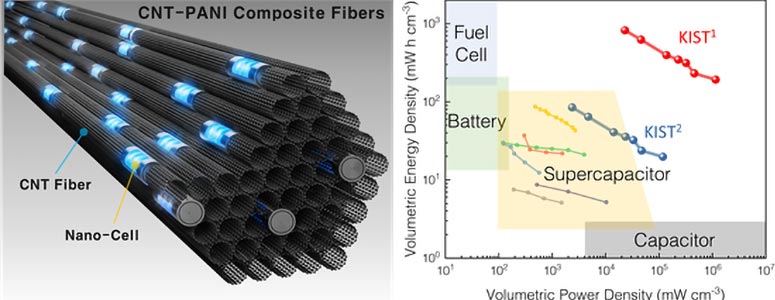
    CNT PANI Composite Fiber Design and Performance
    Left) Schematic illustration of a composite of CNTs and PANIs. It shows that the covalently bonded PANIs are evenly distributed among the CNTs and that each PANI can act as a nanoscale cell. (Right) The composite fiber fabricated based on these characteristics shows excellent power and energy density at the simultaneously, exceeding the characteristics of general supercapacitors. (*KIST1 is the value calculated by the weight of only PANI, and KIST2 is the value calculated by the weight of the fiber.) Credit: Korea Institute of Science and Technology(KIST)

    Innovative CNT‑PANI fiber structure

    To address this challenge, the researchers chemically bonded single-walled carbon nanotubes (CNTs), known for their high conductivity, with polyaniline (PANI), a low-cost and easily processed conductive polymer. By combining these materials at the nanoscale, they created a complex fiber structure that improves the movement of both electrons and ions. This results in a supercapacitor capable of storing more energy and releasing it more quickly.

    Scalability of CNT PANI Fiber Bundles
    To see the commercialization potential of composite fiber capacitors, a mass manufacturing process was introduced. Fiber bundles ranging from one-stranded fibers to 300-stranded fibers were produced through the mass production process, and it can be seen that the specific capacitance is well maintained without decreasing because PANI acts as a nanocell inside. Credit: Korea Institute of Science and Technology(KIST)

    The new supercapacitor has demonstrated stable performance through over 100,000 charge and discharge cycles and remains effective even in high-voltage environments. Because of its durability and efficiency, the technology can serve as either a replacement or an enhancement to current battery systems. In electric vehicles, it could deliver fast-charging power that boosts both driving range and performance.

    Drones and robots may also benefit from longer operation times and improved reliability. Additionally, the CNT-PANI composite fiber is highly flexible, allowing it to be rolled or folded for use in next-generation electronics like wearable devices.

    Mass production and cost reduction

    Another major achievement of the research is the reduction of production costs and the possibility of mass production. Despite their excellent properties, single-walled carbon nanotubes (CNTs) have been difficult to commercialize due to their high production costs, but the researchers solved this problem by compounding them with the low-cost conductive polymer polyaniline (PANI).

    Schematic of the Manufacturing Process for CNT PANI Composite Fibers
    A schematic of the overall process by which PANI manufactures composite fibers: (from left to right) forming a liquid crystal phase based on carbon nanotubes, spinning it into a coagulation bath, solidifying it, and stretching it. The final resulted fiber has a structure with an even distribution of PANI. Credit: Korea Institute of Science and Technology(KIST)

    Furthermore, they have laid the foundation for mass production through a simple process, and recently succeeded in developing film-like structures based on this technology, further advancing commercialization. In the future, it will be utilized as a key enabling technology for the transition to a carbon-neutral society across various industries such as electric vehicles, robots, drones, and wearable devices.

    “This technology overcomes the shortcomings of supercapacitors by using single-walled carbon nanotubes and conductive polymers,” said Dr. Bon-Cheol Ku of KIST. “We will continue to develop and industrialize ultra-high-performance carbon fibers based on carbon nanotubes.”

    Reference: “Nanocell-structured carbon nanotube composite fibers for ultrahigh energy and power density supercapacitors” by Dongju Lee, Junghwan Kim, Chae Won Kim, Jeong-Gil Kim, Se Eun Jung, So Jeong Heo, Byeong Woo Im, Nam Dong Kim, Seo Gyun Kim, Yuanzhe Piao and Bon-Cheol Ku, 27 January 2025, Composites Part B: Engineering.
    DOI: 10.1016/j.compositesb.2025.112179

    This research was supported by the Ministry of Science and ICT (Minister Yoo Sang-im) through the KIST Institutional Program, Regional Innovation Leading Technology Development Project (RS-2019-NR040066), Academic Research Platform Construction Pilot Project (RS-2023-00304729), and the Ministry of Trade, Industry and Energy (Minister Ahn Duk-geun) through the Material Component Technology Development Project (RS-2023-00258521). The research was published in the latest issue of the international journal ‘Composites Part B: Engineering’ (IF: 12.7, JCR: 0.3%), and domestic and U.S. patent applications have been filed.

    Never miss a breakthrough: Join the SciTechDaily newsletter.
    Follow us on Google and Google News.

    Energy Nanotechnology Supercapacitors Sustainability
    Share. Facebook Twitter Pinterest LinkedIn Email Reddit

    Related Articles

    Clean Energy 24/7: Engineers Use Nanotechnology To Harvest Electricity “From Thin Air”

    MXene Nanomaterial Offers Flexible and Stretchable High-Capacity Energy Storage

    Ultralow-Temperature Supercapacitors Using Porous Carbon Aerogel – Could Power Mars & Polar Missions

    Crumpled Graphene Forms Stretchable Supercapacitors to Power Flexible Electronic Devices

    Rice Researchers Develop Thin-Film Battery for Portable, Wearable Electronics

    Scientists Develop Graphene-Coated Silicon Supercapacitor

    A Cost-Effective Fabrication Method for Micro-Scale Graphene-Based Supercapacitors

    Nanosheet-Flower Structure Boosts Energy Storage

    Researchers Study the Use of Photosystem-I as Photovoltaic Panels

    Leave A Reply Cancel Reply

    • Facebook
    • Twitter
    • Pinterest
    • YouTube

    Don't Miss a Discovery

    Subscribe for the Latest in Science & Tech!

    Trending News

    First-of-Its-Kind Discovery: Homer’s Iliad Found Embedded in a 1,600-Year-Old Egyptian Mummy

    Beyond Inflammation: Scientists Uncover New Cause of Persistent Rheumatoid Arthritis

    A Simple Molecule Could Unlock Safer, Easier Weight Loss

    Scientists Just Built a Quantum Battery That Charges Almost Instantly

    Researchers Unveil Groundbreaking Sustainable Solution to Vitamin B12 Deficiency

    Millions of People Have Osteopenia Without Realizing It – Here’s What You Need To Know

    Researchers Discover Boosting a Single Protein Helps the Brain Fight Alzheimer’s

    World-First Study Reveals Human Hearts Can Regenerate After a Heart Attack

    Follow SciTechDaily
    • Facebook
    • Twitter
    • YouTube
    • Pinterest
    • Newsletter
    • RSS
    SciTech News
    • Biology News
    • Chemistry News
    • Earth News
    • Health News
    • Physics News
    • Science News
    • Space News
    • Technology News
    Recent Posts
    • New Research Challenges Long-Held Beliefs About How the Brain Makes Decisions
    • Breakthrough Technology Reveals New Treatment Targets for Cancer
    • Scientists Discover New Way To Make Drug-Resistant Cancer Treatable Again
    • This Simple Exercise Trick Builds Muscle With Less Effort, Study Finds
    • Middle Age Is Becoming a Breaking Point in America, Study Reveals
    Copyright © 1998 - 2026 SciTechDaily. All Rights Reserved.
    • Science News
    • About
    • Contact
    • Editorial Board
    • Privacy Policy
    • Terms of Use

    Type above and press Enter to search. Press Esc to cancel.