
Close Menu
    Facebook X (Twitter) Instagram
    SciTechDaily
    • Biology
    • Chemistry
    • Earth
    • Health
    • Physics
    • Science
    • Space
    • Technology
    Facebook X (Twitter) Pinterest YouTube RSS
    SciTechDaily
    Home»Technology»Rice Researchers Develop Thin-Film Battery for Portable, Wearable Electronics
    Technology

    Rice Researchers Develop Thin-Film Battery for Portable, Wearable Electronics

    By Mike Williams, Rice UniversityApril 28, 2014No Comments4 Mins Read
    Facebook Twitter Pinterest Telegram LinkedIn WhatsApp Email Reddit
    Share
    Facebook Twitter LinkedIn Pinterest Telegram Email Reddit
    Rice Researchers Develop a Flexible Battery
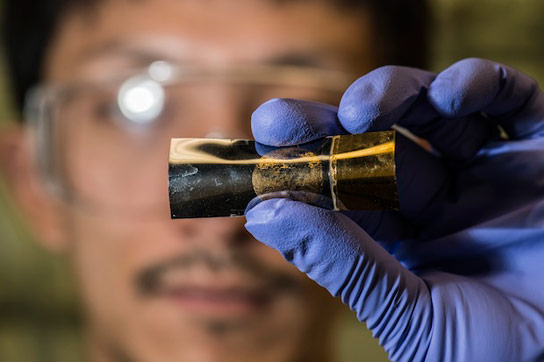
    Rice University postdoctoral researcher Yang Yang holds an energy storage unit with the best qualities of batteries and supercapacitors in a scalable, flexible package. Credit: Jeff Fitlow

    Researchers at Rice University have developed a new flexible energy storage technology that delivers battery-like supercapacitor performance without the lithium found in commercial batteries.

    A Rice University laboratory has flexible, portable, and wearable electronics in its sights with the creation of a thin film for energy storage.

    Rice chemist James Tour and his colleagues have developed a flexible material with nanoporous nickel-fluoride electrodes layered around a solid electrolyte to deliver battery-like supercapacitor performance that combines the best qualities of a high-energy battery and a high-powered supercapacitor without the lithium found in commercial batteries today.

    The new work by the Rice lab of chemist James Tour is detailed in the Journal of the American Chemical Society.

    Their electrochemical capacitor is about a hundredth of an inch thick but can be scaled up for devices either by increasing the size or adding layers, said Rice postdoctoral researcher Yang Yang, co-lead author of the paper with graduate student Gedeng Ruan. They expect that standard manufacturing techniques may allow the battery to be even thinner.

    In tests, the students found their square-inch device held 76 percent of its capacity over 10,000 charge-discharge cycles and 1,000 bending cycles.

    Tour said the team set out to find a material that has the flexible qualities of graphene, carbon nanotubes, and conducting polymers while possessing much higher electrical storage capacity typically found in inorganic metal compounds. Inorganic compounds have, until recently, lacked flexibility, he said.

    Rice Researchers Develop Thin Film Battery for Portable Electronics
    A porous nickel-fluoride film less than a micron thick, seen here in an electron microscope image, is an effective electrode in a new type of battery created at Rice University. The flexible film combines the best qualities of supercapacitors and batteries for potential use in flexible electronics. Credit: the Tour Group

    “This is not easy to do, because materials with such high capacity are usually brittle,” he said. “And we’ve had really good, flexible carbon storage systems in the past, but carbon as a material has never hit the theoretical value that can be found in inorganic systems, and nickel fluoride in particular.”

    “Compared with a lithium-ion device, the structure is quite simple and safe,” Yang said. “It behaves like a battery but the structure is that of a supercapacitor. If we use it as a supercapacitor, we can charge quickly at a high current rate and discharge it in a very short time. But for other applications, we find we can set it up to charge more slowly and to discharge slowly like a battery.”

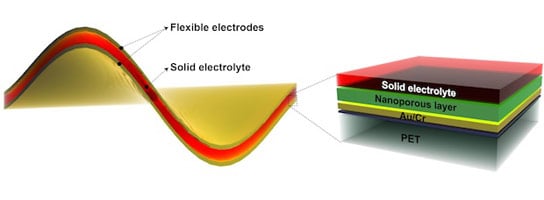
    To create the battery/supercapacitor, the team deposited a nickel layer on a backing. They etched it to create 5-nanometer pores within the 900-nanometer-thick nickel fluoride layer, giving it a high surface area for storage. Once they removed the backing, they sandwiched the electrodes around an electrolyte of potassium hydroxide in polyvinyl alcohol. Testing found no degradation of the pore structure even after 10,000 charge/recharge cycles. The researchers also found no significant degradation to the electrode-electrolyte interface.

    “The numbers are exceedingly high in the power that it can deliver, and it’s a very simple method to make high-powered systems,” Tour said, adding that the technique shows promise for the manufacture of other 3-D nanoporous materials. “We’re already talking with companies interested in commercializing this.”
    Researchers Develop Thin Film Battery for Portable Wearable Electronics
    Nickel-fluoride electrodes around a solid electrolyte are an effective energy storage device that combines the best qualities of batteries and supercapacitors, according to Rice University researchers. The electrodes are plated onto a gold and polymer backing (which can be removed) and made porous through a chemical etching process. Credit: the Tour Group

    Rice graduate student Changsheng Xiang and postdoctoral researcher Gunuk Wang are co-authors of the paper.

    The Peter M. and Ruth L. Nicholas Postdoctoral Fellowship of the Smalley Institute for Nanoscale Science and Technology and the Air Force Office of Scientific Research’s Multidisciplinary University Research Initiative

    Reference: “Flexible Three-Dimensional Nanoporous Metal-Based Energy Devices” by Yang Yang, Gedeng Ruan, Changsheng Xiang, Gunuk Wang and James M. Tour, 15 April 2014, Journal of the American Chemical Society.
    DOI: 10.1021/ja501247f


    Never miss a breakthrough: Join the SciTechDaily newsletter.
    Follow us on Google and Google News.

    Battery Technology Materials Science Nanotechnology Rice University Supercapacitors
    Share. Facebook Twitter Pinterest LinkedIn Email Reddit

    Related Articles

    Rice Engineers Design Flexible and Stackable Laser Induced Graphene Supercapacitors

    Hydrogel Improves Lithium-Ion Battery Performance

    A Cost-Effective Fabrication Method for Micro-Scale Graphene-Based Supercapacitors

    A Step Towards 2D Devices, Hybrid Graphene/Hexagonal Boron Nitride

    Sulfur Cathodes Set a World Record for Energy Storage

    Silicon-Based Anode Shows Significant Improvement Over Current Graphite Anodes

    Macroporous Silicon and Pyrolyzed Polyacrylonitrile Form High Performance Anodes

    Repeating Patterns Dictate Optical Properties of Nanoparticle Arrays

    Spray Paint Battery Can be Painted on Virtually Any Surface

    Leave A Reply Cancel Reply

    • Facebook
    • Twitter
    • Pinterest
    • YouTube

    Don't Miss a Discovery

    Subscribe for the Latest in Science & Tech!

    Trending News

    Scientists Discover Stem Cells That Could Regrow Teeth and Bone

    Early Cannabis Use May Stall Key Brain Skills in Teens

    Popular Vitamin D Supplement Has “Previously Unknown” Negative Effect, Study Finds

    Study Reveals Malaria’s Hidden Role in Human Evolution

    The Hidden Risk of Taking Breaks From Weight-Loss Drugs Like Ozempic

    Scientists Warn That This Common Pet Fish Can Wreck Entire Ecosystems

    Scientists Make Breakthrough in Turning Plastic Trash Into Clean Fuel Using Sunlight

    This Popular Supplement May Interfere With Cancer Treatment, Scientists Warn

    Follow SciTechDaily
    • Facebook
    • Twitter
    • YouTube
    • Pinterest
    • Newsletter
    • RSS
    SciTech News
    • Biology News
    • Chemistry News
    • Earth News
    • Health News
    • Physics News
    • Science News
    • Space News
    • Technology News
    Recent Posts
    • This Tiny Creature Survived a World of Dinosaurs and Changed What Came Next
    • Millions of People Have Osteopenia Without Realizing It – Here’s What You Need To Know
    • Researchers Discover Boosting a Single Protein Helps the Brain Fight Alzheimer’s
    • AI Detects “Invisible” Signs of Pancreatic Cancer Years Before Diagnosis
    • Kratom Use Explodes in the US, With Life-Changing Consequences
    Copyright © 1998 - 2026 SciTechDaily. All Rights Reserved.
    • Science News
    • About
    • Contact
    • Editorial Board
    • Privacy Policy
    • Terms of Use

    Type above and press Enter to search. Press Esc to cancel.