
Close Menu
    Facebook X (Twitter) Instagram
    SciTechDaily
    • Biology
    • Chemistry
    • Earth
    • Health
    • Physics
    • Science
    • Space
    • Technology
    Facebook X (Twitter) Pinterest YouTube RSS
    SciTechDaily
    Home»Technology»Macroporous Silicon and Pyrolyzed Polyacrylonitrile Form High Performance Anodes
    Technology

    Macroporous Silicon and Pyrolyzed Polyacrylonitrile Form High Performance Anodes

    By Mike Williams, Rice UniversityJuly 18, 2012No Comments4 Mins Read
    Facebook Twitter Pinterest Telegram LinkedIn WhatsApp Email Reddit
    Share
    Facebook Twitter LinkedIn Pinterest Telegram Email Reddit
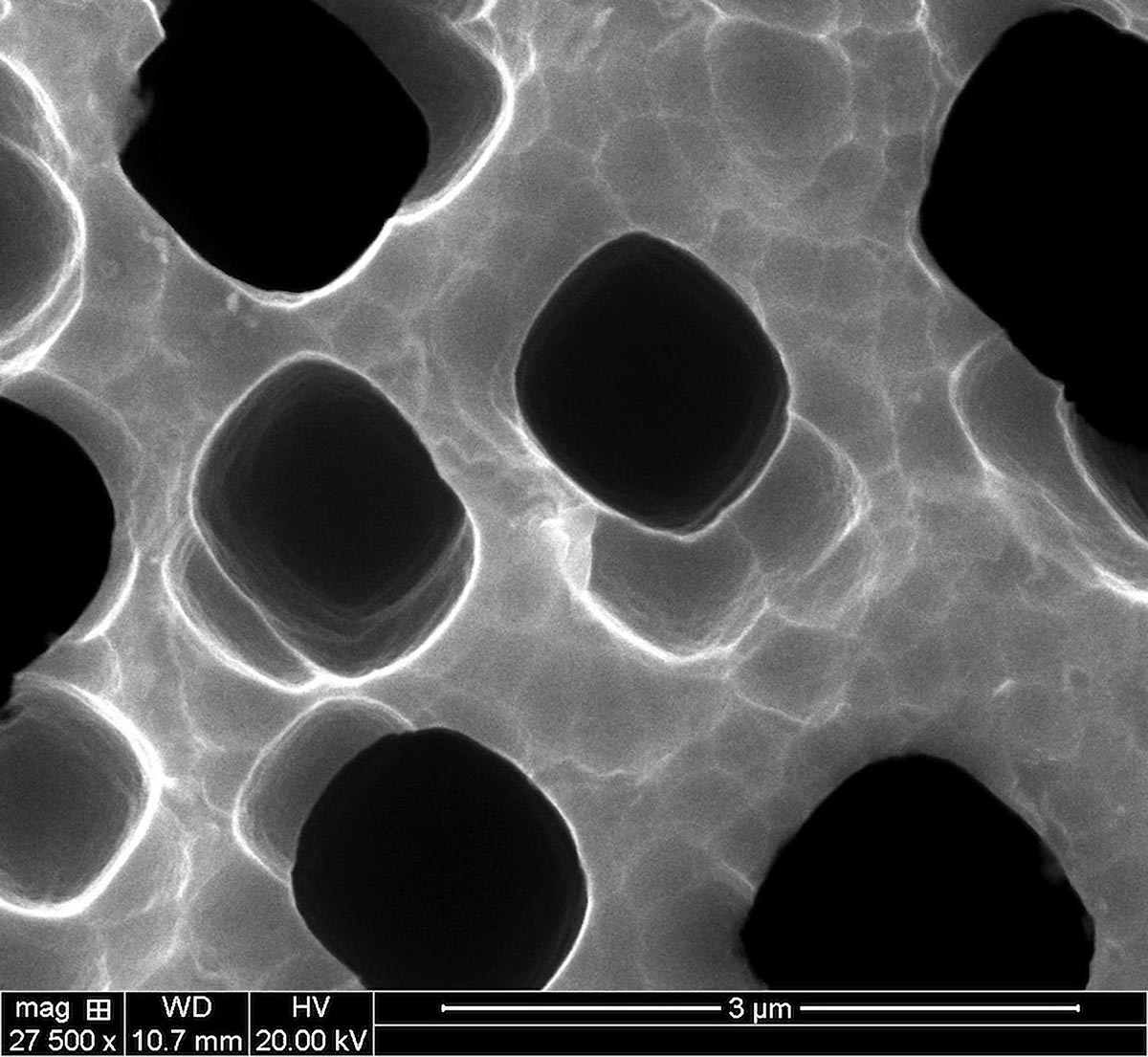
    Micronwide Pores in Silicon
    Micronwide pores in silicon give the material room to expand when soaking in lithium ions in a rechargeable battery, according to researchers at Rice University and Lockheed Martin. The scientists are developing the material to replace graphite as the anode in common batteries for commercial electronics and perhaps even electric vehicles. Credit: Madhuri Thakur/Rice University

    By detaching a freestanding macroporous silicon film from the underlying bulk silicon and combining it with pyrolyzed polyacrylonitrile, researchers have found a way to make multiple high-performance anodes from a single silicon wafer.

    Researchers at Rice University and Lockheed Martin reported this month that they’ve found a way to make multiple high-performance anodes from a single silicon wafer. The process uses simple silicon to replace graphite as an element in rechargeable lithium-ion batteries, laying the groundwork for longer-lasting, more powerful batteries for such applications as commercial electronics and electric vehicles.

    The work led by Sibani Lisa Biswal, an assistant professor of chemical and biomolecular engineering at Rice, and lead author Madhuri Thakur, a Rice research scientist, details the process by which Swiss cheese-like silicon “sponges” that store more than four times their weight in lithium can be electrochemically lifted off of wafers.

    The research was reported online this month in the American Chemical Society journal Chemistry of Materials.
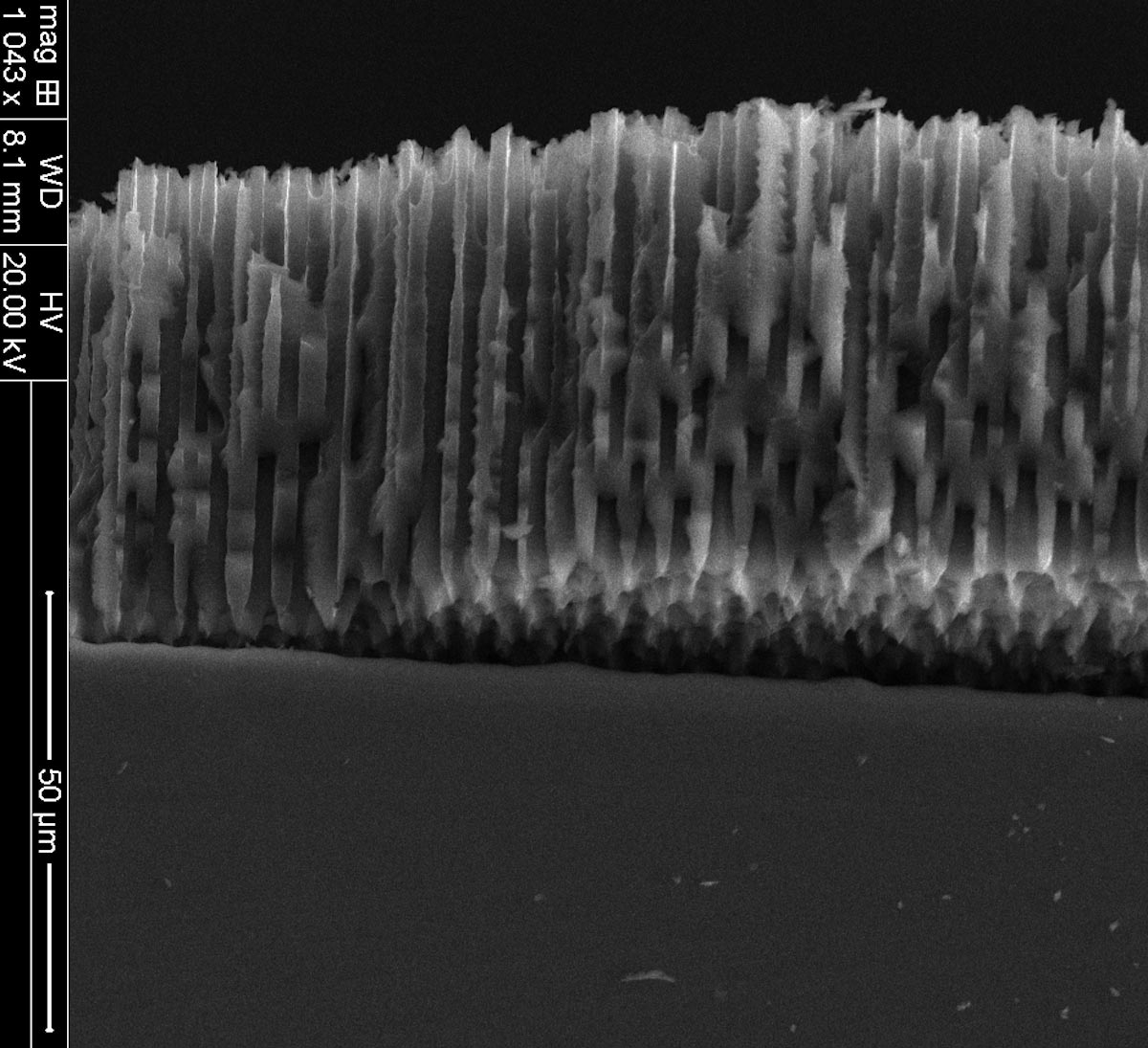
    Swiss Cheese-Like Silicon Sponge
    A Swiss cheese-like silicon sponge lifts off from a wafer in a process developed by researchers at Rice University and Lockheed Martin who hope to replace graphite anodes in lithium-ion batteries with a material that has a larger capacity for lithium. Credit: Madhuri Thakur/Rice University

    Silicon – one of the most common elements on Earth – is a candidate to replace graphite as the anode in batteries. In a previous advance by Biswal and her team, porous silicon was found to soak up 10 times more lithium than graphite.

    Because silicon expands as it absorbs lithium ions, the sponge-like configuration gives it room to grow internally without degrading the battery’s performance, the researchers reported. The promise that silicon sponges, with pores a micron wide and 12 microns deep, held for batteries was revealed in 2010 at Rice’s Buckyball Discovery Conference by Thakur, Biswal, their Rice colleague Michael Wong, a professor of chemical and biomolecular engineering and of chemistry, and Steven Sinsabaugh, a Lockheed Martin Fellow. But even then Thakur saw room for improvement as the solid silicon substrate served no purpose in absorbing lithium.

    In the new work, they discovered the electrochemical etching process used to create the pores can also separate the sponge from the substrate, which is then reused to make more sponges. The team noted that at least four films can be drawn from a standard 250-micron-thick wafer. Removing the sponge from the silicon substrate also eliminates a limiting factor to the amount of lithium that can be stored.
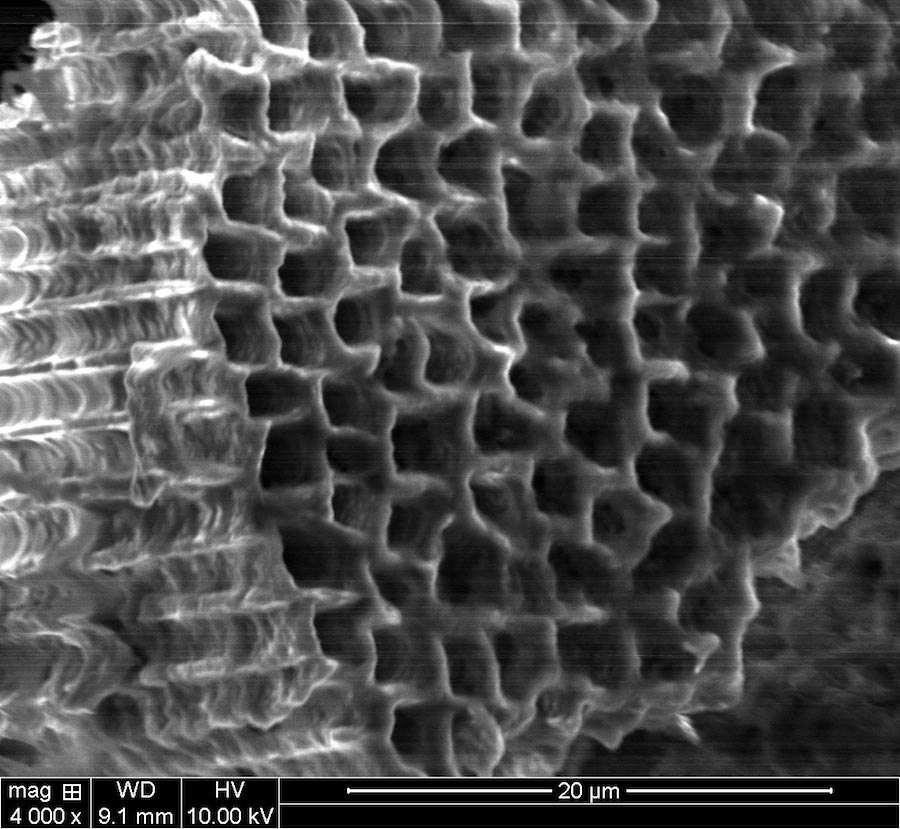
    Sponge Formed From Solid Silicon Wafer
    A sponge formed from a solid wafer of silicon helps the material realize its potential to hold 10 times the amount of lithium ions than current materials used in rechargeable batteries. The material was developed by Rice University and Lockheed Martin. Credit: Madhuri Thakur/Rice University

    The team also found a way to make the pores 50 microns deep. Once lifted from the wafer, the sponges, now open at the top and bottom, were enhanced for conductivity by soaking them in a conductive polymer binder, pyrolyzed polyacrylonitrile (PAN).

    The product was a tough film that could be attached to a current collector (in this case, a thin layer of titanium on copper) and placed in a battery configuration. The result was a working lithium-ion battery with a discharge capacity of 1,260 milliamp-hours per gram, a capability that should lead to batteries that last longer between charges.

    The researchers compared batteries using their film before and after the PAN-and-bake treatment. Before, the batteries started with a discharge capacity of 757 milliamp-hours per gram, dropped rapidly after the second charge-discharge cycle and failed completely by cycle 15. The treated film increased in discharge capacity over the first four cycles – typical for porous silicon, the researchers said – and the capacity remained consistent through 20 cycles.

    The researchers are investigating techniques that promise to vastly increase the number of charge-discharge cycles, a critical feature for commercial applications in which rechargeable batteries are expected to last for years.

    Reference: “Freestanding Macroporous Silicon and Pyrolyzed Polyacrylonitrile As a Composite Anode for Lithium Ion Batteries” by Madhuri Thakur, Roderick B. Pernites, Naoki Nitta, Mark Isaacson, Steven L. Sinsabaugh, Michael S. Wong and Sibani Lisa Biswal, 6 July 2012, Chemistry of Materials.
    DOI: 10.1021/cm301376t

    Co-authors of the paper are postdoctoral researcher Roderick Pernites, alumnus Naoki Nitta and Lockheed Martin researcher Mark Isaacson.

    The work was supported by the Lockheed Martin Advanced Nanotechnology Center of Excellence at Rice.

    Never miss a breakthrough: Join the SciTechDaily newsletter.
    Follow us on Google and Google News.

    Battery Technology Materials Science Rice University Silicon
    Share. Facebook Twitter Pinterest LinkedIn Email Reddit

    Related Articles

    Rice Researchers Develop Thin-Film Battery for Portable, Wearable Electronics

    A Step Towards 2D Devices, Hybrid Graphene/Hexagonal Boron Nitride

    Sulfur Cathodes Set a World Record for Energy Storage

    Silicon-Based Anode Shows Significant Improvement Over Current Graphite Anodes

    ALS Reveals Fundamental Reactions Behind Advanced Battery Technology

    Repeating Patterns Dictate Optical Properties of Nanoparticle Arrays

    Solid-Oxide Fuel Cell That Converts Hydrogen Into Electricity Also Capable of Battery-Like Storage

    Spray Paint Battery Can be Painted on Virtually Any Surface

    Graphene is Transparent to Water

    Leave A Reply Cancel Reply

    • Facebook
    • Twitter
    • Pinterest
    • YouTube

    Don't Miss a Discovery

    Subscribe for the Latest in Science & Tech!

    Trending News

    Scientists Uncover Potential Brain Risks of Popular Fish Oil Supplements

    Scientists Discover a Surprising Way To Make Bread Healthier and More Nutritious

    After 60 Years, Scientists Uncover Unexpected Brain Effects of Popular Diabetes Drug Metformin

    New Research Uncovers Hidden Side Effects of Popular Weight-Loss Drugs

    Scientists Rethink Extreme Warming After Surprising Ocean Discovery

    Landmark Study Links Never Marrying to Significantly Higher Cancer Risk

    Researchers Discover Unknown Beetle Species Just Steps From Their Lab

    Largest-Ever Study Finds Medicinal Cannabis Ineffective for Anxiety, Depression, PTSD

    Follow SciTechDaily
    • Facebook
    • Twitter
    • YouTube
    • Pinterest
    • Newsletter
    • RSS
    SciTech News
    • Biology News
    • Chemistry News
    • Earth News
    • Health News
    • Physics News
    • Science News
    • Space News
    • Technology News
    Recent Posts
    • Early Warning Signals of Esophageal Cancer May Be Hiding in Plain Sight
    • Researchers Have Discovered a THC-Free Cannabis Compound That May Replace Opioids
    • Common Blood Pressure Drug Shows Surprising Power Against Deadly Antibiotic-Resistant Superbug
    • Students Build Dark Matter Detector and Set New Experimental Limits
    • Scientists Discover Caffeine Can Repair Key Memory Circuits After Sleep Loss
    Copyright © 1998 - 2026 SciTechDaily. All Rights Reserved.
    • Science News
    • About
    • Contact
    • Editorial Board
    • Privacy Policy
    • Terms of Use

    Type above and press Enter to search. Press Esc to cancel.