
Close Menu
    Facebook X (Twitter) Instagram
    SciTechDaily
    • Biology
    • Chemistry
    • Earth
    • Health
    • Physics
    • Science
    • Space
    • Technology
    Facebook X (Twitter) Pinterest YouTube RSS
    SciTechDaily
    Home»Space»Overflowing Cosmic “Jug” – Telescope Captures the Spectacular End-of-Life Display of a Red-Giant Star
    Space

    Overflowing Cosmic “Jug” – Telescope Captures the Spectacular End-of-Life Display of a Red-Giant Star

    By Association of Universities for Research in AstronomyAugust 15, 2023No Comments4 Mins Read
    Facebook Twitter Pinterest Telegram LinkedIn WhatsApp Email Reddit
    Share
    Facebook Twitter LinkedIn Pinterest Telegram Email Reddit
    Toby Jug Nebula
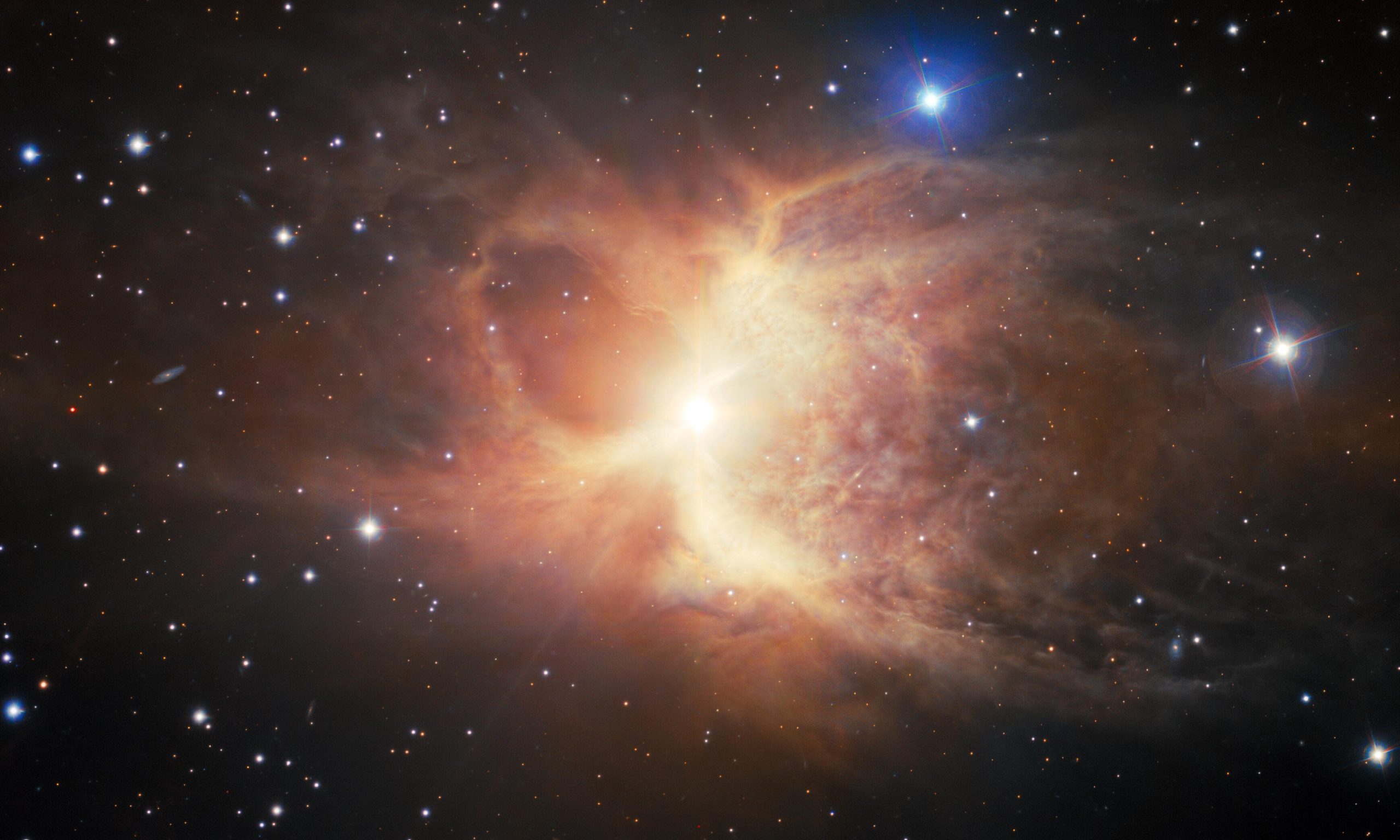
    A billowing pair of nearly symmetrical loops of dust and gas mark the death throes of an ancient red-giant star, as captured by Gemini South, one half of the International Gemini Observatory. The resulting structure, said to resemble an old style of English jug, is a rarely seen bipolar reflection nebula. Evidence suggests that this object formed by the interactions between the dying red giant and a now-shredded companion star. Credit: International Gemini Observatory/NOIRLab/NSF/AURA, T.A. Rector (University of Alaska Anchorage/NSF’s NOIRLab), J. Miller (Gemini Observatory/NSF’s NOIRLab), M. Rodriguez (Gemini Observatory/NSF’s NOIRLab), M. Zamani (NSF’s NOIRLab)

    The Toby Jug Nebula, a unique bipolar reflection nebula, was captured by the Gemini South telescope and offers valuable insights into the evolution of red giants, including our Sun’s future transformation.

    Nicknamed the Toby Jug Nebula owing to its resemblance to an old English drinking vessel, the glowing nebula IC 2220 is a rare astronomical find. This reflection nebula, located approximately 1,200 light-years away in the direction of the constellation Carina (the keel), is a double-lobed, or bipolar, cloud of gas and dust created and illuminated by the red-giant star at its center. This end-of-life phase of red giant stars is relatively brief, and the celestial structures that form around them are rare, making the Toby Jug Nebula an excellent case study into stellar evolution.

    Image and Insights

    This image, captured by the Gemini South telescope, one half of the International Gemini Observatory, operated by NSF’s NOIRLab, showcases the Toby Jug Nebula’s magnificent, nearly symmetrical double-looped structure and glowing stellar heart. These features are unique to red giants transitioning from aging stars to planetary nebulae[1] and therefore offer astronomers valuable insight into the evolution of low- to intermediate-mass stars nearing the end of their lives as well as the cosmic structures they form.

    The Progenitor Star

    At the heart of the Toby Jug Nebula is its progenitor, the red-giant star HR3126. Red giants form when a star burns through its supply of hydrogen in its core. Without the outward force of fusion, the star begins to contract. This raises the core temperature and causes the star to then swell up to 400 times its original size. Though HR3126 is considerably younger than our Sun — a mere 50 million years old compared to the Sun’s 4.6 billion years — it is five times the mass. This allowed the star to burn through its hydrogen supply and become a red giant much faster than the Sun.

    Nebula Formation

    As HR 3126 swelled, its atmosphere expanded and it began to shed its outer layers. The expelled stellar material flowed out into the surrounding area, forming a magnificent structure of gas and dust that reflects the light from the central star. Detailed studies of the Toby Jug Nebula in infrared light have revealed that silicon dioxide (silica) is the most likely compound reflecting HR3126’s light.

    Theory and Observations

    Astronomers theorize that bipolar structures similar to those seen in the Toby Jug Nebula are the result of interactions between the central red giant and a binary companion star. Previous observations, however, found no such companion to HR3126. Instead, astronomers observed an extremely compact disk of material around the central star. This finding suggests that a former binary companion was possibly shredded into the disk, which may have triggered the formation of the surrounding nebula.

    Future Implications

    In around five billion years from now, when our Sun has burned through its supply of hydrogen, it too will become a red giant and eventually evolve into a planetary nebula. In the very distant future, all that will be left of our Solar System will be a nebula as vibrant as the Toby Jug Nebula with the slowly cooling Sun at its heart.

    Notes

    1. The term “planetary nebulae” is a misnomer; they are unrelated to planets. The term was likely first used in the 1780s by astronomer William Herschel, who noted their seemingly round, planet-like shape when observed through early telescopes.

    The image was processed by NOIRLab’s Communication, Education & Engagement team as part of the NOIRLab Legacy Imaging Program. The observations were made with Gemini South on Cerro Pachón in Chile using one of the dual Gemini Multi-Object Spectrographs (GMOS). Though spectrographs are designed to split light into various wavelengths for study, the GMOS spectrographs also have powerful imaging capabilities, as demonstrated by this exceptional view of the Toby Jug Nebula.

    Never miss a breakthrough: Join the SciTechDaily newsletter.
    Follow us on Google and Google News.

    Astronomy AURA Popular
    Share. Facebook Twitter Pinterest LinkedIn Email Reddit

    Related Articles

    Black Hole Pairs Found in Distant Merging Galaxies Provide Crucial Insight Into the Early Universe

    “Failed Stars” Caught Speeding: Astronomers Clock the Fastest-Spinning Brown Dwarfs

    Mysteries of the Milky Way Are Revealed in Spectacular Detail

    Camera Designed to Reveal the Deepest Secrets of Our Universe Captures the Southern Pinwheel Galaxy in Glorious Detail

    Astronomers Have Created the Largest Ever Map of the Sky, Comprising Over a Billion Galaxies

    Astronomers Discover Earliest Supermassive Black Hole and Quasar in the Universe – 1000x More Luminous Than the Milky Way

    See the Incredible First Image of a Sunspot From the Inouye Solar Telescope

    Blast From the Past: Breakthrough in Centuries-Old Effort to Unravel Astronomical Mystery

    Brown Dwarf Discovered by Radio Telescope Observations for the First Time

    Leave A Reply Cancel Reply

    • Facebook
    • Twitter
    • Pinterest
    • YouTube

    Don't Miss a Discovery

    Subscribe for the Latest in Science & Tech!

    Trending News

    Enormous Prehistoric Insects Puzzle Scientists

    Scientists Develop Bioengineered Chewing Gum That Could Help Fight Oral Cancer

    After 37 Years, the World’s Longest-Running Soil Warming Experiment Uncovers a Startling Climate Secret

    NASA Satellite Captures First-Ever High-Res View of Massive Pacific Tsunami

    ADHD Isn’t Just a Deficit: Study Reveals Powerful Hidden Strengths

    Scientists Discover Stem Cells That Could Regrow Teeth and Bone

    Early Cannabis Use May Stall Key Brain Skills in Teens

    Popular Vitamin D Supplement Has “Previously Unknown” Negative Effect, Study Finds

    Follow SciTechDaily
    • Facebook
    • Twitter
    • YouTube
    • Pinterest
    • Newsletter
    • RSS
    SciTech News
    • Biology News
    • Chemistry News
    • Earth News
    • Health News
    • Physics News
    • Science News
    • Space News
    • Technology News
    Recent Posts
    • Darwin’s Islands Still Evolving: Giant Daisies Rewrite the Rules of Evolution
    • Ancient Document Confirms “Legendary” African King Actually Existed
    • First-of-Its-Kind Discovery: Homer’s Iliad Found Embedded in a 1,600-Year-Old Egyptian Mummy
    • Beyond Inflammation: Scientists Uncover New Cause of Persistent Rheumatoid Arthritis
    • Cancer-Like Mutations Found in the Brain May Be Driving Alzheimer’s Disease
    Copyright © 1998 - 2026 SciTechDaily. All Rights Reserved.
    • Science News
    • About
    • Contact
    • Editorial Board
    • Privacy Policy
    • Terms of Use

    Type above and press Enter to search. Press Esc to cancel.