
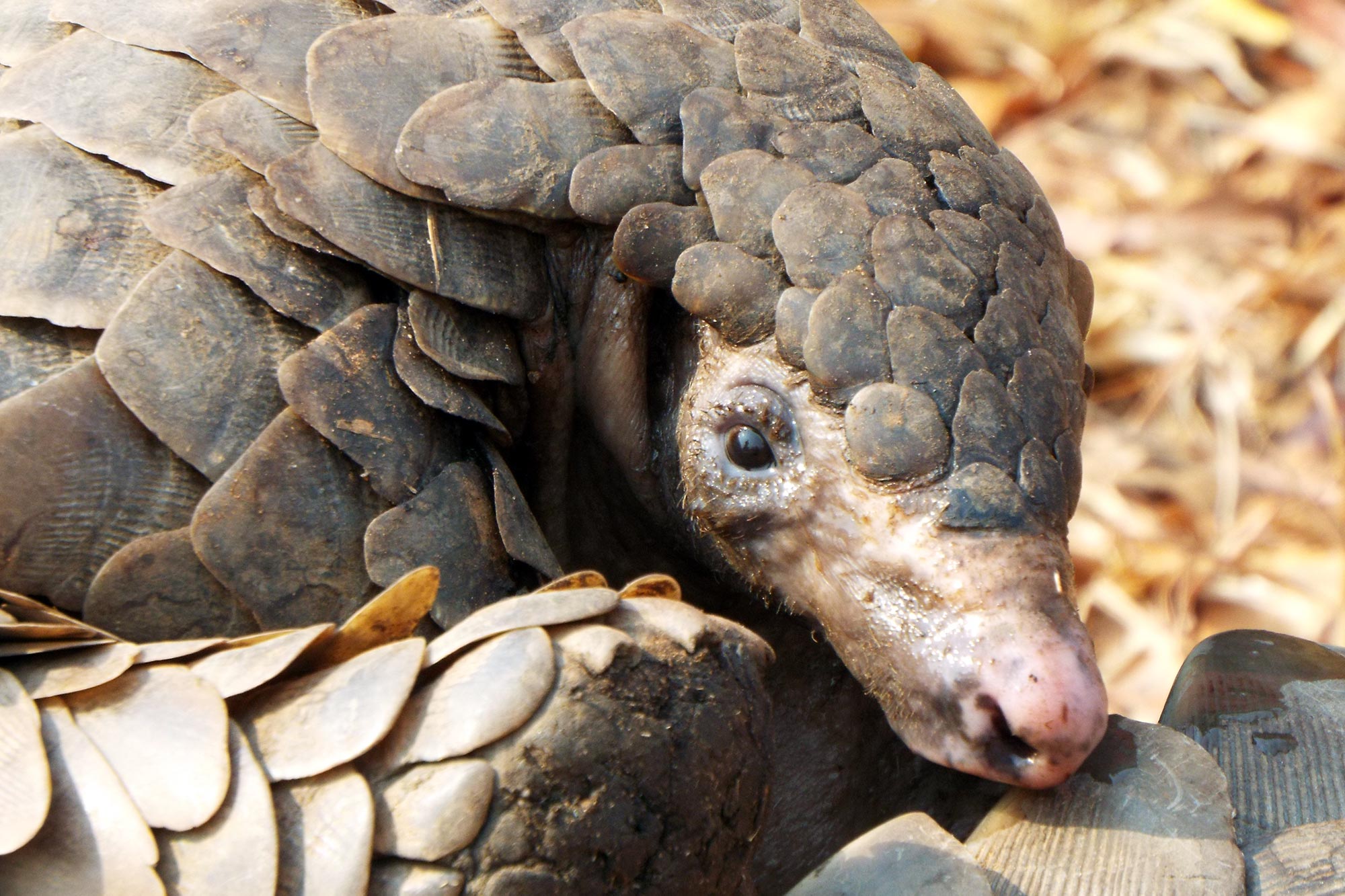
Scientists at the Francis Crick Institute have found important structural similarities between SARS-CoV-2 and a pangolin coronavirus, suggesting that a pangolin coronavirus could infect humans.
While SARS-CoV-2 is thought to have evolved from a bat coronavirus, its exact evolutionary path is still a mystery. Uncovering its history is challenging as there are likely many undiscovered bat coronaviruses and, due to differences between bat coronaviruses and SARS-CoV-2, it is thought that the virus may have passed to humans via at least one other species.
In their study, published in Nature Communications, the scientists compared the structures of the spike proteins found on SARS-CoV-2, the most similar currently identified bat coronavirus RaTG13, and a coronavirus isolated from Malayan pangolins which were seized by authorities after being smuggled to China. They found that the pangolin virus was able to bind to receptors from both pangolins and humans. This differs from the bat coronavirus, which could not effectively bind with human or pangolin receptors.
Pangolin Virus Shows Human Infectivity Potential
Antoni Wrobel, co-lead author and postdoctoral training fellow in the Structural Biology of Disease Processes Laboratory at the Crick, says: “By testing if the spike protein of a given virus can bind with cell receptors from different species, we’re able to see if, in theory, the virus could infect this species.”
“Importantly here, we’ve shown two key things. Firstly, that this bat virus would unlikely be able to infect pangolins. And secondly, a pangolin virus could potentially infect humans.”
The team used cryo-electron microscopy to uncover in minute detail the structure of the pangolin coronavirus’ spike protein, which is responsible for binding to and infecting cells. While some parts of the pangolin virus’ spike were found to be incredibly similar to SARS-CoV-2, other areas differed.
Exploring Possible Evolutionary Routes to Humans
In terms of understanding the evolutionary path of SARS-CoV-2, this work does not confirm whether or not this pangolin virus is definitely part of the chain of evolution for SARS-CoV-2. But the findings do support various possible scenarios for how the coronavirus jumped from bats to humans. One potential route is that SARS-CoV-2 originated from a different, currently unknown bat coronavirus which could infect pangolins, and from this species it then moved to humans. Or alternatively, RaTG13 or a similar bat coronavirus might have merged with another coronavirus in a different intermediate species, other than a pangolin.
Donald Benton, co-lead author and postdoctoral training fellow in the Structural Biology of Disease Processes Laboratory at the Crick, says: “We still don’t have evidence to confirm the evolutionary path of SARS-CoV-2 or to prove definitively that this virus did pass through pangolins to humans.”
“However, we have shown that a pangolin virus could potentially jump to humans, so we urge caution in any contact with this species and the end of illegal smuggling and trade in pangolins to protect against this risk.”
Steve Gamblin, group leader of the Structural Biology of Disease Processes Laboratory at the Crick says: “A lot is still to be uncovered about the evolution of SARS-CoV-2, but the more we know about its history and which species it passed through, the more we understand about how it works, and how it may continue to evolve.”
This work builds upon previous studies from the Crick team, including research published in July 2020, which found that the bat coronavirus RaTG13 could not effectively bind to human receptors.
The team are continuing to examine the spikes of SARS-CoV-2 and related coronaviruses, including other bat viruses, to better understand the mechanisms of infection and evolution.
Reference: “Structure and binding properties of Pangolin-CoV spike glycoprotein inform the evolution of SARS-CoV-2” by Antoni G. Wrobel, Donald J. Benton, Pengqi Xu, Lesley J. Calder, Annabel Borg, Chloë Roustan, Stephen R. Martin, Peter B. Rosenthal, John J. Skehel and Steven J. Gamblin, 5 February 2021, Nature Communications.
DOI: 10.1038/s41467-021-21006-9
Never miss a breakthrough: Join the SciTechDaily newsletter.
Follow us on Google and Google News.
2 Comments
A scientist also found that the virus might have jumped directly to humans from the lab… https://zenodo.org/record/4477081#
The Francis Crick Institute conclusion,
“our structural and biochemical data indicate that a bat virus, similar to RaTG13, would not be able to bind effectively to human ACE2 receptor and would be unlikely to infect humans directly”
is admirable, and can be used as a stepping stone for further research. In so far as I can see (which isn’t very far), a RaTG13 related bat coronavirus needs a RBM (receptor binding motif) like the Malaysian pangolin to bind effectively to human ACE2.
Recently, Kefang Liu, Xiaoqian Pan, and others have shown that RaTG13 RBD was unable to interact with Malayan ACE2.
“The RaTG13 RBD was capable of binding to human, monkey, rabbit, cat, fox, dog, raccoon dog, horse, pig, bovine, wild Bactrian camel, goat, sheep, and mouse ACE2, with equilibrium dissociation constant (KD) values of 0.5–7.14 mM, but were unable to interact with Malayan pangolin, civet, little brown bat, least horseshoe bat…”, in the article “ Binding and molecular basis of the bat coronavirus RaTG13 virus to ACE2 in humans and other species”, by Kefang Liu, Xiaoqian Pan, and others, Cell 184, 3438–3451, June 24, 2021
If other studies verify this, then the question becomes the reverse scenario. Does Malaysian pangolin RBD bind RaTG13-related ACE2 effectively? For Malaysian pangolan coronavirus to donate its RBM to a RaTG13-related bat, this binding would have had to occurred, as a prerequisite to any recombining. Ruling out concurrent evolution or some other unnatural process in bats and pangolans, as the ones below,
“These results suggest that the SARSr-CoV spike protein and Rhinolophus sinicus ACE2 may have ‘coevolved’ over time and experienced selection pressure from each other, triggering the evolutionary arms race dynamics. It further proves that Rhinolophus sinicus is the natural host of SARSrelated-CoVs…In a ‘host-virus arms race situation’, the genes involved tend to display dN/dS ratios (nonsynymous/synonymous mutation) greater than 1 (positive selection), specifically in the codons involved in the interaction interface between the virus and its host, with minimal effect on their physical function…….Similar ‘rapid adaptation’ for SARS-CoV occurred during the SARS outbreak in 2002-2003 …… bat SARSrelated-CoVs may decrease their virulence to fit both the host and themselves.” in the article, “Evolutionary arms race between virus and host drives genetic diversity in bat SARS related coronavirus spike genes”, by Hua Guoa, Bing-Jie Hua, Xing-Lou Yanga, Lei-Ping Zenga, Bei Lia, Song-Ying Ouyang, Zheng-Li Shia, https://doi.org/10.1101/2020.05.13.093658
Setting aside this Zhengli doctrine of coevolution and ‘rapid adaptation’, the question remains, does the Malaysian pangolin RBD bind RaTG13-related ACE2 effectively, to help facilitate pangolin coronavirus entry into RaTG13 related bat? To set the stage for a recombination event in the bat 50 years ago. And questions of bat coronavirus persistence in that possible reservoir.
Did Malaysian pangolan coronavirus ever exist in those pangolans as reservoir, or as disease. This question has been answered by many as, ‘disease’. Because the pangolan coronavirus seemingly has the same pathogenicity in pangolans, as Covid-19 in humans.
One last observation. On Jan 22, 2020, the Guangdong Institute filed sequences SRR10168377 and SRR10168378 viromes for dead Malaysian pangolins lung07 and lung08 with the NCBI. https://www.ncbi.nlm.nih.gov/sra/?term=SRR10168377%20 and https://www.ncbi.nlm.nih.gov/sra/?term=SRR10168378 to see the filing date.
On the very next day, January 23, 2020 ‘tortube’ (Matthew Wong) posted on the Internet, that the RBD (receptor bind domain) for dead Malaysian pangolins was highly similar to RBD for Covid-19, using sequences SRR10168377 and SRR10168378 to reconstruct Malaysian pangolin coronavirus genome. https://virological.org/t/ncov-2019-spike-protein-receptor-binding-domain-shares-high-amino-acid-identity-with-a-coronavirus-recovered-from-a-pangolin-viral-metagenomic-dataset/362
So ‘rapid adaptation’ does occur.
The February 6, 2020 letter from University of North Carolina to the University of Minnesota regarding RFP PA-19-056, “Cell entry, Cross-Species Transmission and Pathogenesis of Novel Coronavirus from Wuhan”, to the National Institute of Health, shows Baric’s desire to study pangolin coronaviruses at that early date. Fang Li’s e-mails at https://usrtk.org/wp-content/uploads/2021/07/Fang-Li-emails.pdf page 1034 Source to be questioned on these issues.