
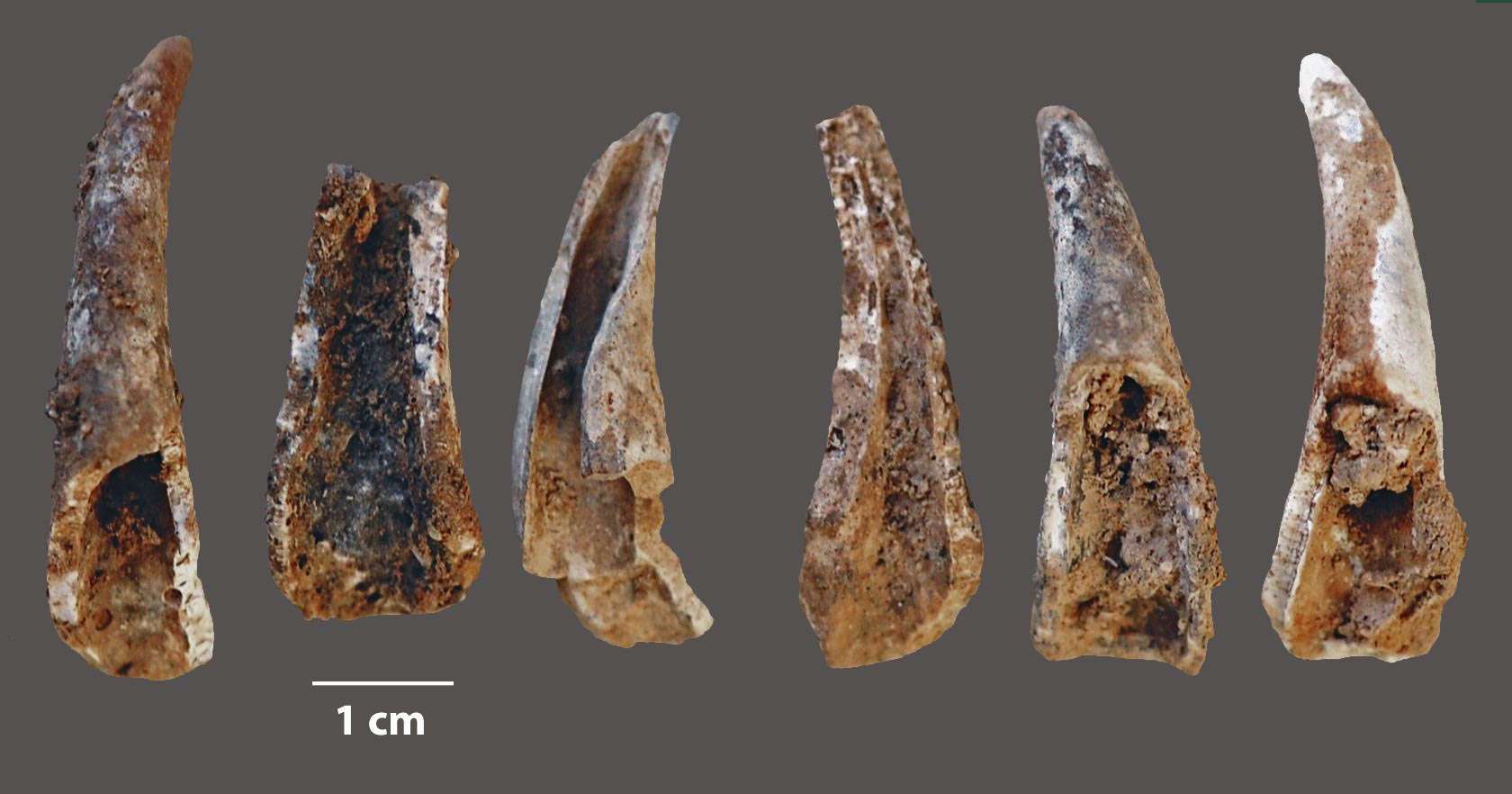
The journal Science has published a study led by the ICREA researcher João Zilhão, from the University of Barcelona, which presents the results of the excavation in Cueva de Figueira Brava, Portugal, which was used as shelter by Neanderthal populations between 86 and 106 thousand years ago. The study reveals fishing and shellfish-gathering contributed significantly to the subsistence economy of the inhabitants of Figueira Brava. The relevance of this discovery lies in the fact that so far, there were not many signs of these practices as common among Neanderthals.
Regarding the consequences of this study, João Zilhão notes that “an influent model on our origins suggests the common consumption of water resources -rich in Omega3 and other fatty acids that favor the development of brain tissues- would have increased the cognitive skills of modern anatomy humans. That is, those humans who, in Africa, were contemporaries of Neanderthals and are usually regarded as the only ancestors of the current Homo sapiens.” But the results of the excavation of Figueira Brava state that, if this common consumption of marine resources played an important role in the development of cognitive skills, it did so on the entire humanity, including Neanderthals, and not only the African population that spread later.”

Zilhão member of the Prehistoric Studies and Research Seminar (SERP-UB), lists the research study in the line of “proof that accumulated over the last decade to show Neanderthals had a symbolic material culture.” Two years ago, in 2018, the journals Science and Science Advances published two studies co-led by João Zilhão which showed that more than 65,000 years ago, Neanderthals made cave paintings in at least three caves in the Iberian Peninsula: La Pasiega, Maltravieso, and Ardales (Science). Furthermore, more than 115,000 years ago, they used perforated marine shells and other remains, such as the ones from Cueva de los Aviones (Murcia, Spain), as pendants and shell containers with residues of complex mixes of pigment (Science Advances). These findings, the most recent one being the one in Figueira Brava, “support a view on human evolution in which the known fossil variants, such as Neanderthals’ in Europe and its African anatomy contemporaries -more similar to ours-, should be understood as remains from our ancestors, not as different higher-lower species,” notes Zilhão.
50% of the diet of the inhabitants in Figueira Brava was built by coastal resources: mollusks (limpet, mussel, and clams; crustaceans (brown crab and spider crab); fish (shark, eel, sea bream, mullet); birds (mallard, common scoter, goose, cormorant, gannet, shag, auk, egret, loon), and mammals (dolphin, seal). This was completed with the hunt of deer, goats, horses, aurochs, and other small prey such as tortoises. Among the other carbonized plants were olive trees, vines, fig trees, and other Mediterranean climate typical species, among which the most abundant was the stone pine -its wood was used as combustible. Pine forests were exploited as fruit tree gardens: mature pines, albeit closed, were taken from the branches and stored in the cave, where the fire could open them so as to take the pines.
The study also provides other results, such as the idea of the concept of Neanderthals as cold and tundra peoples, experts on hunting mammoths, rhinos, buffalos, and reindeer, is biased. “Most Neanderthals would have lived in southern regions, especially in Italy and in the Iberian Peninsula, and its lifestyle would have been very similar to those in Figueira Brava,” notes Zilhão.
Another important affirmation in the study is the familiarity of humans with the sea and its resources as something older and wider than what was thought. “This could probably help explain how, between 45,000 and 50,000 years ago, humans could cross the Timor Sea to colonize Australia and New Guinea, and then, about 30,000 years ago, the closest islands to the western Pacific,” says Zilhão.
References:
“Last Interglacial Iberian Neandertals as fisher-hunter-gatherers” by J. Zilhão, D. E. Angelucci, M. Araújo Igreja, L. J. Arnold, E. Badal, P. Callapez, J. L. Cardoso, F. d’Errico, J. Daura, M. Demuro, M. Deschamps, C. Dupont, S. Gabriel, D. L. Hoffmann, P. Legoinha, H. Matias, A. M. Monge Soares, M. Nabais, P. Portela, A. Queffelec, F. Rodrigues and P. Souton, 27 March 2020, Science.
DOI: 10.1126/science.aaz7943
“Neanderthal surf and turf” by Manuel Will, 27 March 2020, Science.
DOI: 10.1126/science.abb3568
Never miss a breakthrough: Join the SciTechDaily newsletter.
Follow us on Google and Google News.