
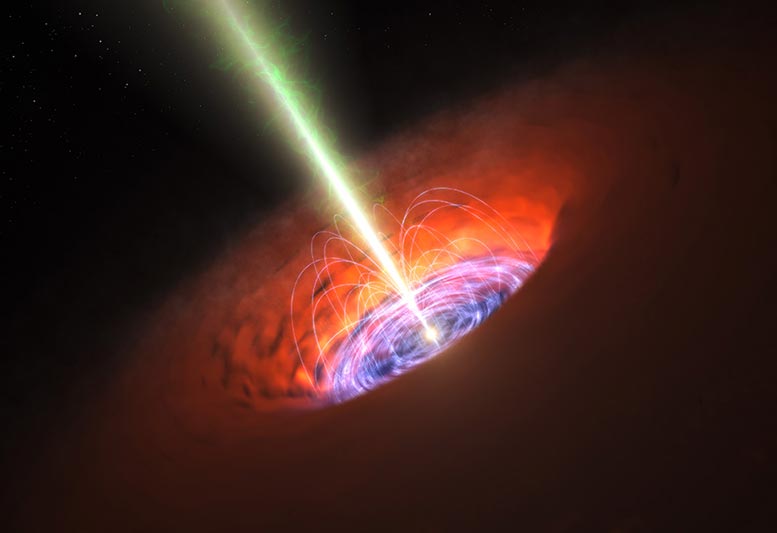
Optical flickers in accretion disks offer a new method to measure supermassive black hole mass.
The flickering light emitted by astrophysical accretion disks can reveal the mass of the supermassive black hole (SMBH) at their center, according to a new study. The findings provide a novel method for characterizing the masses of SMBHs using optical observations and help to constrain the poorly understood processes that occur within accretion disks.
Accretion disks – made of gas, dust, and plasma – surround the SMBHs located at the centers of active galaxies. As material from the accretion disk falls toward the black hole, it heats up, emitting an enormous amount of radiation, including ultraviolet and optical light.
Although these disks are much smaller than their host galaxy – roughly the size of the Solar System – they can often out-shine the entire rest of the galaxy. However, accretion disks flicker for unknown reasons, causing their luminosity to fluctuate over a wide range of time scales.
Colin Burke and colleagues report that a characteristic time scale measured from the optical variability of accretion disks is correlated with the masses of the SMBHs they surround. The authors measured the optical variability of 67 well-observed active galaxies to determine the time scale on which the fluctuations became noticeably smaller, known as the “damping” time scale (usually several hundred days). They find that this damping time scale is related to SMBH mass over the entire range of SMBH masses observed in active galaxies and may even extend to smaller accretion discs around other objects.
“One of the most interesting aspects of the study of Burke et al. is that it extends its findings to much less massive objects, such as white dwarf stars, which emit radiation through a similar accretion disk mechanism and can be regarded as miniature accreting SMBHs,” write Paulina Lira and Patricia Arevalo in a related Perspective.
For more on this discovery, read Mysterious Flickering Decoded: Supermassive Black Hole Size Revealed by Its Feeding Pattern.
Reference: “A characteristic optical variability timescale in astrophysical accretion disks” by Colin J. Burke, Yue Shen, Omer Blaes, Charles F. Gammie, Keith Horne, Yan-Fei Jiang, Xin Liu, Ian M. McHardy, Christopher W. Morgan, Simone Scaringi and Qian Yang, 12 August 2021, Science.
DOI: 10.1126/science.abg9933
Never miss a breakthrough: Join the SciTechDaily newsletter.
Follow us on Google and Google News.
3 Comments
The characterstic time scale of opticaĺ variabilitofy of flickering light pattern emitted by accretion disc of SMBH of any Galaxý is proportional to the mass òf corresponding SBMH.The consþant of pròportionality contains a factor 2 ×ròtationaĺ vector for the concerned galaxy.As each galaxy is ròtating wìth respect to òthers. The factor 2 comes as force is to be divided in equaĺ ratio between galaxy we observing and our milkyway,from where we are observing.Here force is the Gravitation.Here system of galaxies are ìn Space Time coòrdinates.So all òther smaller blackholes and stars shòws to òbey the law.Thanks to the Authors.
This has been confirmed that light emitted by the accretion dicc òf any particular SMBH of a galaxy is electromagnetic wave generated from magnetic field associated with charge. So these lìght pattern time scale òf variable flìckerìng wave (also quanta of energy) corresponds to Gravitation,so propòrtional to Mass of respective SMBH.Here SpaceTime coòrdinates are òbserved.
This has been confirmed that light emitted by the accretion dicc òf any particular SMBH of a galaxy is electromagnetic wave generated from magnetic field associated with charge. So these lìght pattern time scale òf variable flìckerìng wave (also quanta of energy) corresponds to Gravitation,so propòrtional to Mass of respective SMBH.Here SpaceTime coòrdinates are òbserved.Anyhow a term representing value òf vectòr òf rotatìon corresponding to relatìve motion among galaxies is present in the Constant of proportionality.A factor 2 is ìntroduced for equal division of force between galaxy under observation and our milkyway.