
Close Menu
    Facebook X (Twitter) Instagram
    SciTechDaily
    • Biology
    • Chemistry
    • Earth
    • Health
    • Physics
    • Science
    • Space
    • Technology
    Facebook X (Twitter) Pinterest YouTube RSS
    SciTechDaily
    Home»Technology»3D Magnetic Nanonetwork Breakthrough Could Enable New Generation of 3D Storage Technologies
    Technology

    3D Magnetic Nanonetwork Breakthrough Could Enable New Generation of 3D Storage Technologies

    By University of ViennaAugust 14, 2021No Comments3 Mins Read
    Facebook Twitter Pinterest Telegram LinkedIn WhatsApp Email Reddit
    Share
    Facebook Twitter LinkedIn Pinterest Telegram Email Reddit
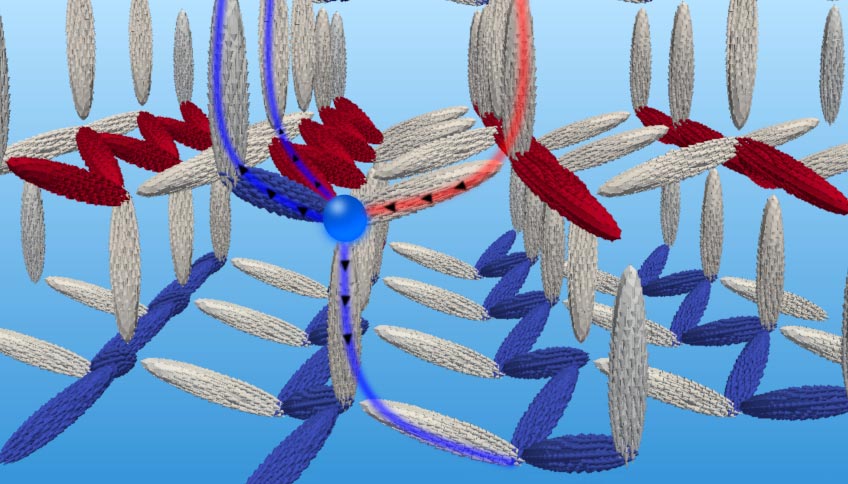
    Magnetic Nanonetwork
    Researchers at the University of Vienna have designed a new 3D magnetic nanonetwork, where magnetic monopoles emerge due to rising magnetic frustration among the nanoelements, and are stable at room temperature. Credit: © Sabri Koraltan University of Vienna

    Emergent Magnetic Monopoles Controlled at Room Temperature

    Three dimensional (3D) nano-network promises a new era in modern solid state physics with numerous applications in photonics, bio-medicine, and spintronics. The realization of 3D magnetic nano-architectures could enable ultra-fast and low-energy data storage devices. Due to competing magnetic interactions in these systems magnetic charges or magnetic monopoles can emerge, which can be utilized as mobile, binary information carriers. Researchers at University of Vienna have now designed the first 3D artificial spin ice lattice hosting unbound magnetic charges. The results published in the journal npj Computational Materials present a first theoretical demonstration that, in the new lattice, the magnetic monopoles are stable at room temperature and can be steered on-demand by external magnetic fields.

    Emergent magnetic monopoles are observed in a class of magnetic materials called spin ices. However, the atomic scales and required low temperatures for their stability limit their controllability. This led to the development of 2D artificial spin ice, where the single atomic moments are replaced by magnetic nano-islands arranged on different lattices. The up-scaling allowed the study of emergent magnetic monopoles on more accessible platforms. Reversing the magnetic orientation of specific nano-islands propagates the monopoles one vertex further, leaving a trace behind. This trace, Dirac Strings, necessarily stores energy and bind the monopoles, limiting their mobility.

    Designing the First 3D Artificial Spin Ice

    Researchers around Sabri Koraltan and Florian Slanovc, and led by Dieter Suess at the University of Vienna, have now designed a first 3D artificial spin ice lattice that combines the advantages of both atomic- and 2D artificial spin ices.

    In a cooperation with Nanomagnetism and Magnonics group from University of Vienna, and Theoretical Division of Los Alamos Laboratory, USA, the benefits of the new lattice are studied employing micromagnetic simulations. Here, flat 2D nano-islands are replaced by magnetic rotational ellipsoids, and a high symmetry three-dimensional lattice is used. “Due to the degeneracy of the ground state the tension of the Dirac strings vanish unbinding the magnetic monopoles,” remarks Sabri Koraltan, one of the first authors of the study. The researchers took the study further to the next step, where in their simulations one magnetic monopole was propagated through the lattice by applying external magnetic fields, demonstrating its application as information carriers in a 3D magnetic nano-network.

    Sabri Koraltan adds, “We make use of the third dimension and high symmetry in the new lattice to unbind the magnetic monopoles, and move them in desired directions, almost like true electrons.” The other first-author Florian Slanovc concludes, “The thermal stability of the monopoles around room temperature and above could lay the foundation for groundbreaking new generation of 3D storage technologies.”

    Reference: “Tension-free Dirac strings and steered magnetic charges in 3D artificial spin ice” by Sabri Koraltan, Florian Slanovc, Florian Bruckner, Cristiano Nisoli, Andrii V. Chumak, Oleksandr V. Dobrovolskiy, Claas Abert and Dieter Suess, 5 August 2021, npj Computational Materials.
    DOI: 10.1038/s41524-021-00593-7

    Never miss a breakthrough: Join the SciTechDaily newsletter.
    Follow us on Google and Google News.

    Magnetism Materials Science Nanotechnology Popular University of Vienna
    Share. Facebook Twitter Pinterest LinkedIn Email Reddit

    Related Articles

    MIT Researchers Create Perfect Nanoscrolls from Graphene Oxide

    Niobium Nanowire Yarns Make High-Performance Supercapacitors

    New Non-Invasive MRI Technology Detects Alzheimer’s Disease Early

    MIT Develops Membrane That Can Separate Highly Mixed Oil-Spill Residues

    New Approach for Mixing Nanoparticles to Produce Composite Materials

    Controlled Graphene Crumpling Used as Artificial Muscle Actuators

    Nanoscale Coating Repels Virtually Any Liquid

    Nanosheet-Flower Structure Boosts Energy Storage

    Spray Paint Battery Can be Painted on Virtually Any Surface

    Leave A Reply Cancel Reply

    • Facebook
    • Twitter
    • Pinterest
    • YouTube

    Don't Miss a Discovery

    Subscribe for the Latest in Science & Tech!

    Trending News

    One of the Universe’s Largest Stars May Be Getting Ready To Explode

    Scientists Discover Enzyme That Could Supercharge Ozempic-Like Weight Loss Drugs

    Popular Sweetener Linked to DNA Damage – “It’s Something You Should Not Be Eating”

    Ancient “Rock” Microbes May Reveal How Complex Life Began

    Researchers Capture Quantum Interference in One of Nature’s Rarest Atoms

    “A Plague Is Upon Us”: The Mass Death That Changed an Ancient City Forever

    Scientists Discover Game-Changing New Way To Treat High Cholesterol

    This Small Change to Your Exercise Routine Could Be the Secret to Living Longer

    Follow SciTechDaily
    • Facebook
    • Twitter
    • YouTube
    • Pinterest
    • Newsletter
    • RSS
    SciTech News
    • Biology News
    • Chemistry News
    • Earth News
    • Health News
    • Physics News
    • Science News
    • Space News
    • Technology News
    Recent Posts
    • Scientists Prove There Are Just Six Degrees of Separation in a Social Network
    • Bee Bacteria Could Fix a Major Flaw in Plant-Based Milk
    • Scientists Discover a Surprising Way To Make Bread Healthier and More Nutritious
    • Natural Compounds Boost Bone Implant Success While Killing Bacteria and Cancer Cells
    • After 60 Years, Scientists Uncover Unexpected Brain Effects of Popular Diabetes Drug Metformin
    Copyright © 1998 - 2026 SciTechDaily. All Rights Reserved.
    • Science News
    • About
    • Contact
    • Editorial Board
    • Privacy Policy
    • Terms of Use

    Type above and press Enter to search. Press Esc to cancel.