
Close Menu
    Facebook X (Twitter) Instagram
    SciTechDaily
    • Biology
    • Chemistry
    • Earth
    • Health
    • Physics
    • Science
    • Space
    • Technology
    Facebook X (Twitter) Pinterest YouTube RSS
    SciTechDaily
    Home»Space»WISE Views Stellar Formation in the Trifid Nebula
    Space

    WISE Views Stellar Formation in the Trifid Nebula

    By Whitney Clavin, Jet Propulsion Laboratory; NASAJanuary 30, 2014No Comments3 Mins Read
    Facebook Twitter Pinterest Telegram LinkedIn WhatsApp Email Reddit
    Share
    Facebook Twitter LinkedIn Pinterest Telegram Email Reddit
    WISE Views a Storm of Stars in the Trifid Nebula
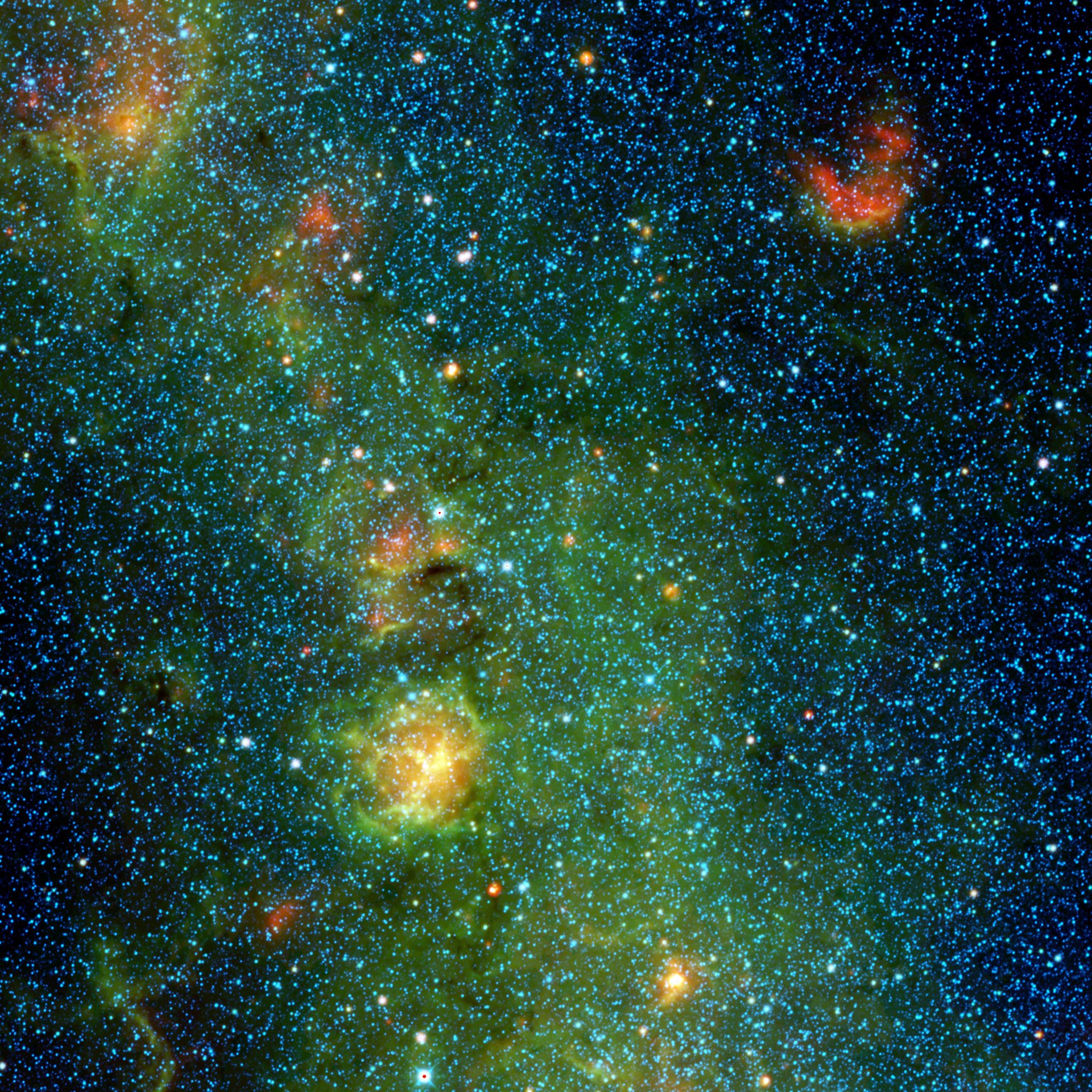
    Radiation and winds from massive stars have blown a cavity into the surrounding dust and gas, creating the Trifid nebula, as seen here in infrared light by NASA’s Wide-field Infrared Survey Explorer, or WISE. Credit: NASA/JPL-Caltech/UCLA

    NASA’s Wide-field Infrared Survey Explorer views stellar formation in the Trifid nebula, which is located 5,400 light-years away in the constellation Sagittarius.

    A storm of stars is brewing in the Trifid nebula, as seen in this view from NASA’s Wide-field Infrared Survey Explorer, or WISE. The stellar nursery, where baby stars are bursting into being, is the yellow-and-orange object dominating the picture. Yellow bars in the nebula appear to cut a cavity into three sections, hence the name Trifid nebula.

    The colors in this image represent different wavelengths of infrared light detected by WISE. The main green cloud is made up of hydrogen gas. Within this cloud is the Trifid nebula, where radiation and winds from massive stars have blown a cavity into the surrounding dust and gas, and presumably triggered the birth of new generations of stars. Dust glows in infrared light, so the three lines that make up the Trifid, while appearing dark in visible-light views, are bright when seen by WISE.

    The blue stars scattered around the picture are older, and they lie between Earth and the Trifid nebula. The baby stars in the Trifid will eventually look similar to those foreground stars. The red cloud at the upper right is gas heated by a group of very young stars.

    The Trifid nebula is located 5,400 light-years away in the constellation Sagittarius.

    Blue represents light emitted at 3.4-micron wavelengths, and cyan (blue-green) represents 4.6 microns, both of which come mainly from hot stars. Relatively cooler objects, such as the dust of the nebula, appear green and red. Green represents 12-micron light and red, 22-micron light.

    NASA’s Jet Propulsion Laboratory, Pasadena, California, manages and operates the recently activated NEOWISE asteroid-hunting mission for NASA’s Science Mission Directorate. The results presented here are from the WISE all-sky survey mission, which operated before NEOWISE, using the same spacecraft, in 2010 and 2011. WISE was selected competitively under NASA’s Explorers Program managed by the agency’s Goddard Space Flight Center in Greenbelt, Maryland. The science instrument was built by the Space Dynamics Laboratory in Logan, Utah. The spacecraft was built by Ball Aerospace & Technologies Corp. in Boulder, Colorado. Science operations and data processing take place at the Infrared Processing and Analysis Center at the California Institute of Technology, Pasadena. Caltech manages JPL for NASA.

    Never miss a breakthrough: Join the SciTechDaily newsletter.
    Follow us on Google and Google News.

    Astronomy NASA Star Formation Stellar Nursery WISE
    Share. Facebook Twitter Pinterest LinkedIn Email Reddit

    Related Articles

    A Cosmic Accident Just Exposed the Hidden Chemistry of Giant Planets

    Cosmic Feast: Massive Star Spotted Devouring Gas at an Astounding Rate

    NASA’s WISE Uncovers New Clues on Jovian Trojans

    NASA’s WISE Discovers Millions of Black Holes

    Mysterious Disappearance of Dust Ring Leaves Astronomers Searching for Solutions

    In McNeil’s Nebula, Protostar V1647 Ori Flaunts its X-ray Spots

    Flame Nebula Burns Bright in New WISE Image

    WISE Observations Provide Crucial Information on Brown Dwarfs

    WISE Views Aging Star Erupting With Dust

    Leave A Reply Cancel Reply

    • Facebook
    • Twitter
    • Pinterest
    • YouTube

    Don't Miss a Discovery

    Subscribe for the Latest in Science & Tech!

    Trending News

    Scientists May Have Found the Key to Jupiter and Saturn’s Moon Mystery

    Scientists Uncover Brain Changes That Link Pain to Depression

    Saunas May Do More Than Raise Body Temperature – They Activate Your Immune System

    Exercise in a Pill? Metformin Shows Surprising Effects in Cancer Patients

    Hidden Oceans of Magma Could Be Protecting Alien Life

    New Study Challenges Alzheimer’s Theories: It’s Not Just About Plaques

    Artificial Sweeteners May Harm Future Generations, Study Suggests

    Splashdown! NASA Artemis II Returns From Record-Breaking Moon Mission

    Follow SciTechDaily
    • Facebook
    • Twitter
    • YouTube
    • Pinterest
    • Newsletter
    • RSS
    SciTech News
    • Biology News
    • Chemistry News
    • Earth News
    • Health News
    • Physics News
    • Science News
    • Space News
    • Technology News
    Recent Posts
    • Scientists Discover Unexpected Climate Benefit Hidden in Forest Soils
    • The Grand Canyon’s “Swiss Cheese” Rocks Hold a Critical Secret
    • Scientists Discover 430,000-Year-Old Wooden Tools, Rewriting Human History
    • Scientists Make Breakthrough on 40-Year-Old 2D Physics Puzzle
    • As Cities Invade the Amazon, Yellow Fever Makes a Dangerous Comeback
    Copyright © 1998 - 2026 SciTechDaily. All Rights Reserved.
    • Science News
    • About
    • Contact
    • Editorial Board
    • Privacy Policy
    • Terms of Use

    Type above and press Enter to search. Press Esc to cancel.