
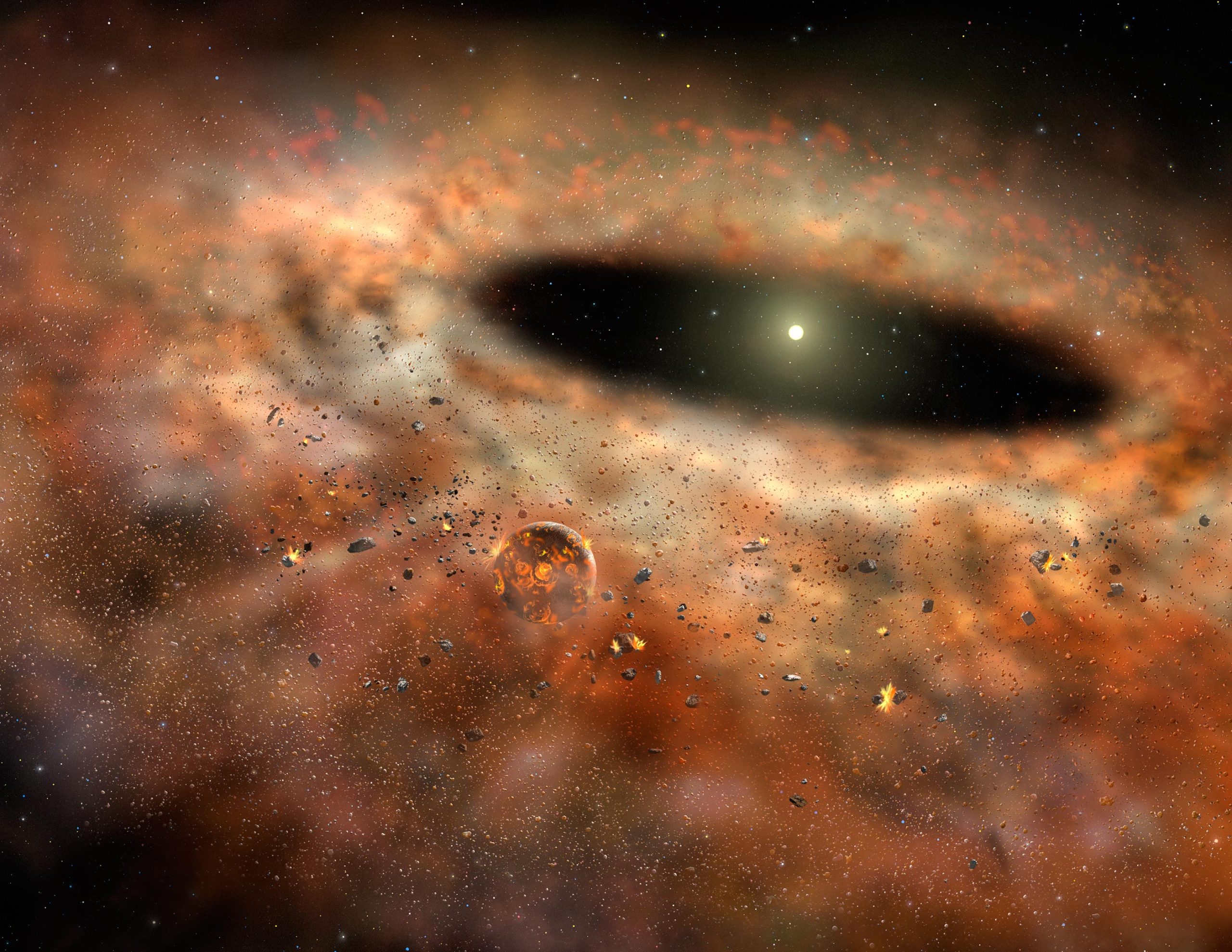
First seen by the NASA Infrared Astronomical Satellite in 1983, the dusty disk around a young sun-like star called TYC 8241 2652 has disappeared, leaving astronomers searching for possible solutions to the mystery.
Imagine if the rings of Saturn suddenly disappeared. Astronomers have witnessed the equivalent around a young sun-like star called TYC 8241 2652. Enormous amounts of dust known to circle the star are unexpectedly nowhere to be found.
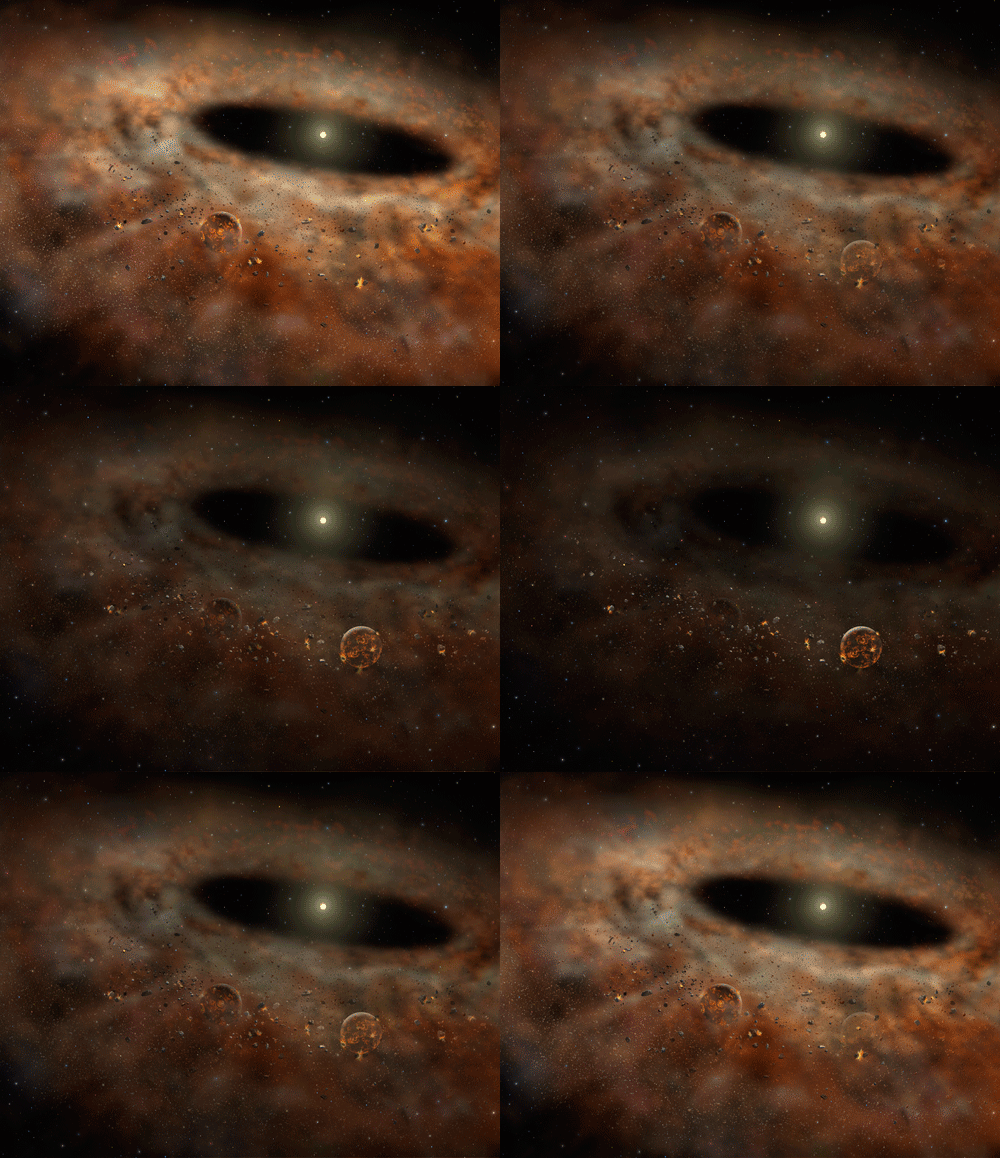
“It’s like the classic magician’s trick: now you see it, now you don’t. Only in this case we’re talking about enough dust to fill an inner solar system and it really is gone!” said Carl Melis of the University of California, San Diego, who led the new study appearing in the July 5 issue of the journal Nature.
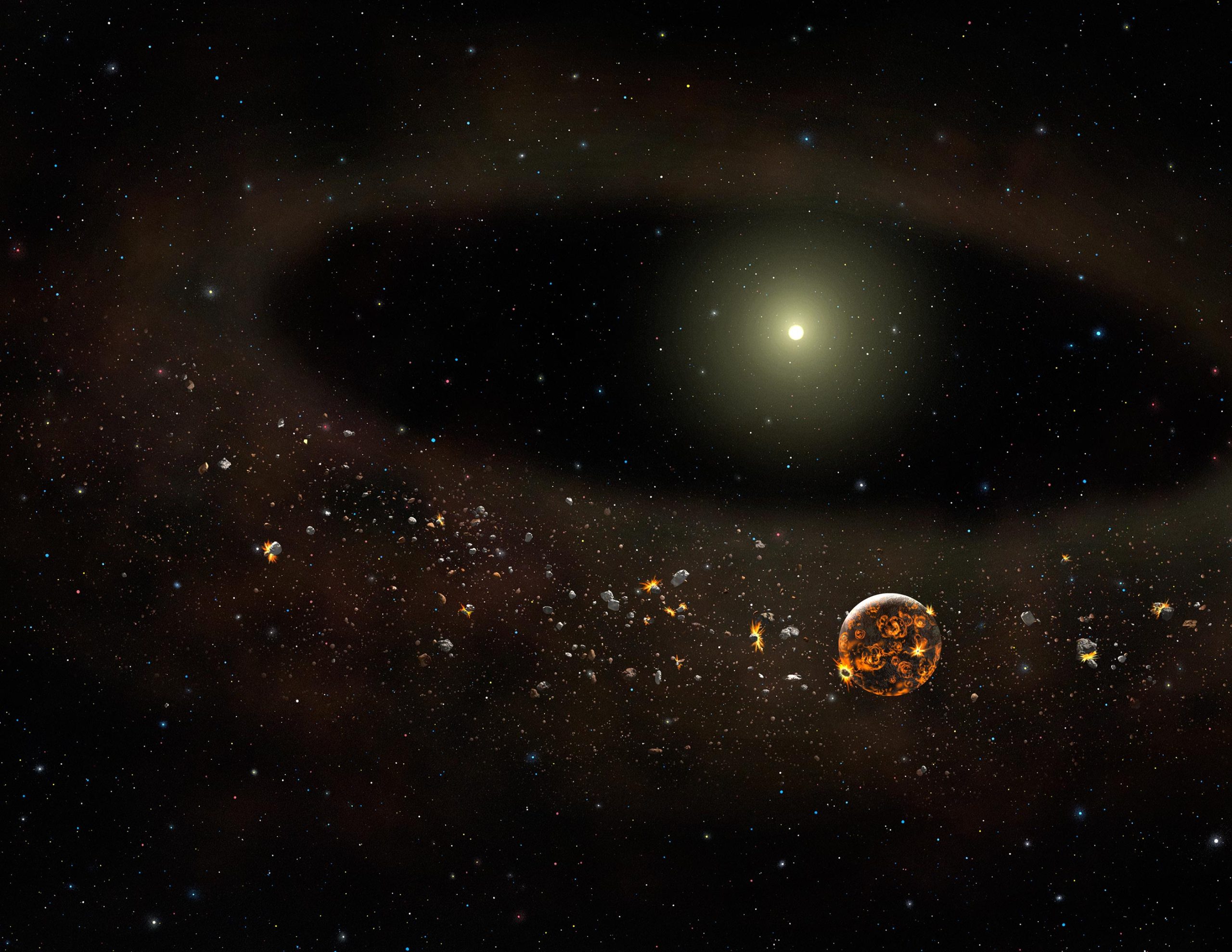
A dusty disk around TYC 8241 2652 was first seen by the NASA Infrared Astronomical Satellite (IRAS) in 1983, and continued to glow brightly for 25 years. The dust was thought to be due to collisions between forming planets, a normal part of planet formation. Like Earth, warm dust absorbs the energy of visible starlight and reradiates that energy as infrared, or heat, radiation.
The first strong indication of the disk’s disappearance came from images taken in January 2010 by NASA’s Wide-field Infrared Survey Explorer, or WISE. An infrared image obtained at the Gemini telescope in Chile on May 1, 2012, confirmed that the dust has now been gone for two-and-a-half years.
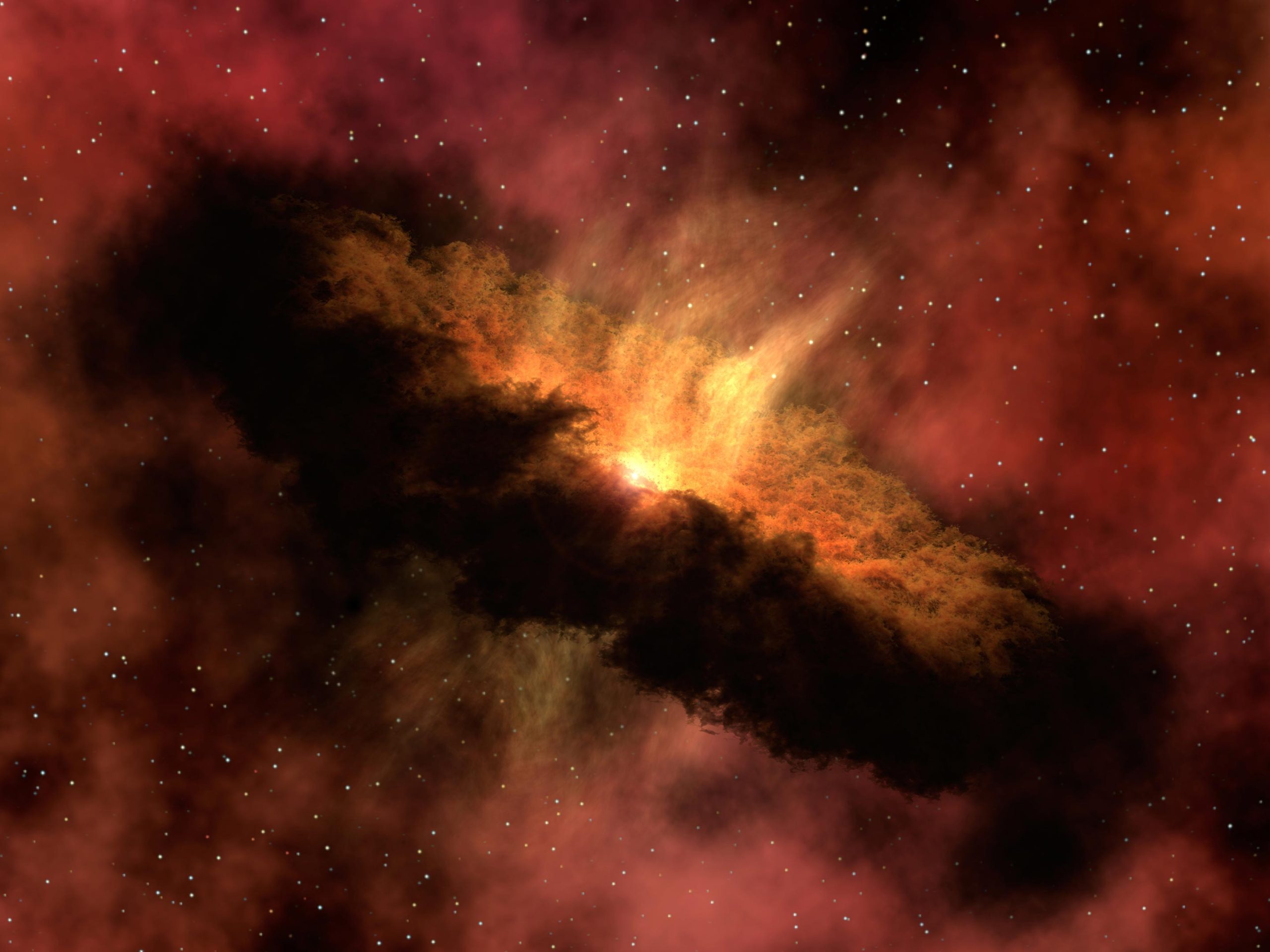
“Nothing like this has ever been seen in the many hundreds of stars that astronomers have studied for dust rings,” said co-author Ben Zuckerman of UCLA, whose research is funded by NASA. “This disappearance is remarkably fast even on a human time scale, much less an astronomical scale. The dust disappearance at TYC 8241 2652 was so bizarre and so quick, initially I figured that our observations must simply be wrong in some strange way.”
The astronomers have come up with a couple of possible solutions to the mystery, but they say none are compelling. One possibility is that gas produced in the impact that released the dust helped to quickly drag the dust particles into the star and thus to their doom. In another possibility, collisions of large rocks left over from an original major impact provide a fresh infusion of dust particles into the disk, which caused the dust grains to chip apart into smaller and smaller pieces.
The result is based upon multiple sets of observations of TYC 8241 2652 obtained with the Thermal-Region Camera Spectrograph on the Gemini South telescope in Chile; IRAS; WISE; NASA’s Infrared Telescope on Mauna Kea in Hawaii; the European Space Agency’s Herschel Space Telescope, in which NASA plays an important role; and the Japanese/European Space Agency AKARI infrared satellite.
Reference: “Rapid disappearance of a warm, dusty circumstellar disk” by Carl Melis, B. Zuckerman, Joseph H. Rhee, Inseok Song, Simon J. Murphy and Michael S. Bessell, 4 July 2012, Nature.
DOI: 10.1038/nature11210
NASA’s Jet Propulsion Laboratory, Pasadena, California, manages, and operated, WISE for NASA’s Science Mission Directorate. The spacecraft was put into hibernation mode after it scanned the entire sky twice, completing its main objectives. Edward Wright is the principal investigator and is at UCLA. The mission was selected competitively under NASA’s Explorers Program managed by the agency’s Goddard Space Flight Center in Greenbelt, Md. The science instrument was built by the Space Dynamics Laboratory in Logan, Utah. The spacecraft was built by Ball Aerospace & Technologies Corp. in Boulder, Colo. Science operations and data processing take place at the Infrared Processing and Analysis Center at the California Institute of Technology in Pasadena. Caltech manages JPL for NASA.
IRAS was executed jointly by the United States (NASA), the Netherlands, and the United Kingdom. The Infrared Telescope is operated and managed for NASA by the University of Hawaii, located in Honolulu.
Never miss a breakthrough: Join the SciTechDaily newsletter.
Follow us on Google and Google News.
2 Comments
I would like to know what phase the star or protostar happens to be in at the moment. If it’s a protostar in its early stage, a T-Tauri wind could account for the disappearance of the gas and dust in the disk.
Historically, Saturn’s rings seemed to disappear, when in fact, they were tilted so that the top and bottom of the rings were not visible. Only the edges would have been visible through the small telescopes of the times. Maybe that is what is happening here.