
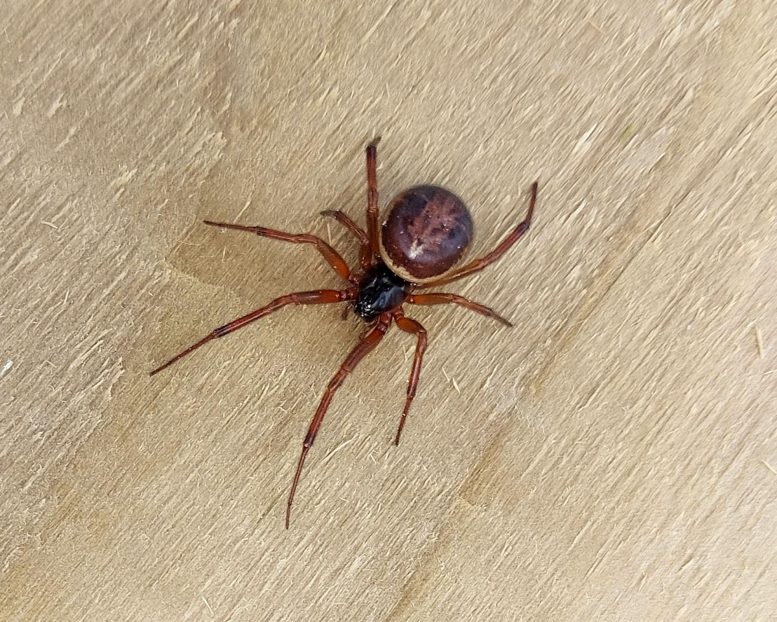
NUI Galway study confirms that the Noble False Widow spider does have public health implications.
- The research team established a DNA database to allow clinicians dealing with cases to confirm the species identity using genetic analysis.
- Epidemiology of bites reveals that almost all bites occurred in and around the home, and 88% of bites occurred when the victim was either asleep in bed or when the spider was trapped in clothing.
- In parts of Ireland and Britain, the False Widow spider has become one of the most common species of spiders found in and around urban habitats.
A team of scientists from NUI Galway have published a new study showing that Noble False Widow spiders can deliver a bite that requires hospitalization.
The threat posed by the Noble False Widow spider has been debated among spider and healthcare specialists for many years. This new study, published in the international medical journal Clinical Toxicology, confirms that some bite victims experience symptoms very similar to the true black widow spiders and some severe cases require hospitalization.
Invasion and Global Spread
Originating from Madeira and the Canary Islands, the Noble False Widow spider Steatoda nobilis, now has the potential to become one of the world’s most invasive species of spider. It was first documented in Britain over 140 years ago, but in recent decades the species has suddenly increased in numbers, significantly expanding its range and density.
The reasons behind this sudden expansion are not clear. Scientists have ruled out climate change as the likely cause but have suggested that a new genetic mutation within the species may have made Noble False Widows more adaptable to new environments. In addition, the species has benefited from an ever-increasing globalized economy, hitchhiking in containers and crates throughout the globe. Human movement has largely contributed to spreading this species throughout Europe, North Africa, West Asia, and parts of North and South America.
In parts of Ireland and Britain, it has become one of the most common species of spiders found in and around urban habitats. With the increase in False Widow spiders around homes, bites are becoming more prevalent, and scientists are now beginning to realize the full medical importance of these spiders.
Symptoms and Severity of Envenomation
Envenomation symptoms can be both localized and systemic, ranging from mild to debilitating pain and mild to intense swelling. Some victims have experienced tremors, reduced or elevated blood pressure, nausea, and impaired mobility. In rare instances, victims have developed minor wounds at the bite site or had to be treated for severe bacterial infections.
The research team at NUI Galway have established a DNA database to allow clinicians dealing with cases to confirm the species identity using genetic analysis. This is especially important when the spider has been squashed so an accurate identification of the spider can be made. The study also provides epidemiology of bites which reveals that almost all bites occurred in and around the home, and 88% of bites occurred when the victim was either asleep in bed or when the spider was trapped in clothing. The team are encouraging members of the public to email them at [email protected] if they think they may have been bitten.
Expert Insights and Public Advice
Dr. Michel Dugon, Head of the Venom Systems Lab at NUI Galway and senior author of the study, said: “In addition to their medically significant venom, Noble False Widows are extremely adaptable and competitive in the wild. Two decades ago, this species was almost unknown in Ireland, the UK or in continental Europe. We still have much to learn about its genetics, origin, behavior, and development. One thing is certain though: this species is here to stay, and we must learn how to live with it.”
Dr. John Dunbar, Postdoctoral Researcher at the Venom Systems Lab at NUI Galway and lead author of the study, said: “Speculations around the potential severity of the bites by the Noble False Widow have been debated for many years. We only compiled envenomation cases where we had a clear identification of the spider responsible for the bite. We had to rely on DNA extraction and genetic profiling to confirm some cases. We are encouraging people to capture a photograph of the spider immediately after being bitten. Our latest study confirms without a doubt that Noble False Widows can cause severe envenomations (the process by which venom is injected).
“This species is increasing its range and population density which will undoubtedly lead to an increase in bites (since submitting our study in March we have already received further confirmed bite cases). While most cases will have a mild outcome, we need to continue to closely monitor bites by the Noble False Widow to understand the potential range of symptoms and to treat severe cases when they occur.”
Aiste Vitkauskaite, MSc student in Toxicology at NUI Galway and joint lead in the study, said: “Approximately ten species of Irish spiders have fangs large enough to bite through human skin, yet over the past five years, we have never heard of anybody being bitten by any of the native species. Within the same period, we have recorded dozens of confirmed or probable False Widow bites. These spiders will become increasingly common and so will their bites.”
Professor Derek O’Keeffe, Professor of Medical Device Technology at NUI Galway and Consultant Physician, University Hospital Galway said: “This innovative research led by Dr Dugon and his team clearly demonstrates that Noble False Widow spider bites may result in significant patient morbidity that requires hospital care. This is important as previously we only had anecdotal evidence of its potential harms in victims and therefore this new evidence will allow the updating of clinical guidelines and protocols. These findings demonstrates the key importance of interdisciplinary collaboration between scientists and clinicians to improve patient care.”
Reference: “Bites by the noble false widow spider Steatoda nobilis can induce Latrodectus-like symptoms and vector-borne bacterial infections with implications for public health: a case series” by John P. Dunbar, Aiste Vitkauskaite, Derek T. O’Keeffe, Antoine Fort, Ronan Sulpice and Michel M. Dugon, 26 May 2021, Clinical Toxicology.
DOI: 10.1080/15563650.2021.1928165
Never miss a breakthrough: Join the SciTechDaily newsletter.
Follow us on Google and Google News.
2 Comments
I swear this article about false widow spiders was published perhaps a couple months ago? Had almost the same title and everything…
Indeed. It was published on May 31, 2021, as shown in the dateline at the top. I’m not sure where you saw it now, but it has not been republished (or even edited) at SciTechDaily.com.