
Close Menu
    Facebook X (Twitter) Instagram
    SciTechDaily
    • Biology
    • Chemistry
    • Earth
    • Health
    • Physics
    • Science
    • Space
    • Technology
    Facebook X (Twitter) Pinterest YouTube RSS
    SciTechDaily
    Home»Space»Perfectly Sideways Galaxy Spied by NASA’s Spitzer Space Telescope
    Space

    Perfectly Sideways Galaxy Spied by NASA’s Spitzer Space Telescope

    By Jet Propulsion LaboratoryAugust 8, 2019No Comments3 Mins Read
    Facebook Twitter Pinterest Telegram LinkedIn WhatsApp Email Reddit
    Share
    Facebook Twitter LinkedIn Pinterest Telegram Email Reddit
    Galaxy NGC 5866
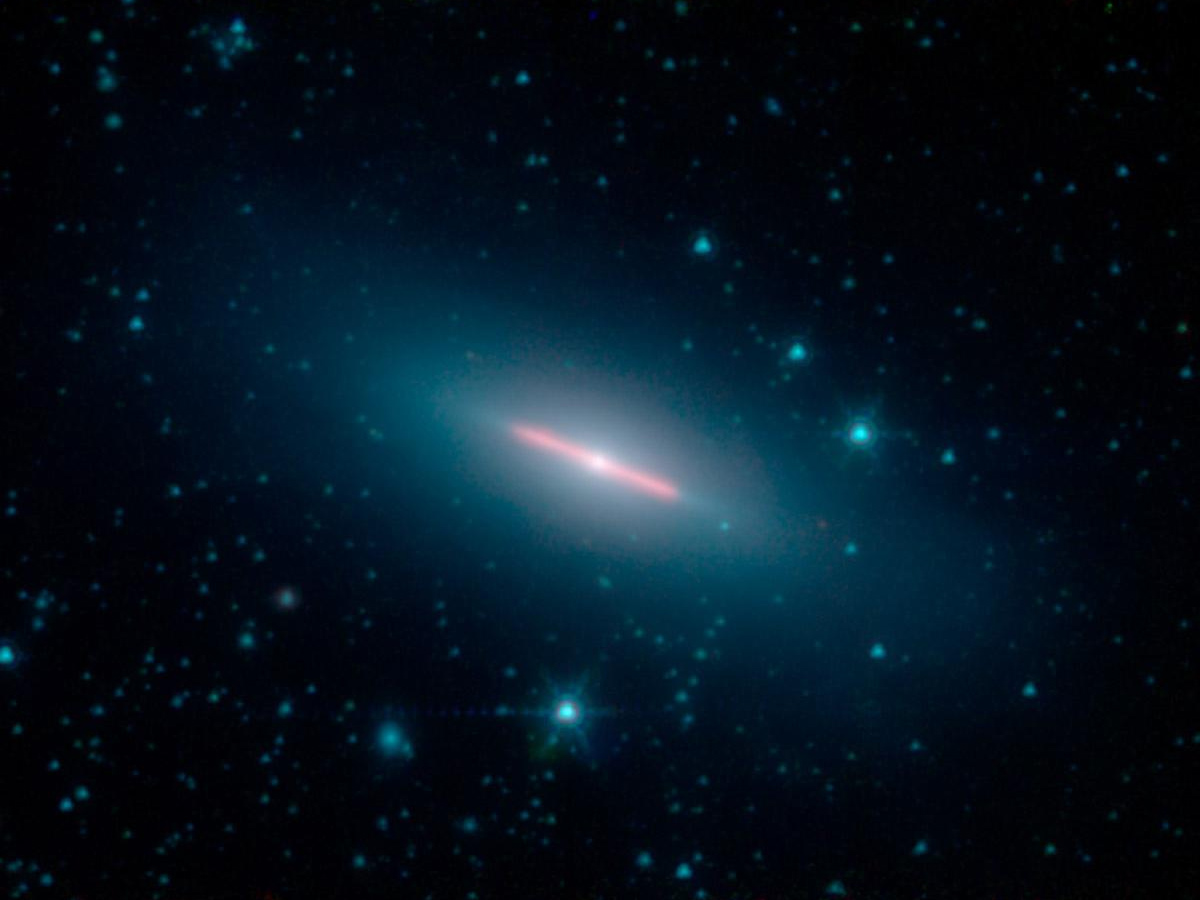
    Galaxy NGC 5866 lies 44 million light-years from Earth and has a diameter of roughly 60,000 light-years – a little more than half the diameter of our own Milky Way galaxy. From our viewpoint, NGC 5866 is oriented almost exactly edge-on, yielding most of its structural features invisible. Credit: NASA/JPL-Caltech

    This image from NASA’s Spitzer Space Telescope might look like a lightsaber floating in space, but it’s actually an entire galaxy viewed on its side.

    The long red beam in the center of the image is a galaxy called NGC 5866. It lies 44 million light-years from Earth and has a diameter of roughly 60,000 light-years – a little more than half the diameter of our own Milky Way galaxy. When we think of galaxies, we often imagine massive spiral arms or thick disks of dust. But not all galaxies are oriented face-on as viewed from Earth. From our viewpoint, we see only the edge of NGC 5866, so most of its structural features are invisible.

    Spitzer detects infrared light, and the red color here corresponds to an infrared wavelength typically emitted by dust. With a consistency similar to soot or thick smoke, the dust absorbs light from stars, then re-emits light at longer wavelengths, including in infrared. (Materials used to make blacklight posters work via this same mechanism, by absorbing ultraviolet light and re-emitting visible light.) The clean edges of the dust emission from NGC 5866 indicate that there is a very flat ring or disk of dust circling the outer region of the galaxy. Dust rings and disks sometimes form in the wake of galaxies merging, but this galaxy lacks any sign of twists or distortions in the ring that often appear as the result of a merger.

    Trying to learn about the history and shape of NGC 5866 is challenging due to its orientation. Our view of this galaxy is somewhat like our view of the Milky Way galaxy: Because Earth lies inside the Milky Way, we can see it only edge-on rather than face-on. But our proximity to the rest of the Milky Way has allowed astronomers to reconstruct what our galaxy would look like viewed face-on. Even the Sombrero galaxy, which is nearly edge-on as viewed from Earth, is tilted just enough to reveal a symmetric ring of dust around the galaxy’s center. If seen perfectly edge-on, the Sombrero might look a lot like NGC 5866.

    Spitzer took this image during its “cold” mission, which ended in 2009. The colors represent three infrared wavelengths captured by the Infrared Array Camera instrument. Blue light corresponds to Spitzer’s observations at a wavelength of 3.6 microns, produced mainly by stars; green corresponds to 4.5 microns; and red corresponds to 8 microns. In this image, the blue haze is produced by stars that make up most of the mass of the galaxy.

    Never miss a breakthrough: Join the SciTechDaily newsletter.
    Follow us on Google and Google News.

    JPL NASA Spitzer Space Telescope
    Share. Facebook Twitter Pinterest LinkedIn Email Reddit

    Related Articles

    Measuring the Expansion of Universe – A Newly Refined Value for the Hubble Constant

    New Image of the Helix Nebula Unraveling Into Space

    NASA Telescopes Spot Ultra-Distant Galaxy, MACS 1149-JD

    Smaller Than Earth, Exoplanet Candidate UCF-1.01 Is Just 33 Light-Years Away

    Patterns of Light Appear to be From the First Stars and Galaxies

    Sombrero Galaxy Exhibits Dual Characteristics

    Searching for “Bubbles” in the Milky Way

    New Images of Orion Nebula Show Young Stars Hidden in Gas and Dust Clouds

    NASA’s Spitzer Space Telescope Finds Solid Buckyballs in Space

    Leave A Reply Cancel Reply

    • Facebook
    • Twitter
    • Pinterest
    • YouTube

    Don't Miss a Discovery

    Subscribe for the Latest in Science & Tech!

    Trending News

    Popular Sugar-Free Sweetener Linked to Liver Disease, Study Warns

    What Is Hantavirus? The Deadly Disease Raising Alarm Worldwide

    Scientists Just Discovered How the Universe Builds Monster Black Holes

    Scientists Unveil New Treatment Strategy That Could Outsmart Cancer

    A Simple Vitamin May Hold the Key to Treating Rare Genetic Diseases

    Scientists Think the Real Fountain of Youth May Be Hiding in Your Gut

    Ravens Don’t Follow Wolves, They Predict Them

    This Common Knee Surgery May Be Doing More Harm Than Good

    Follow SciTechDaily
    • Facebook
    • Twitter
    • YouTube
    • Pinterest
    • Newsletter
    • RSS
    SciTech News
    • Biology News
    • Chemistry News
    • Earth News
    • Health News
    • Physics News
    • Science News
    • Space News
    • Technology News
    Recent Posts
    • Popular Supplement Ingredient Linked to Shorter Lifespan in Men
    • Scientists May Have Found a Way To Repair Nerve Damage in Multiple Sclerosis
    • GLP-1 Weight Loss Linked To Dramatically Lower Risk of Sleep Apnea, Kidney Disease and More
    • Scientists Uncover the Surprising Source of Strange Clouds Near the Milky Way’s Supermassive Black Hole
    • This Dazzling Green Snake Was Hiding in Plain Sight for Decades
    Copyright © 1998 - 2026 SciTechDaily. All Rights Reserved.
    • Science News
    • About
    • Contact
    • Editorial Board
    • Privacy Policy
    • Terms of Use

    Type above and press Enter to search. Press Esc to cancel.