
Close Menu
    Facebook X (Twitter) Instagram
    SciTechDaily
    • Biology
    • Chemistry
    • Earth
    • Health
    • Physics
    • Science
    • Space
    • Technology
    Facebook X (Twitter) Pinterest YouTube RSS
    SciTechDaily
    Home»Physics»Physicists Design New System for Stopping ‘Leaks’ in Quantum Computers
    Physics

    Physicists Design New System for Stopping ‘Leaks’ in Quantum Computers

    By Jim Shelton, Yale UniversityJuly 25, 2018No Comments3 Mins Read
    Facebook Twitter Pinterest Telegram LinkedIn WhatsApp Email Reddit
    Share
    Facebook Twitter LinkedIn Pinterest Telegram Email Reddit
    Stopping ‘Leaks’ in Quantum Computers
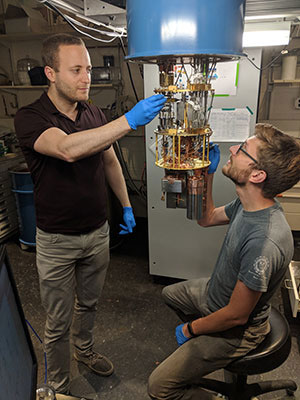
    Serge Rosenblum (left) and Philip Reinhold, co-lead authors of a new study on a fault-tolerant quantum error correction system.

    Yale researchers have designed a new system to keep tomorrow’s quantum computers from “leaking.”

    Large-scale quantum computers are still years away, but it is well known that they will need error correction. All of the components in a quantum computer are connected in a fragile, entangled state that allows a quantum computer to solve problems that would be impossible on a classical computer. Because of this entanglement, an error in just one bit of quantum information, called a qubit — or even the act of measuring a qubit — can collapse the entire enterprise.

    Unfortunately, researchers say, the process of correcting errors is itself faulty and can further corrupt the information contained in qubits.

    “The only way a quantum computer can work is if its ‘logical’ qubits are constantly monitored by ‘ancillary’ qubits, which ensure logical errors are detected and corrected before they can affect the computation,” said Yale postdoctoral associate Serge Rosenblum, co-lead author of a new study published in the journal Science.

    Ancillary qubits have already been shown to correct logical errors, but their use so far has been limited because errors in the ancillary qubits can “leak” to the logical qubits, thereby introducing more errors than they’re able to fix. The Yale team solves this problem by making its system fault tolerant — meaning that errors in the ancillary qubits aren’t able to leak over to the logical qubits. Fault tolerance prevents faulty ancillary qubits from collapsing the logical quantum state.

    “Using this method, the chance of catastrophic failure during error detection has been reduced by a factor of five,” Rosenblum said.

    Co-lead author Philip Reinhold, a graduate student, said fault tolerance “essentially amounts to making a robust system out of faulty parts. It opens the way for error correction that increases the fidelity of quantum computation.”

    Rosenblum and Reinhold work in the Yale lab of Robert Schoelkopf, the study’s principal investigator.

    Additional authors of the study are Liang Jiang and Luigi Frunzio from Yale and Mazyar Mirrahimi from the French Institute for Research in Computer Science and Automation.

    Yale researchers are at the forefront of efforts to develop the first fully useful quantum computers, which have the potential to solve certain problems orders of magnitude faster than today’s supercomputers. Yale’s quantum computing research includes pioneering work using superconducting circuits.

    This research was supported by the U.S. Army Research Office.

    Reference: “Fault-tolerant detection of a quantum error” by S. Rosenblum, P. Reinhold, M. Mirrahimi, Liang Jiang, L. Frunzio and R. J. Schoelkopf, 20 July 2018, Science.
    DOI: 10.1126/science.aat3996

    Never miss a breakthrough: Join the SciTechDaily newsletter.
    Follow us on Google and Google News.

    Quantum Computing Quantum Physics Qubits Yale University
    Share. Facebook Twitter Pinterest LinkedIn Email Reddit

    Related Articles

    Physicists Complete First End-to-End Quantum Data Transmission Done on Demand

    Yale Researchers Cross the “Break Even” Point in Preserving a Bit of Quantum Information

    Researchers Develop A Universal Quantum Gate

    Schrödinger’s Cat Gets a Second Box

    Researchers Develop a New Quantum Error Correcting Code

    Physicists Track Quantum Errors in Real Time

    Physicists Create and Control a Large Quantum Mechanical System Built on Photons

    Yale Physicists Observe Quantum Information While Preserving Its Integrity

    Quantum Bits Store Data for Nearly Two Seconds Using Laboratory Grown Diamonds

    Leave A Reply Cancel Reply

    • Facebook
    • Twitter
    • Pinterest
    • YouTube

    Don't Miss a Discovery

    Subscribe for the Latest in Science & Tech!

    Trending News

    Don’t Miss: August Brings Two Eclipses and the Perseid Meteor Shower

    Brain Waves Once Dismissed As Noise May Help Build Our Reality

    Perseverance Finds Organic Carbon Preserved Just Beneath the Martian Surface

    Tick Found in Austin Apartment Linked to Rare Relapsing Fever

    Ozempic Changes Your Body, but Does It Change Your Life? A New Study Suggests Not

    Ancient Super-Eruptions May Have Frozen Earth for Centuries

    A Common Sugar May Loosen Cancer Cells and Help Them Spread

    Scientists Discover a Major Brain Change That Starts Around Age 50

    Follow SciTechDaily
    • Facebook
    • Twitter
    • YouTube
    • Pinterest
    • Newsletter
    • RSS
    SciTech News
    • Biology News
    • Chemistry News
    • Earth News
    • Health News
    • Physics News
    • Science News
    • Space News
    • Technology News
    Recent Posts
    • Scientists Discover a Hidden Way T Cells Attack Leukemia
    • A Vegan Diet May Begin Changing Gene Activity in Just 4 Weeks
    • Belly Fat and Low Vitamin D May More Than Double the Risk of Early Death
    • Researchers Map the Hidden 3D Geometry of a Quantum Wavefunction
    • Lost in Space: Rare Cosmic Flare Exposes a Wandering Black Hole Far From Its Galaxy’s Center
    Copyright © 1998 - 2026 SciTechDaily. All Rights Reserved.
    • Science News
    • About
    • Contact
    • Editorial Board
    • Privacy Policy
    • Terms of Use

    Type above and press Enter to search. Press Esc to cancel.