
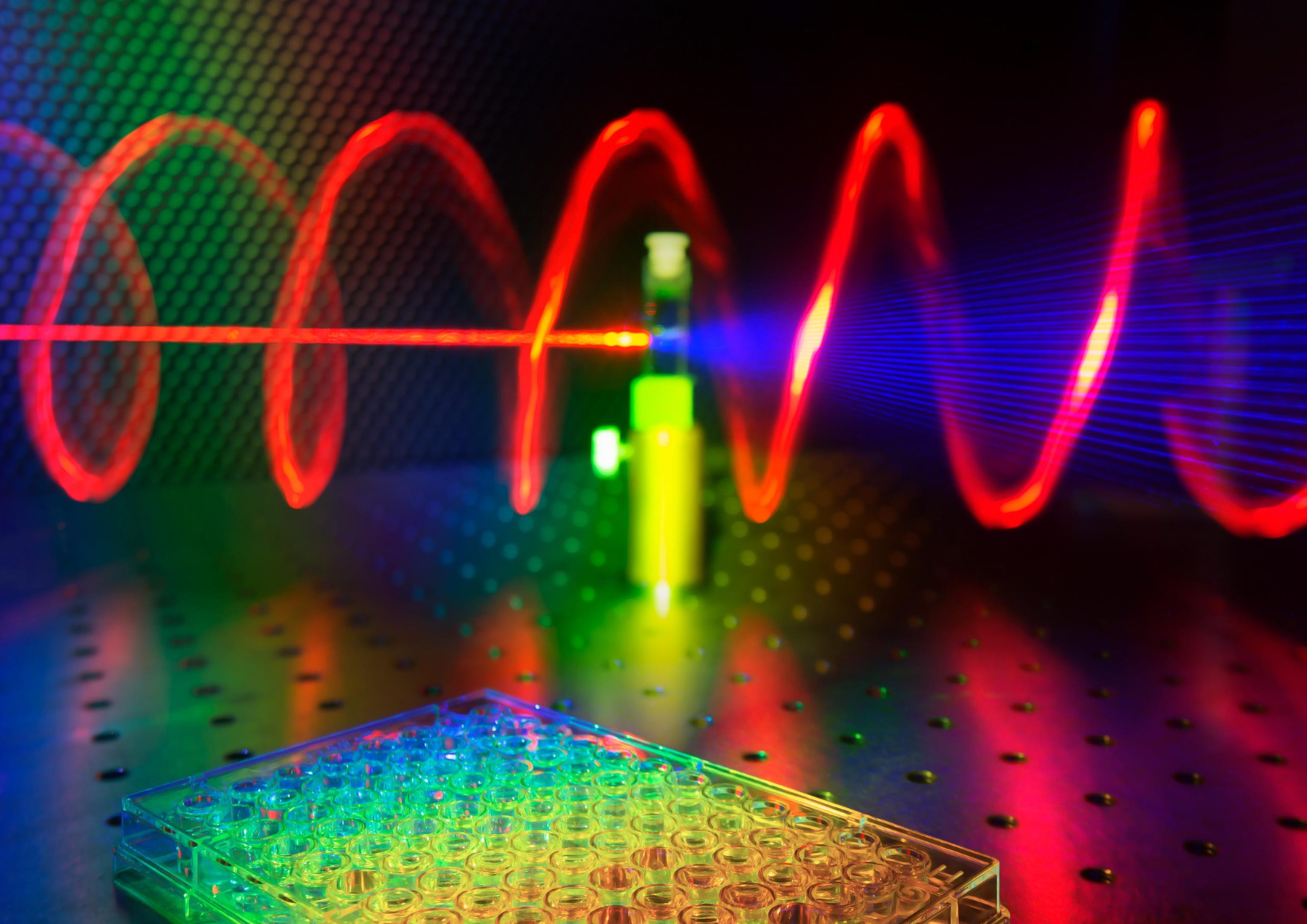
Keeping up with the first law of robotics: a new photonic effect for accelerated drug discovery.
A new photonic discovery in semiconducting nanohelices could revolutionize drug discovery by enabling the measurement of chirality in minute volumes, thus speeding up the development of critical pharmaceuticals.
A new photonic effect in semiconducting helical particles with nanoscale dimensions has been discovered by an international team of scientists led by researchers at the University of Bath. The observed effect has the potential to accelerate the discovery and development of life-saving medicines and photonic technologies.
In his Robot series, science-fiction writer Isaac Asimov imagined a future where robots grew into trustworthy companions for humans. These robots were guided by the laws of robotics, the first of which states that “a robot may not injure a human being or, through inaction, allow a human being to come to harm.” Thanks to the new photonic discovery, robots may get a chance to prevent humans from coming to harm in a very meaningful way – by greatly speeding up the development of important drugs, such as new antibiotics.
Currently, the World Health Organisation regards antibiotic resistance (the growing ineffectiveness of drugs currently on the market) as one of the top 10 threats to humanity. Moreover, globalization coupled with human encroachment into wildlife habitats increases the risk of new infectious diseases emerging. It is widely recognized that the cost of discovering and development new drugs for these and other conditions using today’s technology is unsustainable. The need for pharmaceutical research to be accelerated has never been more pressing and it would benefit hugely from the help of artificial intelligence (AI).
The Role of High-Throughput Screening in Modern Medicine
Bath Physics professor Ventsislav Valev, who headed the research, said: “Although we are a long way still from Asimov’s positronic robot brains, our latest finding does have the potential to link AI algorithms that analyze chemical reactions and robotic arms that prepare chemical mixtures – a process known as high-throughput screening.”
High-throughput screening (HTS) is an experimental method that uses robots to discover new drugs. Some labs have adopted it already, to help them analyze vast libraries of molecules. In the future, however, discovering new drugs could happen entirely through HTS. Using this method, robots simultaneously operate a large number of syringes, preparing thousands of chemical mixtures that are then robotically analyzed. The results are fed back to AI algorithms, which then determine what mixtures to prepare next, and so on until a useful drug is discovered.
Advancements in Measuring Chirality at the Nanoscale
The analytical step is key, since without it, the robots cannot know what they have prepared.
HTS happens on microplates (or tablets) that are about the size of a chocolate bar. Each tablet contains wells into which the chemical mixtures are poured. The more wells found on a tablet, the more chemicals can be analyzed in one hit. But though a modern tablet can host thousands of wells, the size of the table does not change.
“To meet the requirements of the emerging robotized chemistry, wells are getting really tiny – too small for current analytical methods,” said Professor Valev. “So, fundamentally new methods are needed to analyze would-be drugs.
“Currently, most new drugs that are entering the market and the majority of old drugs are chiral (their chemical formula lacks mirror symmetry). Therefore it is especially important to be able to measure chirality in tiny volumes of less than 1 mm3 which is about the size of a cube with sides of the thickness of a credit card.”
The effect discovered by the researchers allows chirality to be measured in volumes that are 10,000 times smaller than 1 mm3.
Innovations in Semiconducting Nanohelices
“We have used a very exciting new material developed by our colleagues at the University of Michigan in the US, led by Professor Nicholas Kotov,” explained Professor Valev. “It’s a biomimetic structure (i.e. one that simulates biological phenomena) that chemically assembles into semiconducting helices, at the nanoscale, similarly to the way proteins assemble.”
Professor Kotov said: “Being illuminated with red light, the small semiconductor helices generate new light that is blue and twisted. The blue light is also emitted in a specific direction, which makes it easy to collect and analyze. The trifecta of unusual optical effects drastically reduce the noise that other nanoscale molecules and particles in biological fluids may cause.”
Professor Valev added: “This means that by carefully measuring the blue light, we can ascertain the direction of twist (or chirality) of the structures we’re studying.”
Future Implications and Technological Development
The twist of the nanohelices can change dramatically depending on the kind of biomolecules that were present when these helixes formed, providing a wealth of information about the biological samples.
“Our results open the way for measuring chirality in volumes potentially 10-million times smaller than 1 mm3. Although the structures that we measured so far are much larger than typical pharmaceuticals, we have proven that the physical effect is real, so in principle, applications to molecules and especially drugs are now only a question of technological development. Our next step is to seek funding for this development,” said Professor Valev.
PhD student Lukas Ohnoutek, also involved in the research, said: “In nanotechnology, one of the big challenges is to be able to see the properties of tiny things. Nowadays, this is easy for stationary objects but it’s still hard for an object that freely floats in a liquid.
“It has been extremely gratifying to reduce our volume of study so successfully – we now focus light to a spot that would be invisible to most people’s eyes. And within that volume, we can determine the direction of twist of helices that are much smaller still.”
Reference: “Third-harmonic Mie scattering from semiconductor nanohelices” by Lukas Ohnoutek, Ji-Young Kim, Jun Lu, Ben J. Olohan, Dora M. Răsădean, G. Dan Pantoș, Nicholas A. Kotov and Ventsislav K. Valev, 13 January 2022, Nature Photonics.
DOI: 10.1038/s41566-021-00916-6
The research is published in the journal Nature Photonics. It was funded by The Royal Society, the Science and Technology Facilities Council (STFC) and the Engineering and Physical Science Research Council (EPSRC).
Never miss a breakthrough: Join the SciTechDaily newsletter.
Follow us on Google and Google News.
2 Comments
Quantum physics, nano particles, lights of different frequencies… It sounds like so-called alternative medicine, be careful.
And not one mention that the way medicine is used in modern times is the unsustainable part. Yay at brute forcing discovery, but it won’t matter a bit if we don’t change anything else…