

Researchers have, for the first time, described the properties of one-dimensional anyons and outlined how these particles can be observed using existing experimental setups.
Physicists have traditionally classified all elementary particles in our three-dimensional universe into two groups: bosons and fermions. Bosons typically include force-carrying particles such as photons, while fermions make up matter, including electrons, protons, and neutrons.
In lower-dimensional systems, however, this clear distinction begins to break down. Since the 1970s, scientists have predicted the existence of a third category of particles that fall between bosons and fermions, known as anyons. These particles were first observed experimentally in 2020 in ultra-thin, strongly magnetized semiconductor systems.
Building on that work, researchers from the Okinawa Institute of Science and Technology (OIST) and the University of Oklahoma have now identified a one-dimensional system where anyons can exist and analyzed their theoretical properties.
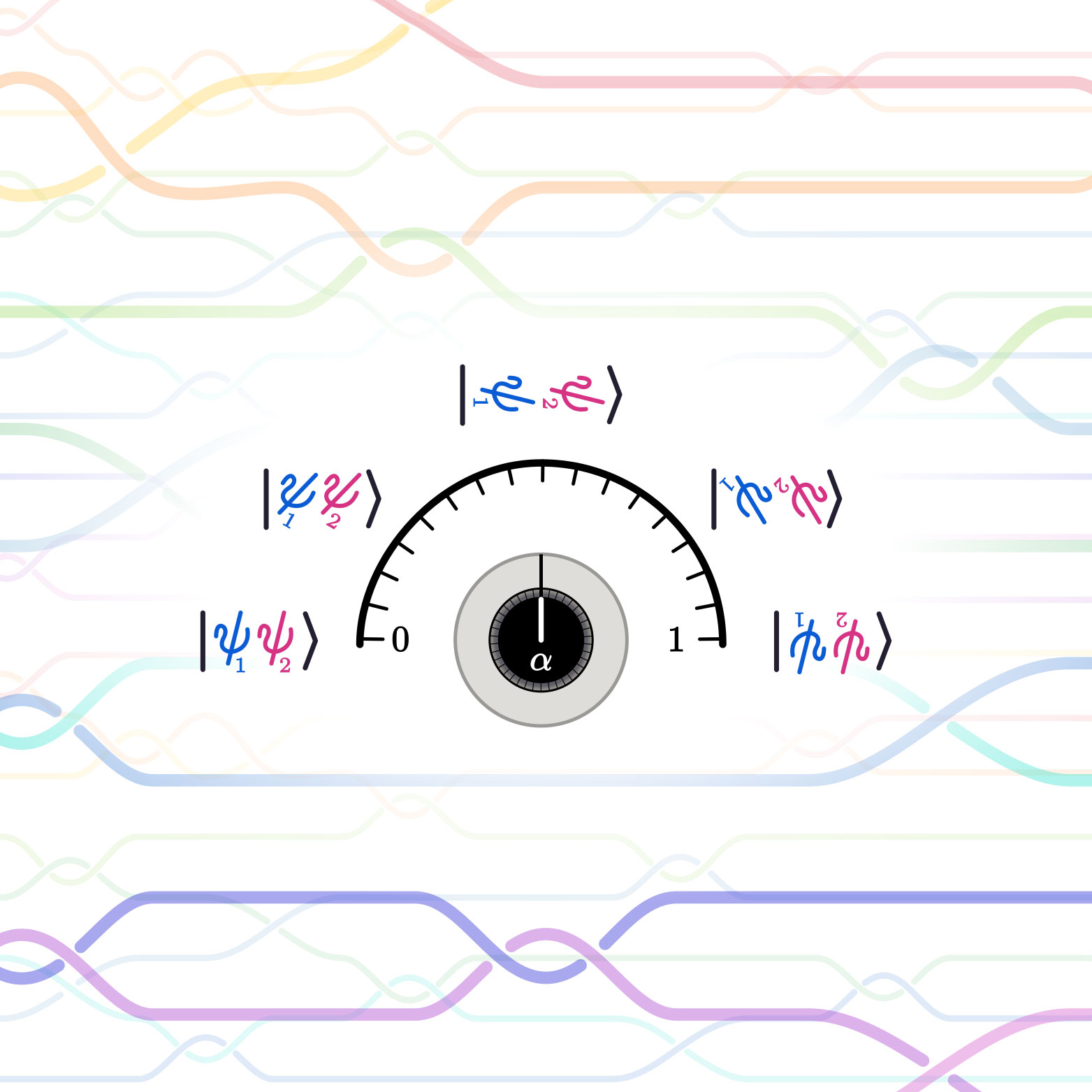
Advances in controlling individual particles in ultracold atomic systems have made it possible to explore these ideas experimentally. “Every particle in our universe seems to fit strictly into two categories: bosonic or fermionic. Why are there no others?” asks Professor Thomas Busch of the Quantum Systems Unit at OIST. “With these works, we’ve now opened the door to improving our understanding of the fundamental properties of the quantum world and it’s very exciting to see where theoretical and experimental physics take us from here.”
Breaking the boson/fermion binary
The traditional classification depends on how identical particles behave when they exchange positions. In three-dimensional space, experiments show only two possible outcomes: either the system remains unchanged, as with bosons, or it changes sign, as with fermions.
This behavior is rooted in the quantum principle of indistinguishability. Unlike classical objects, identical quantum particles cannot be labeled or distinguished from one another. When two such particles swap positions, the system must remain physically the same. As Raúl Hidalgo-Sacoto, a PhD student in the OIST unit, explains: “Because this exchange is equivalent to doing nothing, the mathematical statistics governing the event, known as the exchange factor, must obey a simple rule: the square of the exchange factor must be equal to 1. The only two numbers that satisfy this rule are +1 and -1. That’s why all particles must be, respectively, bosons, for which the factor is 1, or fermions, for which the factor is -1.”
This distinction leads to very different physical behaviors. Bosons tend to act collectively, as seen in lasers or Bose-Einstein condensates, where particles share the same state. Fermions, in contrast, cannot occupy the same state, a property that underlies the structure of atoms and the periodic table.
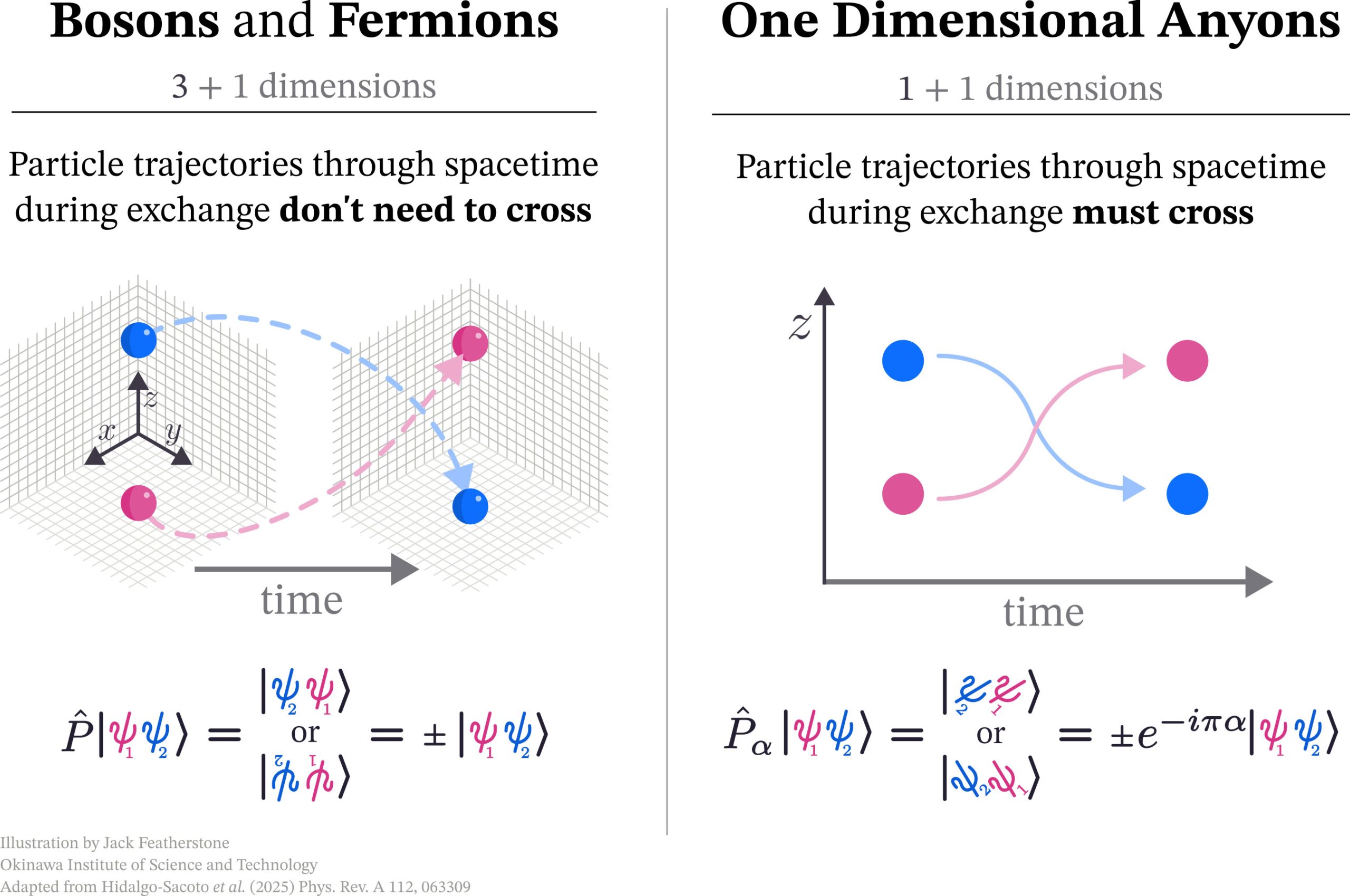
In lower dimensions, the situation changes. Particles have fewer ways to move around each other, and exchanges become tied to their paths through space and time. This means the system can no longer return to an identical state after particles swap. Hidalgo-Sacoto explains: “In lower dimensions, this exchange is no longer topologically equivalent to doing nothing. To satisfy the law of indistinguishability, we need exchange factors over a continuous range to account for the exchange, dependent on the exact twists and turns of the paths.”
This allows for a new class of particles with exchange factors that are not limited to +1 or -1. These particles are called anyons.
A recipe for adjustable anyons
In their recent work, Hidalgo-Sacoto and colleagues demonstrate that in one-dimensional systems, this expanded range of behavior persists and can even be tuned. In one dimension, particles cannot move around each other and must instead pass through one another, which changes how their exchange is defined.
The researchers show that the exchange factor in this case is directly linked to the strength of interactions between particles at short distances. This relationship allows scientists to adjust the exchange behavior in a controlled way, opening up new possibilities for experiments.
“We’ve identified not only the possibility of the existence of one-dimensional anyons, but we’ve also shown how their exchange statistics can be mapped, and, excitingly, how their nature can be observed through their momentum distribution,” summarizes Prof. Busch. “The experimental setups necessary for making these observations already exist. We’re thrilled to see what future discoveries are made in this area, and what it can tell us about the fundamental physics of our universe.”
References: “Universal momentum tail of identical one-dimensional anyons with two-body interactions” by Raúl Hidalgo-Sacoto, Thomas Busch and D. Blume, 11 December 2025, Physical Review A.
DOI: 10.1103/zf6z-2jjs
“Two identical one-dimensional anyons with zero-range interactions: Exchange statistics, scattering theory, and anyon-anyon mapping” by Raúl Hidalgo-Sacoto, Thomas Busch and D. Blume, 11 December 2025, Physical Review A.
DOI: 10.1103/h2vs-ll9d
Funding: Okinawa Institute of Science and Technology Graduate University, U.S. National Science Foundation
Never miss a breakthrough: Join the SciTechDaily newsletter.
Follow us on Google and Google News.
8 Comments
Pah, that’s nothing – my wife says I’ve been one-dimensional for years!
Physicists, what do they know? !
The formula connecting mass, energy and space is the following
S( The magnetic field Continuously radiating from every Atom and every atom Is in a constant state of static equilibrium) =e( dipole component potons) x c^3
The speed of light cube because it’s a growing volume expansion
No time travel butt i think it minuten be the key to fast space travl
Anyonic gates and braiding of 3 bit qubits into transfer of information between timing and trajectory and pending calculation, are three states that interact and exchange template information as time slows down in 1st perspective as you approach an event horizon.. lols at Ai, only knew of Anions, before I coined the term for anyon gating in the brain. It’s disturbing how, the internet has effectively forgotten my work upon this subject, and I’m still unemployed, view my public work on tictok @ danielnittmann775.
You all can continue using my inspiration, I’m glad I inspired.
But nobody yet believes in time dialation. Or time traveling content..
Not everyone. I dont just believe. I know
🤣
No time travel butt i think it minuten be the key to fast space travl
I can already see the rightwingers going nuts! There are only two options and they’re assigned at particle birth 🤣