

A study finds that shelterbelts in Japan’s wet farmlands boost edge-dwelling birds but reduce grassland species by about 74 percent, with populations recovering roughly one kilometer away, revealing a conservation trade-off.
A team of researchers investigated how shelterbelts shape bird communities in an agricultural wetland landscape along the western coast of central Japan. Shelterbelts are rows of trees planted as windbreaks, but the study found they do not automatically increase bird diversity in these environments.
The findings were published in the Journal of Environmental Management.
Tree planting and hedgerow restoration are widely promoted through agri-environmental policies as ways to boost biodiversity in farmland. Because woody features can provide nesting sites, food sources, and shelter, they are often assumed to benefit wildlife. However, much of the supporting research comes from croplands and grasslands in Europe and North America. Far less is known about their effects in wet farmed systems such as rice paddies, which dominate much of Asia and function as important habitats for wetland-dependent species. These wetlands are declining worldwide, increasing the stakes for effective conservation.
“The central question of our study is, ‘Do shelterbelts and other woody linear features benefit all farmland birds equally in agricultural wetland landscapes, or do they create trade-offs by disadvantaging species that depend on open habitats?’” said corresponding author Masumi Hisano, assistant professor at Hiroshima University’s Graduate School of Advanced Science and Engineering.
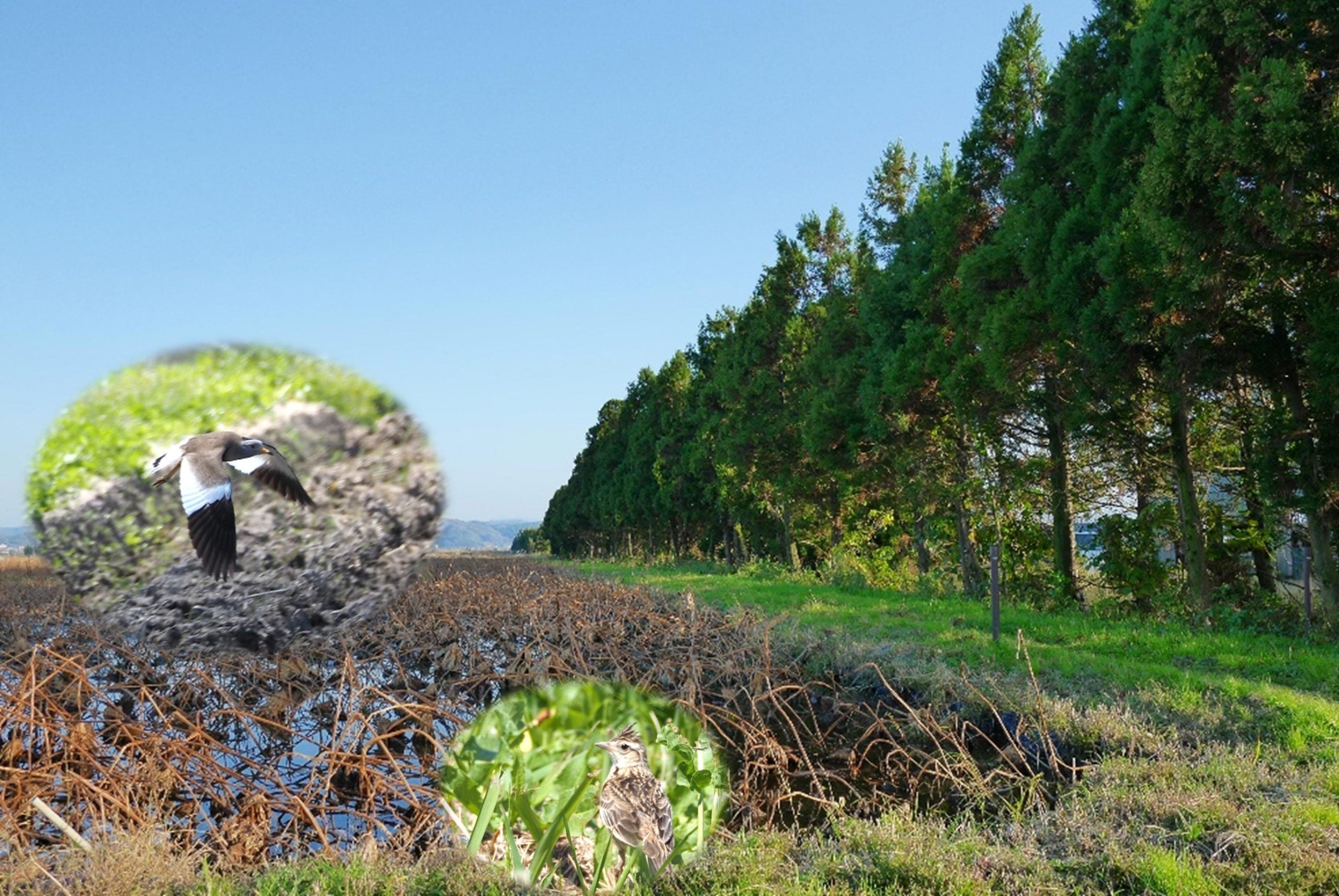
The issue carries broader implications because agricultural wetlands serve a dual role. They produce food, but they also act as substitute wetlands for many birds, including migratory species that travel along major flyways. If planting shelterbelts reduces the suitability of open farmland for grassland and wetland birds, then well-intentioned conservation measures could unintentionally harm the very biodiversity they are meant to support.
Small tweaks, big consequences
The team focused their study on the fields around Lake Kahokugata in central Japan. The lands there consist of mostly of rice paddies, but also lotus fields, cultivated croplands, and pastures. The Lake Kahokugata area experiences strong winds and storms during the winter. Shelterbelts are planted along agricultural fields there to protect croplands from wind damage.
This area is an important stopover site for migratory birds along the East Asian-Australasian Flyway. Wintering birds spend the cold months there and breeding species use the area during the summer. Almost 300 different bird species have been recorded in the area. The team conducted their bird surveys in February and March 2021 and June 2023. They used a point-count method to collect the bird data.
The bird surveys showed that in wet-farmed landscapes, shelterbelts create a clear trade-off. They support bush- and edge-associated birds, but at the same time, they strongly reduce the abundance of grassland species and diversity of wetland species that require large, open spaces.
“We found that the abundance of grassland birds was more than 70 percent lower at sites next to shelterbelts compared with open sites located about one kilometer away,” said Hisano. This shows that even narrow, linear tree features can dramatically alter what birds can live in a landscape.
“A useful way to think about this is that shelterbelts act like ecological walls,” said Hisano. The shelterbelts create habitat for some species, but for others, particularly birds that nest and forage in open ground, they shrink the usable landscape and increase exposure to predators. “Our study provides clear, quantitative evidence that small-scale landscape features can have large ecological consequences, directly relevant to land-use planning and environmental management,” said Hisano.
Spatial design guides outcomes
The team explains that rather than asking whether woody vegetation is “good” or “bad,” their study shows that the spatial design and placement of trees matter. “Biodiversity-friendly farmland management must balance structural complexity with the ecological needs of open-habitat species, especially in landscapes where wetlands have already been heavily modified by humans,” said Hisano. The team considers their management-focused message to be crucial because many current agri-environmental schemes promote tree planting without considering how it reshapes entire bird communities.
Looking ahead, the team notes that future research needs to examine how different shelterbelt designs, such as width, height, spacing, and configuration, and tree species composition and diversity, affect wildlife across seasons and regions. They also want to better understand how birds respond indirectly through changes in predator activity and habitat connectivity.
“Ultimately, our goal is to help design evidence-based agri-environmental policies that work in wet-farmed landscapes worldwide. Rather than promoting a single solution, such as planting more trees everywhere, we aim to support landscape-level planning that combines open habitats and woody features in ways that sustain diverse bird communities and the ecosystem functions they provide. By doing so, agricultural wetlands can remain productive for people while continuing to serve as vital habitats for wildlife in a rapidly changing world,” said Hisano.
Reference: “Shelterbelts support edge birds but limit grassland and wetland specialists in agricultural landscape” by Masumi Hisano, Shota Deguchi, Wenhuan Xu, Xike Xiao, Keinosuke Sannoh, Xinli Chen and Ken Motomura, 8 January 2026, Journal of Environmental Management.
DOI: 10.1016/j.jenvman.2026.128583
The research was supported by Kahokugata Lake Institute and the Japan Society for the Promotion of Science KAKENHI.
Never miss a breakthrough: Join the SciTechDaily newsletter.
Follow us on Google and Google News.