
Close Menu
    Facebook X (Twitter) Instagram
    SciTechDaily
    • Biology
    • Chemistry
    • Earth
    • Health
    • Physics
    • Science
    • Space
    • Technology
    Facebook X (Twitter) Pinterest YouTube RSS
    SciTechDaily
    Home»Science»Polarization Through Perception: How Political Partisanship Affects First Impressions
    Science

    Polarization Through Perception: How Political Partisanship Affects First Impressions

    By PLOSJanuary 1, 2023No Comments3 Mins Read
    Facebook Twitter Pinterest Telegram LinkedIn WhatsApp Email Reddit
    Share
    Facebook Twitter LinkedIn Pinterest Telegram Email Reddit
    Republican Democrat Politics
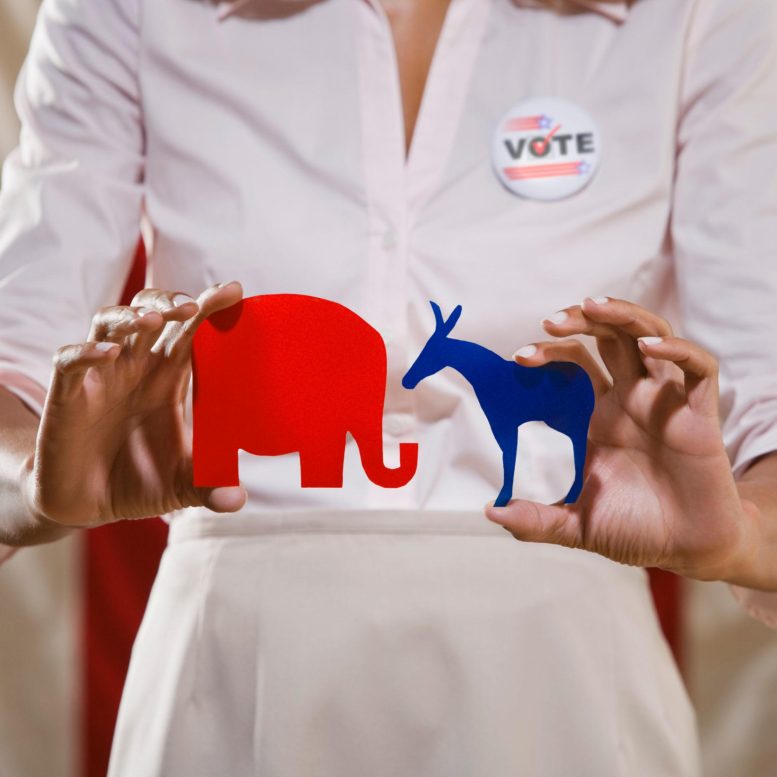
    The research suggests that polarization based on political partisanship can appear in basic aspects of perception.

    Disclosing the political partisanship of subjects in photos significantly impacted impressions of their likeability and competence.

    The results of an experimental study conducted by Brittany Cassidy of the University of North Carolina at Greensboro and her colleagues showed that participants’ initial impressions of photos of strangers’ faces were significantly affected by whether or not the stranger’s political affiliation was disclosed. The study was recently published in the journal PLOS ONE.

    Previous studies have suggested that political polarization is increasing in the United States, causing conflicts between individuals with different political beliefs. This polarization could potentially affect how people perceive each other, such as their initial impressions based on facial appearance. While research has looked at the relationship between facial impressions and interpersonal behavior, few studies have examined the connection between facial impressions and political party affiliation.

    To explore how political partisanship might influence face impressions, Cassidy and colleagues conducted two experiments involving 275 undergraduate college students.

    In the first experiment, participants were presented with pairs of photos of two unfamiliar people’s faces and asked to select which was more likable and competent. In some cases, photos were labeled according to the subjects’ true political partisanship—Republican or Democratic. In other cases, these labels were inaccurate or omitted, but the researchers were aware of all subjects’ true political ideologies.

    Results from the first experiment showed that participants’ first impressions of the faces were more strongly affected by disclosed political partisanship—even if it was inaccurate—than non-disclosed partisanship.

    In the second experiment, participants evaluated the likeability of faces before and after political partisanship was disclosed. The researchers found that participants changed their impressions post-disclosure based on their own political partisanship.

    Influence of Perceived Partisan Threat

    In both experiments, the researchers also evaluated each participant’s level of perceived partisan threat; they found that the effects of disclosure on face impressions were particularly pronounced for people with stronger perceptions of partisan threat.

    These results suggest that polarization based on political partisanship can appear in basic aspects of perception. The researchers suggest their findings—and future research in this area—could help inform efforts to foster more equitable interactions between people of differing political ideologies.

    Reference: “Disclosing political partisanship polarizes first impressions of faces” by Brittany S. Cassidy, Colleen Hughes and Anne C. Krendl, 9 November 2022, PLOS ONE.
    DOI: 10.1371/journal.pone.0276400

    The study was funded by the National Institutes of Health and the National Center for Advancing Translational Sciences. The authors declare no conflicts of interest. The funders had no role in study design, data collection and analysis, decision to publish, or preparation of the manuscript.

    Never miss a breakthrough: Join the SciTechDaily newsletter.
    Follow us on Google and Google News.

    Politics Psychology University of North Carolina
    Share. Facebook Twitter Pinterest LinkedIn Email Reddit

    Related Articles

    Rational Riddles: Unpacking the Puzzle of Political Polarization

    Polarization or Paradox? MIT Study Unveils the True Tendencies of American News Consumption

    The Generosity Divide: How Political Views Shape Altruistic Behavior

    Guns Over Masks: Avoiding COVID-19 Precautions Linked to Increased Firearm Purchases

    Science Reveals: Why Doesn’t Everybody View the World the Same Way?

    COVID-19 Pandemic Burdens May Contribute to Outbreaks of Violent Protest and Antigovernment Sentiment

    Study Finds Root of Intense Political Partisanship on Both Left and Right

    Protective Factors Are Important in Preventing Violence in Veterans

    Scientific Study Proves Blogging Therapeutic for Teens

    Leave A Reply Cancel Reply

    • Facebook
    • Twitter
    • Pinterest
    • YouTube

    Don't Miss a Discovery

    Subscribe for the Latest in Science & Tech!

    Trending News

    Millions Take These IBS Drugs, But a New Study Finds Serious Risks

    Scientists Unlock Hidden Secrets of 2,300-Year-Old Mummies Using Cutting-Edge CT Scanner

    Bread Might Be Making You Gain Weight Even Without Eating More Calories

    Scientists Discover Massive Magma Reservoir Beneath Tuscany

    Europe’s Most Active Volcano Just Got Stranger – Here’s Why Scientists Are Rethinking It

    Alzheimer’s Symptoms May Start Outside the Brain, Study Finds

    Millions Take This Popular Supplement – Scientists Discover a Concerning Link to Heart Failure

    The Universe Is Expanding Too Fast and Scientists Can’t Explain Why

    Follow SciTechDaily
    • Facebook
    • Twitter
    • YouTube
    • Pinterest
    • Newsletter
    • RSS
    SciTech News
    • Biology News
    • Chemistry News
    • Earth News
    • Health News
    • Physics News
    • Science News
    • Space News
    • Technology News
    Recent Posts
    • U.S. Waste Holds $5.7 Billion Worth of Crop Nutrients
    • Scientists Say a Hidden Structure May Exist Inside Earth’s Core
    • Doctors Surprised by the Power of a Simple Drug Against Colon Cancer
    • Why Popular Diabetes Drugs Like Ozempic Don’t Work for Everyone: The “Genetic Glitch”
    • Scientists Create Improved Insulin Cells That Reverse Diabetes in Mice
    Copyright © 1998 - 2026 SciTechDaily. All Rights Reserved.
    • Science News
    • About
    • Contact
    • Editorial Board
    • Privacy Policy
    • Terms of Use

    Type above and press Enter to search. Press Esc to cancel.