
Close Menu
    Facebook X (Twitter) Instagram
    SciTechDaily
    • Biology
    • Chemistry
    • Earth
    • Health
    • Physics
    • Science
    • Space
    • Technology
    Facebook X (Twitter) Pinterest YouTube RSS
    SciTechDaily
    Home»Biology»Of Ants and Men: Ant Behavior and Political Polarization May Be Driven by the Same Processes
    Biology

    Of Ants and Men: Ant Behavior and Political Polarization May Be Driven by the Same Processes

    By Princeton UniversityJanuary 9, 20202 Comments6 Mins Read
    Facebook Twitter Pinterest Telegram LinkedIn WhatsApp Email Reddit
    Share
    Facebook Twitter LinkedIn Pinterest Telegram Email Reddit
    Ant Close Up
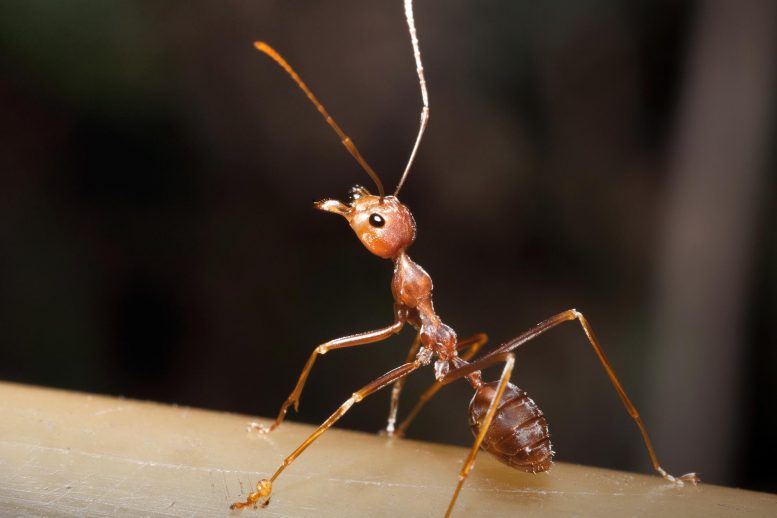
    Ant behavior theorists Chris Tokita, an ecology and evolutionary biology graduate student, and his adviser Corina Tarnita found that division of labor and political polarization — two social phenomena not typically considered together — may be driven by the same processes.

    Princeton researchers find that division of labor and political polarization may be driven by the same processes in ant societies.

    Could the division of labor in an anthill be driven by the same social dynamics governing the gap between liberals and conservatives? That was the surprising question tackled by Princeton biologists Chris Tokita and Corina Tarnita.

    “Our findings suggest that division of labor and political polarization — two social phenomena not typically considered together — may actually be driven by the same process,” said Tokita, a graduate student in ecology and evolutionary biology. “Division of labor is seen as a benefit to societies, while political polarization usually isn’t, but we found that the same dynamics could theoretically give rise to them both.”

    Political Polarization Might Mirror Ant Behavior
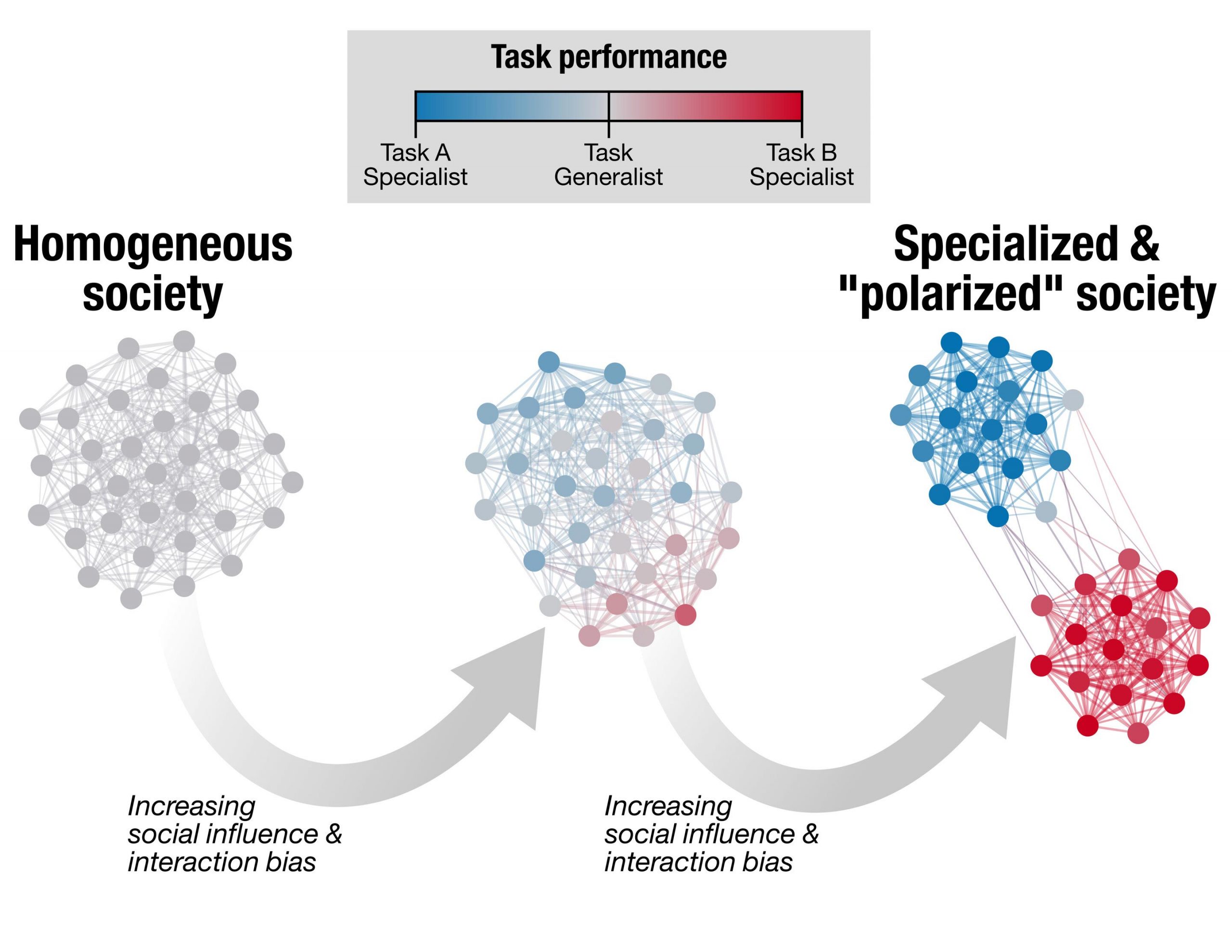
    Princeton’s Chris Tokita and Corina Tarnita found that division of labor and political polarization — two social phenomena not typically considered together — may be driven by the same processes. They found that ‘social influence,’ the tendency of individuals to become similar to those they interact with, and ‘interaction bias,’ which leads us to interact with others who are already like us, are both necessary for division of labor and polarized social networks to emerge. When only social influence is present (top), individuals interact randomly and become similar, ultimately causing the group members to tend to perform the same task. When only interaction bias is present (bottom), individuals cannot differentiate, and the society remains homogenous. When both social forces are present, feedback between them results in both division of labor and polarized social networks. Credit: Chris Tokita, Princeton University

    In a paper published January 8, 2020, in the Journal of the Royal Society Interface, Tokita and Tarnita examined two forces known to drive political polarization and added them to an existing model for how division of labor arises in ant communities. They found that a feedback between these two forces simultaneously resulted in division of labor and polarized social networks.

    The two forces are “social influence,” the tendency of individuals to become similar to those they interact with, and “interaction bias,” which leads us to interact with others who are already like us. The researchers combined those with a “response threshold” model of ant social dynamics, in which ants choose their activities based on which need meets a critical internal threshold.
    Chris Tokita, Princeton University
    Princeton computational ecologist Chris Tokita and his adviser Corina Tarnita found that division of labor and political polarization — two social phenomena not typically considered together — may be driven by the same processes. Credit: Sameer Khan/Fotobuddy

    In other words, if ants A and B have both checked community food stores recently and checked on their young recently, but A has a lower threshold for hunger while B has a lower threshold for worrying about the health of the larvae, A will head out foraging while B rushes back to the nursery. Over time, this leads A to interact with other hunger-sensitive ants, who become the foraging team, while B spends more time with other care providers, and they become the nurses. Combine that with social influence and interaction bias, and the gulf between the foragers and the nurses grows steadily wider as foragers reinforce the behavior of other foragers and nurses reinforce other nurses.

    When this leads to societies eating well and raising healthy young, it’s called division of labor and heralded as a cornerstone of civilization. When it leads to tribalism, it’s called a breakdown of civil discourse.

    But the underlying forces might be the same, say the researchers.
    Division of Labor and Political Polarization
    Princeton computational ecologist Chris Tokita and his adviser Corina Tarnita found that division of labor and political polarization — two social phenomena not typically considered together — may be driven by the same processes. Their model shows that the emergence of division of labor and polarized social networks both require the combination of social influence and interaction bias. As both social influence and interaction bias increase, the behavior of individuals becomes more specialized (i.e., biased) and individuals increasingly interact with those who are similar. ‘Social influence’ refers to the tendency of individuals to become similar to those they interact with, and ‘interaction bias’ leads us to interact with others who are already like us. Credit: Chris Tokita, Princeton University

    “Social insect colonies thrive on the heterogeneity that leads to division of labor, but sometimes they need to make decisions that have to be embraced by the whole nest,” said Tarnita, an associate professor of ecology and evolutionary biology. “For example, when honeybees need to move their nest to a new location, it would be problematic if the colony couldn’t reach consensus and it ended up splitting,”

    So what the researchers wondered next was how the social forces that polarized the ants into doing different tasks could be tamed to rebuild consensus when that was needed. Their model predicted a clear way back from polarization: fight the tendency to interact only with those who are similar, and be willing to let your internal thresholds shift a little.

    “Our model predicts that if you interact with those who are different from you, over time, you’ll become similar to each other,” Tokita said. “It basically erases those differences.”

    It even applies to scientists and sociologists, he added. “One of the things I hope comes from this project is that it causes people in different fields, coming at and thinking about social behavior from different perspectives, to talk to each other a little more. In this project, we learned a lot by borrowing theories from sociology and political science, and combining them with our biological model.”

    Reference: “Social influence and interaction bias can drive emergent behavioural specialization and modular social networks across systems” by Christopher K. Tokita and Corina E. Tarnita, 8 January 2020, Journal of the Royal Society Interface.
    DOI: 10.1098/rsif.2019.0564

    Their work was supported by the National Science Foundation Graduate Research Fellowship under grant DGE1656466.

    Never miss a breakthrough: Join the SciTechDaily newsletter.
    Follow us on Google and Google News.

    Ants Behavioral Science Political Science Princeton University
    Share. Facebook Twitter Pinterest LinkedIn Email Reddit

    Related Articles

    Microscopic Parasite Toxoplasma Gondii Linked to Personality Changes

    Brain Scans Help Predict Whether Patients Will Respond to Therapy

    Viruses Attack Mitochondria to Travel and Spread Within the Nervous System

    Hyperparasite Fungus Limits the Effects of ‘Zombie-Ant’ Fungus

    Odor Processing Function of Fly Resembles Mammalian Brain

    Rational Thinking Ruled Out as Reason for Children’s Selective Imitation

    Sex Deprived Fruit Flies Consume More Alcohol

    Desert Ants Need Very Few Landmarks for Orientation

    Bonobo Great Apes Are Domesticating Themselves

    2 Comments

    1. John-Paul on January 9, 2020 6:56 am

      You stink! I don’t care worker says drone.

      Reply
    2. Eric Berman on January 10, 2020 4:48 am

      When you speak of ‘decision-making’ and ‘consensus’ in an ant colony, are you not anthropomorphizing the ants? At least in the literature, the workers and drones have a set behavior somehow built into their nervous system and they could never depart from their task. Nursery attendants didn’t lay the eggs, they just take care of them, and they do only that, not fuss and worry, not forage or gather in groups to decide when and if the colony should move. One does see a division of labor in kibbutzes, though, with pressures much as described. So your observations are interesting, but don’t pin such machinations on ants.

      Reply
    Leave A Reply Cancel Reply

    • Facebook
    • Twitter
    • Pinterest
    • YouTube

    Don't Miss a Discovery

    Subscribe for the Latest in Science & Tech!

    Trending News

    Mezcal “Worm” in a Bottle Mystery: DNA Testing Reveals a Surprise

    New Research Reveals That Your Morning Coffee Activates an Ancient Longevity Switch

    This Is What Makes You Irresistible to Mosquitoes

    Shockingly Powerful Giant Octopuses Ruled the Seas 100 Million Years Ago

    Scientists Stunned by New Organic Molecules Found on Mars

    Rewriting Dinosaur Evolution: Scientists Unearth Remarkable 150-Million-Year-Old Stegosaur Skull

    Omega-3 Supplements Linked to Cognitive Decline in Surprising New Study

    First-of-Its-Kind Discovery: Homer’s Iliad Found Embedded in a 1,600-Year-Old Egyptian Mummy

    Follow SciTechDaily
    • Facebook
    • Twitter
    • YouTube
    • Pinterest
    • Newsletter
    • RSS
    SciTech News
    • Biology News
    • Chemistry News
    • Earth News
    • Health News
    • Physics News
    • Science News
    • Space News
    • Technology News
    Recent Posts
    • These Simple Daily Habits Can Quickly Improve Blood Pressure and Heart Risk Factors
    • A Common Nutrient May Play a Surprising Role in Anxiety
    • Doing This After 9 p.m. Could Double Your Risk of Gut Issues
    • New Research Challenges Long-Held Beliefs About How the Brain Makes Decisions
    • Breakthrough Technology Reveals New Treatment Targets for Cancer
    Copyright © 1998 - 2026 SciTechDaily. All Rights Reserved.
    • Science News
    • About
    • Contact
    • Editorial Board
    • Privacy Policy
    • Terms of Use

    Type above and press Enter to search. Press Esc to cancel.