
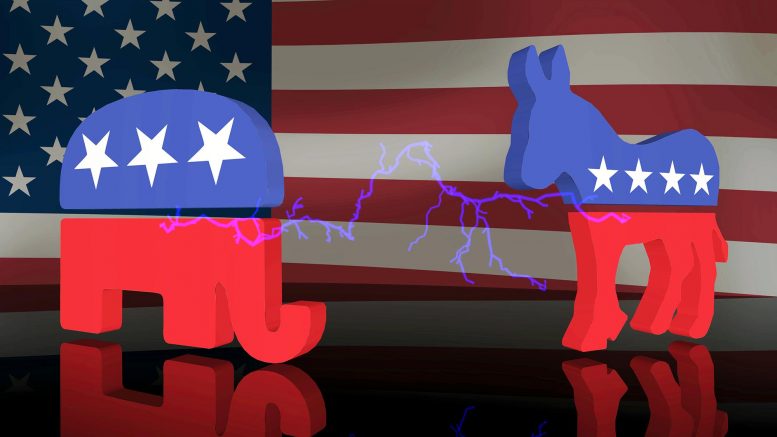
Ever-widening divisions between Democrats and Republicans are believed to reflect deeply rooted ideological differences, but a new study points to a radically different interpretation: The side taken by each party may be mostly a matter of luck.
It’s a phenomenon that Michael Macy, the Goldwin Smith Professor of Arts and Sciences and director of the Social Dynamics Laboratory, calls an “opinion cascade” – in which partisans pile onto whatever emerging position they identify with their party.
Macy is the senior author of “Opinion Cascades and the Unpredictability of Partisan Polarization,” which was published on August 28 in Science Advances.
Social scientists have long wondered how political partisanship develops. In his 2002 book, “The Blank Slate,” cognitive psychologist Steven Pinker asked: “Why on Earth should people’s beliefs about sex predict their beliefs about the size of the military? What does religion have to do with taxes?”
Even more confusing is the tendency of U.S. political parties to radically shift platforms. Macy asks: “Why have the major political parties shifted positions on issues like free trade, balanced budgets, legalization of marijuana, same-sex marriage, and trust in science? And how is it that voters on both sides often have contradictory positions on abortion rights and capital punishment?”
Macy’s team looked for answers by conducting an experiment in which they re-created the early days of opinion formation, to see how the cards might have fallen differently had early movers held different arbitrary opinions.
The researchers split more than 2,000 Democratic and Republican volunteers into 10 “parallel worlds,” each isolated from the others. Within each world, participants took turns filling out an online survey to indicate whether they agreed or disagreed with a series of unfamiliar political and cultural issues. In two of the 10 “worlds,” the survey was private, but in the other eight, whenever a partisan took a position on a given issue, all other participants in their “world” saw a real-time update of how each party was leaning.
The results showed how a handful of “early movers” can trigger a cascade in which later partisans pile on to their party’s newly emerging position, leading eventually to large political differences. The big surprise was that the party that supported the issue in one world was just as likely to oppose the issue in another world.
“Sometimes the same party’s early movers would go one way, and sometimes the other,” Macy said.
And in each world, participants followed these early movers – often in opposite directions.
“In one world, it was Democrats who favored using AI to spot online criminals, and in another world it was Republicans,” he said. “In one world, Democrats favored classic books, and in another world, Republicans favored the classics. In one world, Democrats were more optimistic about the future and in another world, it was Republicans.”
This unpredictability has a surprising implication for our world, Macy said.
“Deep political divisions between Democrats and Republicans – which seem like they must have some philosophical or ideological foundation – may turn out to be arbitrary, in that the two sides could have switched but for the luck of the draw among the early movers,” he said.
Macy hopes that these findings might help civilize the political discourse.
“In our world, political divisions are so fiercely defended,” Macy said. “The two sides get very worked up, which would seem to indicate that positions are deeply rooted fundamental divisions. But our study suggests that these positions may just be identity markers, like bumper stickers, the result of opinion cascades that propelled people into a position with which they came to emotionally identify.
“Learning that the two parties could just as easily have switched sides,” he said, “might encourage people to re-examine their positions and listen to the views of people with whom they sharply disagree.”
The study, co-authored by graduate students Sebastian Deri (psychology), Alexander Ruch (sociology), and Natalie Tong (information science), was supported by the National Science Foundation.
Reference: “Opinion cascades and the unpredictability of partisan polarization” by Michael Macy, Sebastian Deri, Alexander Ruch and Natalie Tong, 28 August 2019, Science Advances.
DOI: 10.1126/sciadv.aax0754
Never miss a breakthrough: Join the SciTechDaily newsletter.
Follow us on Google and Google News.