
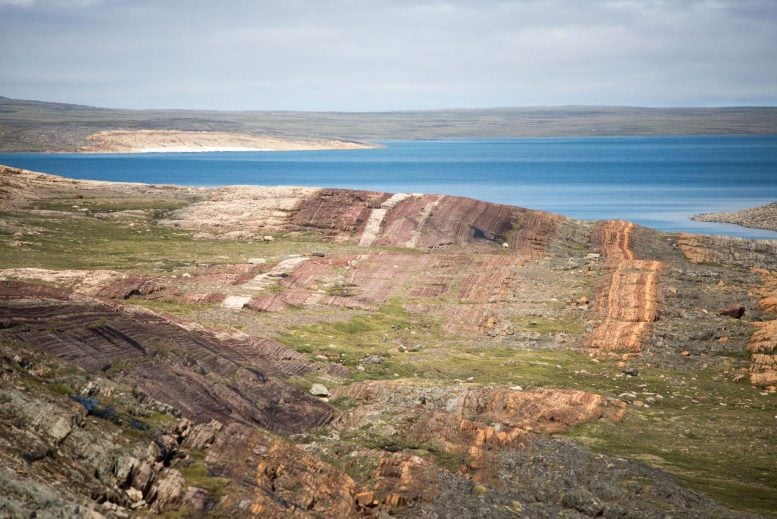
When significant oxygen entered the atmosphere, ancient life multiplied. But after a few hundred million years, Earth’s oxygen plummeted, resulting in a die-off likely greater than the extinction of the dinosaurs.
Clues from Canadian rocks formed billions of years ago reveal a previously unknown loss of life even greater than that of the mass extinction of the dinosaurs 65 million years ago when Earth lost nearly three-quarters of its plant and animal species.
Rather than prowling animals, this die-off involved minuscule microorganisms that shaped the Earth’s atmosphere and ultimately paved the way for those larger animals to thrive.
“This shows that even when biology on Earth is comprised entirely of microbes, you can still have what could be considered an enormous die-off event that otherwise is not recorded in the fossil record,” said Malcolm Hodgskiss, co-lead author of a new study published in Proceedings of the National Academy of Sciences.
Invisible clues
Because this time period preceded complex life, researchers cannot simply dig up fossils to learn what was living 2 billion years ago. Even clues left behind in mud and rocks can be difficult to uncover and analyze.
Instead, the group turned to barite, a mineral collected from the Belcher Islands in Hudson Bay, Canada, that encapsulates a record of oxygen in the atmosphere. Those samples revealed that Earth experienced huge changes to its biosphere – the part of the planet occupied by living organisms – ending with an enormous drop in life approximately 2.05 billion years ago that may also be linked to declining oxygen levels.
“The fact that this geochemical signature was preserved was very surprising,” Hodgskiss said. “What was especially unusual about these barites is that they clearly had a complex history.”
Looking at the Earth’s productivity through ancient history provides a glimpse into how life is likely to behave over its entire existence – in addition to informing observations of atmospheres on planets outside our solar system.
“The size of the biosphere through geologic time has always been one of our biggest questions in studying the history of the Earth,” said Erik Sperling, an assistant professor of geological sciences at Stanford who was not involved with the study. “This new proxy demonstrates how interlinked the biosphere and levels of oxygen and carbon dioxide in the atmosphere are.”
Biological angle
This relationship between the proliferation of life and atmospheric oxygen has given researchers new evidence of the hypothesized “oxygen overshoot.” According to this theory, photosynthesis from ancient microorganisms and the weathering of rocks created a huge amount of oxygen in the atmosphere that later waned as oxygen-emitting organisms exhausted their nutrient supply in the ocean and became less abundant. This situation is in contrast to the stable atmosphere we know on Earth today, where the oxygen created and consumed balances out. The researchers’ measurements of oxygen, sulfur, and barium isotopes in barite support this oxygen overshoot hypothesis.
The research helps scientists hone their estimates of the size of the oxygen overshoot by revealing the significant biological consequences of oxygen levels above or below the capacity of the planet.
“Some of these oxygen estimates likely require too many microorganisms living in the ocean in Earth’s past,” said co-lead author Peter Crockford, a postdoctoral researcher at the Weizmann Institute of Science and Princeton University. “So we can now start to narrow in on what the composition of the atmosphere could have been through this biological angle.”
Co-authors include researchers from Nanjing University, the University of Colorado Boulder and Woods Hole Oceanographic Institution
The research was supported by Stanford University McGee and Compton Grants, the Northern Scientific Training Program, NSERC, National Geographic, the American Philosophical Society, Geological Society of America and the Agouron Institute.
Reference: “A productivity collapse to end Earth’s Great Oxidation” by Malcolm S. W. Hodgskiss, Peter W. Crockford, Yongbo Peng, Boswell A. Wing, and Tristan J. Horner, August 27, 2019, Proceedings of the National Academy of Sciences.
DOI: 10.1073/pnas.1900325116
Never miss a breakthrough: Join the SciTechDaily newsletter.
Follow us on Google and Google News.
3 Comments
This seems to be an ‘alternative’ explanation for what naturally follows from the scientific discovery that the Earth’s core was on the verge of losing its magnetic spin at 535 million years ago. Not billions, millions. What saved Earth’s magnetosphere was the consolidation of the Earth’s inner core. The outer half of the inner core solidified, the inner half of the inner core reversed its magnetism 90 degrees. This is what saved Earth’s life and the reason we are here. Since we are again losing our magnetosphere, warnings of a 90 degree magnetic reversal are being discussed, which implies, strongly, that this is a step-down inherent in our planet’s existence.
Consider our ‘recovery’ since the last magnetic reversal; would we be able to know and understand the difference in the lesser magnetic field?
The general consensus is that the magnetic field reverses every 200,000 years or so as shown by magnetic banding of spreading center rocks. The timing is somewhat chaotic though, and the last reversal was about 780,000 BC. We’re due for a flip, but don’t expect a mass die-off, not, at least, from a magnetic reversal. We’ve had hundreds of ’em in the last 2 billion years.
Ice astroid hits magmaphere called earth. Cools surface . Pond scum proliferates cyanobacteria produces oxygen . Pond scum life span ends . Sinks, creating future oil reserves.cianobacteria survives.Oxygrn levels plummet.frash water remains after pond scum die off .Earth life begins. Simple yes?