
Close Menu
    Facebook X (Twitter) Instagram
    SciTechDaily
    • Biology
    • Chemistry
    • Earth
    • Health
    • Physics
    • Science
    • Space
    • Technology
    Facebook X (Twitter) Pinterest YouTube RSS
    SciTechDaily
    Home»Technology»Power Unleashed: The Revolutionary 70 kW Vanadium Flow Battery Stack
    Technology

    Power Unleashed: The Revolutionary 70 kW Vanadium Flow Battery Stack

    By Dalian Institute of Chemical Physics, Chinese Academy SciencesJanuary 22, 20242 Comments2 Mins Read
    Facebook Twitter Pinterest Telegram LinkedIn WhatsApp Email Reddit
    Share
    Facebook Twitter LinkedIn Pinterest Telegram Email Reddit
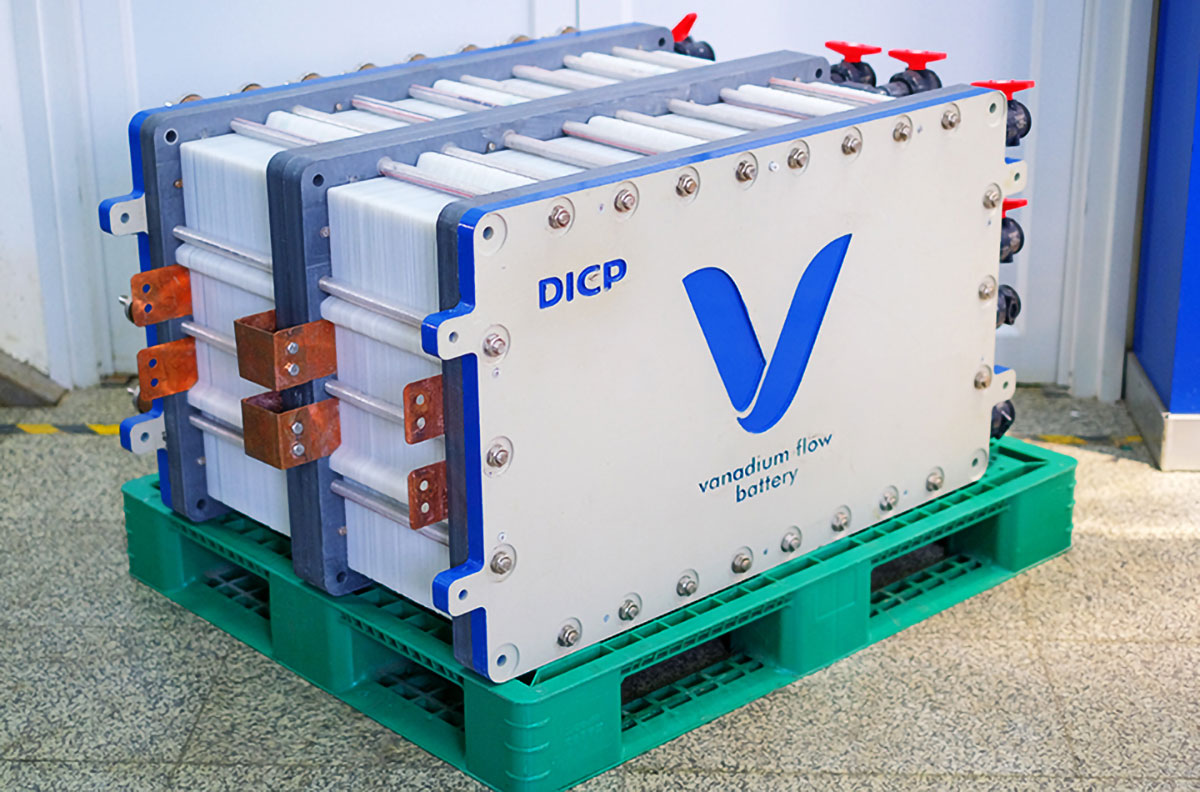
    70 kW Vanadium Flow Battery Stack
    70 kW-level vanadium flow battery stack. Credit: DICP

    A new 70 kW-level vanadium flow battery stack, developed by researchers, doubles energy storage capacity without increasing costs, marking a significant leap in battery technology.

    Recently, a research team led by Prof. Xianfeng Li from the Dalian Institute of Chemical Physics (DICP) of the Chinese Academy of Sciences (CAS) developed a 70 kW-level high power density vanadium flow battery stack. Compared with the current 30kW-level stack, this stack has a volume power density of 130kW/m3, and the cost is reduced by 40%.

    Cost-Effective Energy Storage Solution

    Vanadium flow batteries are one of the preferred technologies for large-scale energy storage. At present, the initial investment of vanadium flow batteries is relatively high.

    Stack is the core component of a vanadium flow battery. The power density determines the cost of the stack. The higher the power density is, the smaller the stack volume is, resulting in lower cost under the same power output conditions.

    Innovations in Battery Design

    Based on self-developed highly selective weldable porous composite membranes and weldable highly conductive bipolar plates, Prof. Li’s team developed a 70kW-level stack, using a short flow path, an ultra-thin battery structure, and low flow resistance and high distribution uniformity flow channels.

    The energy efficiency of this stack is 81.0% under 70kW rated power charge and discharge conditions, and the energy efficiency is 82.1% under 60kW constant power charge and discharge conditions, In addition, the stack operates stably after more than 1,200 cycles, with only 1.7% energy efficiency decay.

    Scaling Up Energy Storage Capacity

    By using this stack, a 20-foot container energy storage unit module can be upgraded from 250kW to 500kW without greatly increasing the size of power units and the cost of system-supporting facilities.

    “This 70kW-level stack can promote the commercialization of vanadium flow batteries. We believe that the development of this stack will improve the integration of power units in energy,” said Prof. Li.

    Never miss a breakthrough: Join the SciTechDaily newsletter.
    Follow us on Google and Google News.

    Battery Technology Chinese Academy of Sciences
    Share. Facebook Twitter Pinterest LinkedIn Email Reddit

    Related Articles

    Scientists Develop the World’s First Rechargeable Hydride Ion Battery

    Unprecedented Air Stability: New Molecules Promise Longer Battery Life

    Game-Changing Advances in All-Solid-State Lithium Battery Technology

    Unlocking High Energy: New Aqueous Batteries Surpass Traditional Limits

    Chinese Scientists Develop a High-Performance Ultralong-Life Aqueous Zinc-Ion Battery

    Nanowires Covered in Nanoparticles Boost Performance

    Liquid Battery Design Utilizes Heat From Charging and Discharging

    MIT Researchers Design Inexpensive Liquid Batteries With Distinct Layers

    Lithium Iron Phosphate Batteries Could Lead to Cheaper, More Efficient Solar Energy

    2 Comments

    1. Len on January 23, 2024 12:18 pm

      Does the author of this article know the difference between kW and kWh?

      Reply
    2. Ahmad Khowaiter on February 5, 2024 9:09 pm

      Dear Len,

      The author understands very well the difference between a flow battery and more traditional batteries. In a flow battery the stack does not store energy (measured in kWh), rather it only converts the chemical energy from the chemical energy potenial in the flowing electroloyte into electricity. Therfore the flow battery stacks are rated by their power conversion output in kW. The energy is stored in the form of a liquid electrolyte in a separate tank and therfore the tanks are rated by kWh based on the volume of liquid electrolyte they contain. That is the advantage of flow batteries – very low cost energy storage and a decoupkling of power and energy capcaity.

      Reply
    Leave A Reply Cancel Reply

    • Facebook
    • Twitter
    • Pinterest
    • YouTube

    Don't Miss a Discovery

    Subscribe for the Latest in Science & Tech!

    Trending News

    Even Occasional Binge Drinking May Triple Liver Damage Risk

    Liftoff! NASA’s Artemis II Launch Sends Astronauts Around the Moon for First Time in 50 Years

    Scientists Discover New Way To Eliminate “Zombie Cells” Driving Aging

    This New Quantum Theory Could Change Everything We Know About the Big Bang

    This One Vitamin May Help Protect Your Brain From Dementia Years Later

    Stopping Weight-Loss Drugs Like Ozempic Can Quickly Erase Heart Benefits

    A 500-Million-Year-Old Surprise Is Forcing Scientists to Rethink Spider Evolution

    Coffee and Blood Pressure: What You Need To Know Before Your Next Cup

    Follow SciTechDaily
    • Facebook
    • Twitter
    • YouTube
    • Pinterest
    • Newsletter
    • RSS
    SciTech News
    • Biology News
    • Chemistry News
    • Earth News
    • Health News
    • Physics News
    • Science News
    • Space News
    • Technology News
    Recent Posts
    • Tiny 436-Million-Year-Old Fish Fossil Rewrites the Origins of Vertebrates
    • 1,800 Miles Down: Scientists Uncover Mysterious Movements at the Edge of Earth’s Core
    • Scientists Uncover Earth’s Hidden “Gold Kitchen” Beneath the Ocean Floor
    • You Don’t Need To Be Rich: New Study Reveals a Simple Life Is the Real Secret to Happiness
    • “Crazy Dice” Help Scientists Prove Only One 150-Year-Old Theory About Randomness Works
    Copyright © 1998 - 2026 SciTechDaily. All Rights Reserved.
    • Science News
    • About
    • Contact
    • Editorial Board
    • Privacy Policy
    • Terms of Use

    Type above and press Enter to search. Press Esc to cancel.