
Close Menu
    Facebook X (Twitter) Instagram
    SciTechDaily
    • Biology
    • Chemistry
    • Earth
    • Health
    • Physics
    • Science
    • Space
    • Technology
    Facebook X (Twitter) Pinterest YouTube RSS
    SciTechDaily
    Home»Physics»Researching the Properties of Relativistic Electron Vortex Beams
    Physics

    Researching the Properties of Relativistic Electron Vortex Beams

    By RIKEN Advanced Science InstituteFebruary 17, 2012No Comments3 Mins Read
    Facebook Twitter Pinterest Telegram LinkedIn WhatsApp Email Reddit
    Share
    Facebook Twitter LinkedIn Pinterest Telegram Email Reddit
    Electron Beams Spin and Vortex Orientation
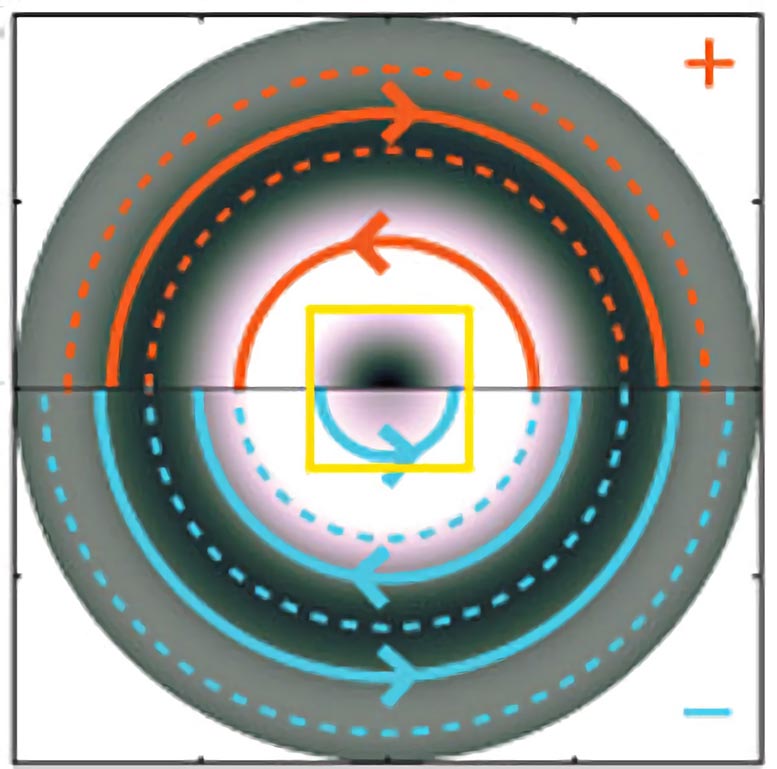
    Figure 1: A comparison of electron beams with parallel (top) and antiparallel (bottom) spin and vortex orientation. The plot shows the density (grey) and current distributions (arrows) for electrons in the x and y direction, with either ‘up’ (+) or ‘down’ (-) spin, respectively. For electrons in the center of the beam, the distribution is predicted to be different for both cases. Credit: 2011 American Physical Society

    Researchers at the RIKEN Advanced Science Institute (ASI) have developed a theory that provides an understanding of relativistic electron vortex beams. Through the combined consideration of quantum and relativistic properties of the electrons in the beam, the researchers found that spin-orbit interaction results in a different behavior for vortex beams made of electrons with spins pointing up or down, respectively.

    Whether a car or a ball, the forces acting on a body moving in a straight line are very different to those acting on one moving in tight curves. This maxim also holds true at microscopic scales. As such, a beam of electrons that moves forward linearly has different properties to one with vortex-like properties. Since vortex beams show properties in magnetic fields that could lead to novel applications, a RIKEN-led research team has developed a theory that provides an understanding of these properties.[1]

    “Ours is the first comprehensive theory of relativistic electron vortex beams and adds significantly to their understanding,” comments team member Konstantin Bliokh from the RIKEN Advanced Science Institute (ASI).

    Like any particle, electrons can exhibit wave-like characteristics; and, understanding this behavior is critical to understanding the behavior of vortex beams so they can be harnessed in future applications. Unlike the broad front of an ocean wave hitting a beach, however, the oscillations of electron waves are out of sync along the beam: the slight shifts in their timing gives the waves a corkscrew character.

    A vortex beam shows unique and potentially exploitable quantum effects arising from the interplay between the so-called ‘orbital angular momentum’ of its electrons and their intrinsic property called spin. The potential of these beams became apparent only recently, when they were demonstrated for the first time by Masaya Uchida and Akira Tonomura from ASI.[2]

    The complex mixture of electron spin, beam vortex properties, and the relativistic properties of the electrons has complicated the theoretical understanding of the beams, says team leader Franco Nori also from ASI. He explains that their fundamental theoretical description was possible only through the combined consideration of quantum and relativistic properties of the electrons in the beam. This provided new insights into the interaction between the electrons’ spin and the vortex property of the beam. In particular, the researchers found that this so-called spin-orbit interaction results in a different behavior for vortex beams made of electrons with spins pointing up or down, respectively—an effect that should be observable (Figure 1).

    Beyond providing these fundamental insights, the new theory also has sound practical implications, as the beams are very sensitive to magnetic fields, according to Nori. “The theoretical understanding that we have reached will eventually contribute to the development of enhanced electron microscopes that can image magnetic materials with atomic resolution,” he says.

    The corresponding author for this highlight is based at the Digital Materials Team, RIKEN Advanced Science Institute

    References:

    1. “Relativistic Electron Vortex Beams: Angular Momentum and Spin-Orbit Interaction” by Konstantin Y. Bliokh, Mark R. Dennis and Franco Nori, 17 October 2011, Physical Review Letters.
      DOI: 10.1103/PhysRevLett.107.174802
    2. “Generation of electron beams carrying orbital angular momentum” by Masaya Uchida and Akira Tonomura, 1 April 2010, Nature.
      DOI: 10.1038/nature08904

    Never miss a breakthrough: Join the SciTechDaily newsletter.
    Follow us on Google and Google News.

    Electron Microscope Electron Vortex Beams Electrons Oscillation RIKEN
    Share. Facebook Twitter Pinterest LinkedIn Email Reddit

    Related Articles

    Ghost Particles No More: A New Theory Shines Light on Superconductor Mysteries

    Physicists Illuminate Ultra-Fast Electron Dynamics With X-Rays

    Beyond Einstein: Attosecond X-Ray Pulses Unlock the Secrets of the Photoelectric Effect

    Electrons Defy Expectations: Quantum Discoveries Unveil New States of Matter

    Astonishing Nuclear Breakthrough Could Rewrite the Fundamental Constants of Nature

    Solving Quantum Mysteries: Physicists Confirm Entropy Rule for Entanglement

    New Research Unravels the Mystery of Slow Electrons

    A Flash of Genius: Taming Electrons With Laser Precision for 1,000,000x Faster Electronics

    Researchers Create Electron Vortex Beams Inside Electron Microscopes

    Leave A Reply Cancel Reply

    • Facebook
    • Twitter
    • Pinterest
    • YouTube

    Don't Miss a Discovery

    Subscribe for the Latest in Science & Tech!

    Trending News

    Just 10 Minutes a Day: Scientists Say This Ancient Chinese Practice Shows Powerful Blood Pressure Benefits

    Scientists Say This Popular Food Could Help Your Body Get Rid of Microplastics

    For the First Time, ChatGPT Has Solved an Unproven Math Problem in Geometry

    This Popular Supplement May Actually Slow Biological Aging, Scientists Reveal

    Can a Common Vitamin Fight the Most Aggressive Brain Cancer?

    Scientists Discover How to Stop Vision Loss Before It Starts

    The Mediterranean Isn’t Safe: Scientists Warn of Inevitable Tsunami

    Scientists Say Washing Dishes With a Sponge Has a Concerning Side Effect

    Follow SciTechDaily
    • Facebook
    • Twitter
    • YouTube
    • Pinterest
    • Newsletter
    • RSS
    SciTech News
    • Biology News
    • Chemistry News
    • Earth News
    • Health News
    • Physics News
    • Science News
    • Space News
    • Technology News
    Recent Posts
    • A 30-Year-Old Flu Shot Still Works Today With One Big Problem
    • Widely Available Drug Found To Ease One of Long COVID’s Most Stubborn Symptoms
    • New Study Finds Internalized Stress May Accelerate Cognitive Decline
    • Stopping Weight-Loss Drugs Like Ozempic Can Quickly Erase Heart Benefits
    • A 500-Million-Year-Old Surprise Is Forcing Scientists to Rethink Spider Evolution
    Copyright © 1998 - 2026 SciTechDaily. All Rights Reserved.
    • Science News
    • About
    • Contact
    • Editorial Board
    • Privacy Policy
    • Terms of Use

    Type above and press Enter to search. Press Esc to cancel.