
Close Menu
    Facebook X (Twitter) Instagram
    SciTechDaily
    • Biology
    • Chemistry
    • Earth
    • Health
    • Physics
    • Science
    • Space
    • Technology
    Facebook X (Twitter) Pinterest YouTube RSS
    SciTechDaily
    Home»Technology»Powerful Photon-Based Processing Units Enable Complex Artificial Intelligence
    Technology

    Powerful Photon-Based Processing Units Enable Complex Artificial Intelligence

    By American Institute of PhysicsAugust 1, 2020No Comments3 Mins Read
    Facebook Twitter Pinterest Telegram LinkedIn WhatsApp Email Reddit
    Share
    Facebook Twitter LinkedIn Pinterest Telegram Email Reddit
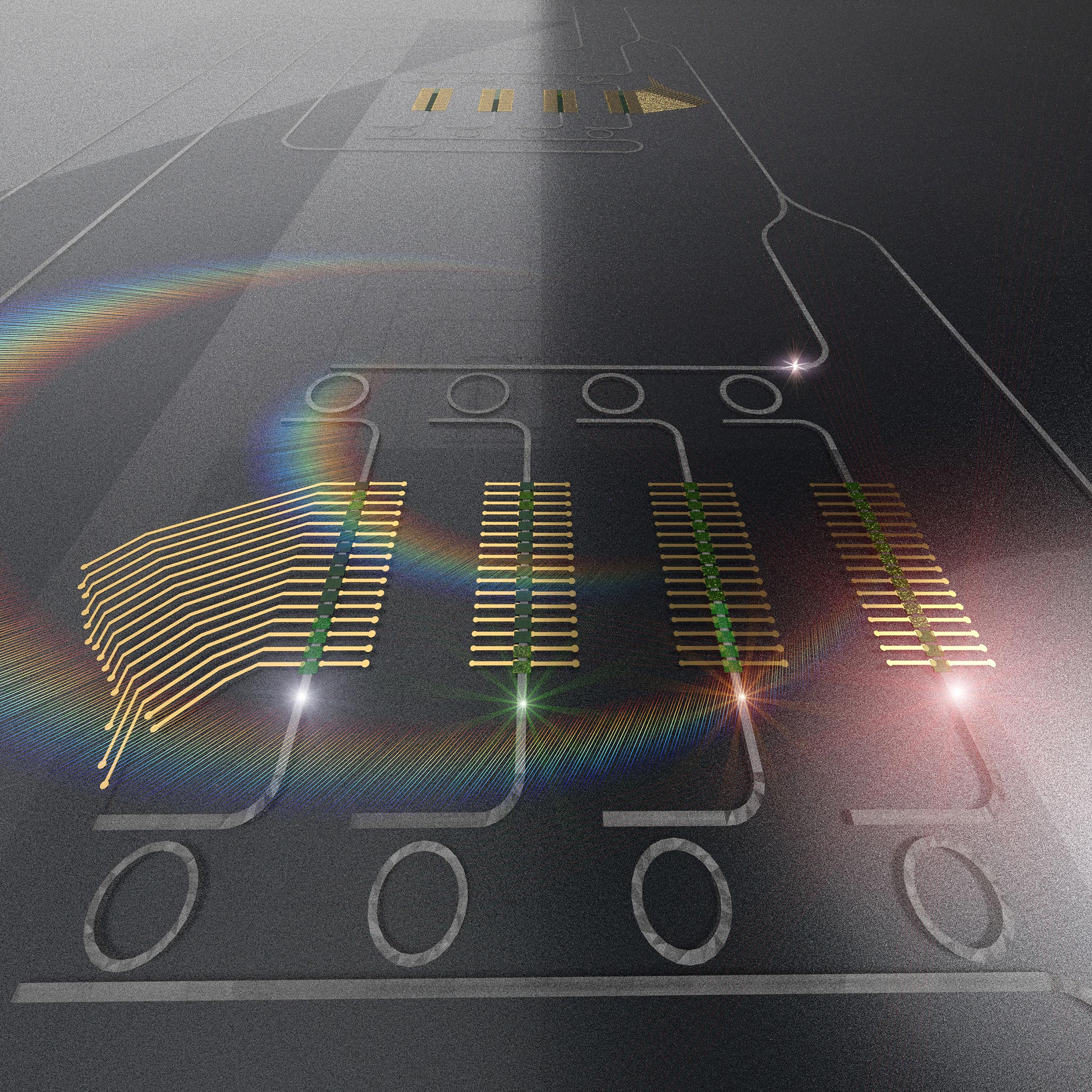
    Photonic Tensor Core
    The photonic tensor core performs vector-matrix multiplications by utilizing the efficient interaction of light at different wavelengths with multistate photonic phase change memories. Credit: Mario Miscuglio

    Using photons to create more powerful and power-efficient processing units for more complex machine learning.

    Machine learning performed by neural networks is a popular approach to developing artificial intelligence, as researchers aim to replicate brain functionalities for a variety of applications.

    A paper in the journal Applied Physics Reviews, by AIP Publishing, proposes a new approach to perform computations required by a neural network, using light instead of electricity. In this approach, a photonic tensor core performs multiplications of matrices in parallel, improving speed and efficiency of current deep learning paradigms.

    In machine learning, neural networks are trained to learn to perform unsupervised decision and classification on unseen data. Once a neural network is trained on data, it can produce an inference to recognize and classify objects and patterns and find a signature within the data.

    The photonic TPU stores and processes data in parallel, featuring an electro-optical interconnect, which allows the optical memory to be efficiently read and written and the photonic TPU to interface with other architectures.

    “We found that integrated photonic platforms that integrate efficient optical memory can obtain the same operations as a tensor processing unit, but they consume a fraction of the power and have higher throughput and, when opportunely trained, can be used for performing inference at the speed of light,” said Mario Miscuglio, one of the authors.

    Most neural networks unravel multiple layers of interconnected neurons aiming to mimic the human brain. An efficient way to represent these networks is a composite function that multiplies matrices and vectors together. This representation allows the performance of parallel operations through architectures specialized in vectorized operations such as matrix multiplication.

    However, the more intelligent the task and the higher accuracy of the prediction desired, the more complex the network becomes. Such networks demand larger amounts of data for computation and more power to process that data.

    Current digital processors suitable for deep learning, such as graphics processing units or tensor processing units, are limited in performing more complex operations with greater accuracy by the power required to do so and by the slow transmission of electronic data between the processor and the memory.

    The researchers showed that the performance of their TPU could be 2-3 orders higher than an electrical TPU. Photons may also be an ideal match for computing node-distributed networks and engines performing intelligent tasks with high throughput at the edge of a networks, such as 5G. At network edges, data signals may already exist in the form of photons from surveillance cameras, optical sensors and other sources.

    “Photonic specialized processors can save a tremendous amount of energy, improve response time and reduce data center traffic,” said Miscuglio.

    For the end user, that means data is processed much faster, because a large portion of the data is preprocessed, meaning only a portion of the data needs to be sent to the cloud or data center.

    Reference: “Photonic tensor cores for machine learning featured” by Mario Miscuglio and Volker J. Sorger, 21 July 2020, Applied Physics Reviews.
    DOI: 10.1063/5.0001942

    Never miss a breakthrough: Join the SciTechDaily newsletter.
    Follow us on Google and Google News.

    American Institute of Physics Artificial Intelligence Electrical Engineering Machine Learning Nanotechnology Optics Popular
    Share. Facebook Twitter Pinterest LinkedIn Email Reddit

    Related Articles

    Revolutionary New Intelligent Transistor Developed

    Ordinary Microscope Sees in Super-Resolution With Specially Engineered Light-Shrinking Material

    MIT Develops Nanostructured Device That Stops Light in Its Tracks

    Ditching the Fiber in Fiber Optics: Capturing Free-Space Optical Light for High-Speed WiFi

    Light-Based Processor Chips Advance Machine Learning

    AI Boosted by Parallel Convolutional Light-Based Processors

    Smarter Artificial Intelligence Technology in a New Light-Powered Chip

    Good Vibrations for New Energy: Nanogenerator “Scavenges” Power From Surroundings

    Order From Disorder: Harnessing Turbulence in Light to Create a High-Precision Laser

    Leave A Reply Cancel Reply

    • Facebook
    • Twitter
    • Pinterest
    • YouTube

    Don't Miss a Discovery

    Subscribe for the Latest in Science & Tech!

    Trending News

    Wasp Colonies Explode Into Violence After Losing Their Queen

    Scientists Create “Living Plastic” That Self-Destructs in Just Six Days

    Your Blood May Carry a 700-Million-Year-Old Secret

    Scientists Discover Some “Zombie Cells” May Actually Help You Live Longer

    Earth May Be Seeding Venus With Life, According to New Research

    What Scientists Found Inside a 117-Year-Old Woman Reveals New Clues to Long Life

    Scientists Discover Mysterious Creature Living in the Great Salt Lake – and It Exists Nowhere Else on Earth

    It’s Alive? Surprising Discovery Changes What We Know About Fog

    Follow SciTechDaily
    • Facebook
    • Twitter
    • YouTube
    • Pinterest
    • Newsletter
    • RSS
    SciTech News
    • Biology News
    • Chemistry News
    • Earth News
    • Health News
    • Physics News
    • Science News
    • Space News
    • Technology News
    Recent Posts
    • Scientists Crack Major Ammonia Problem With a Platinum Catalyst Breakthrough
    • MIT Engineers Solve a Major Lidar Problem That Has Stumped Researchers for Years
    • NASA’s X-59 Sonic Boom Killer Is Ready for Its Biggest Test Yet
    • Why Some Cancers Turn Deadly: Researchers Uncover a Hidden Trigger
    • The Best Exercise Combination for Longevity, According to a 30-Year Study
    Copyright © 1998 - 2026 SciTechDaily. All Rights Reserved.
    • Science News
    • About
    • Contact
    • Editorial Board
    • Privacy Policy
    • Terms of Use

    Type above and press Enter to search. Press Esc to cancel.