
Close Menu
    Facebook X (Twitter) Instagram
    SciTechDaily
    • Biology
    • Chemistry
    • Earth
    • Health
    • Physics
    • Science
    • Space
    • Technology
    Facebook X (Twitter) Pinterest YouTube RSS
    SciTechDaily
    Home»Space»Powerful Supercomputers Provide New Evidence of Dark Matter
    Space

    Powerful Supercomputers Provide New Evidence of Dark Matter

    By Durham UniversityApril 23, 2017No Comments3 Mins Read
    Facebook Twitter Pinterest Telegram LinkedIn WhatsApp Email Reddit
    Share
    Facebook Twitter LinkedIn Pinterest Telegram Email Reddit
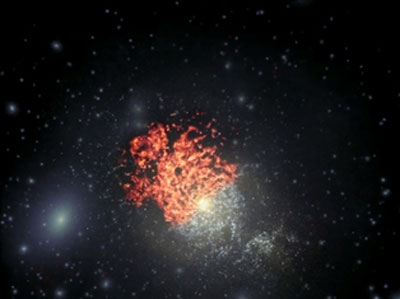
    Simulated Galaxies Reveal New Evidence of Dark Matter
    A simulated galaxy is pictured, showing the main ingredients that make up a galaxy: the stars (blue), the gas from which the stars are born (red), and the dark matter halo that surrounds the galaxy (light grey)

    Using powerful supercomputers, astronomers at Durham University reveal further evidence of the existence of dark matter – the mysterious substance that is believed to hold the Universe together.

    The scientists used computer models to simulate the formation of galaxies in the presence of dark matter and were able to demonstrate that their size and rotation speed were linked to their brightness in a similar way to observations made by astronomers.

    Alternative theories

    Until now, theories of dark matter have predicted a much more complex relationship between the size, mass, and brightness (or luminosity) of galaxies than is actually observed, which has led to dark matter skeptics proposing alternative theories that are seemingly a better fit with what we see.

    The research led by Dr. Aaron Ludlow of the Institute for Computational Cosmology, is published in the academic journal, Physical Review Letters.

    Most cosmologists believe that more than 80 percent of the total mass of the Universe is made up of dark matter – a mysterious particle that has so far not been detected but explains many of the properties of the Universe such as the microwave background measured by the Planck satellite.

    Convincing explanations

    Alternative theories include Modified Newtonian Dynamics, or MOND. While this does not explain some observations of the Universe as convincingly as dark matter theory it has, until now, provided a simpler description of the coupling of the brightness and rotation velocity, observed in galaxies of all shapes and sizes.

    The Durham team used powerful supercomputers to model the formation of galaxies of various sizes, compressing billions of years of evolution into a few weeks, in order to demonstrate that the existence of dark matter is consistent with the observed relationship between mass, size, and luminosity of galaxies.

    Long-standing problem resolved

    Dr. Ludlow said: “This solves a long-standing problem that has troubled the dark matter model for over a decade. The dark matter hypothesis remains the main explanation for the source of the gravity that binds galaxies. Although the particles are difficult to detect, physicists must persevere.”

    Durham University collaborated on the project with Leiden University, Netherlands; Liverpool John Moores University, England and the University of Victoria, Canada. The research was funded by the European Research Council, the Science and Technology Facilities Council, Netherlands Organization for Scientific Research, COFUND, and The Royal Society.

    Reference: “Mass-Discrepancy Acceleration Relation: A Natural Outcome of Galaxy Formation in Cold Dark Matter Halos” by Aaron D. Ludlow, Alejandro Benítez-Llambay, Matthieu Schaller, Tom Theuns, Carlos S. Frenk, Richard Bower, Joop Schaye, Robert A. Crain, Julio F. Navarro, Azadeh Fattahi and Kyle A. Oman, 21 April 2017, Physical Review Letters.
    DOI: 10.1103/PhysRevLett.118.161103

    Never miss a breakthrough: Join the SciTechDaily newsletter.
    Follow us on Google and Google News.

    Astronomy Astrophysics Cosmology Dark Matter Durham University
    Share. Facebook Twitter Pinterest LinkedIn Email Reddit

    Related Articles

    These Strange Stars Could Reveal the True Nature of Dark Matter

    The Milky Way May Be Surrounded by 100 Hidden Galaxies

    Rewriting Cosmology: New Calculations Shake Foundations of the Big Bang Theory

    Scientists Capture the Universe’s Hidden Web of Dark Matter

    Astronomers Just Found a 3-Million-Light-Year Connection Between Galaxies

    First Direct Image of the Cosmic Web Reveals the Universe’s Hidden Highways

    AI-Powered Insights Reveal the Universe’s Fundamental Settings

    Shapley Supercluster Discovery Shatters Previous Cosmic Boundaries

    Astronomers Unveil Vast Gravitational Basins in the Local Universe

    Leave A Reply Cancel Reply

    • Facebook
    • Twitter
    • Pinterest
    • YouTube

    Don't Miss a Discovery

    Subscribe for the Latest in Science & Tech!

    Trending News

    The Universe Is Expanding Too Fast and Scientists Can’t Explain Why

    “Like Liquid Metal”: Scientists Create Strange Shape-Shifting Material

    Early Warning Signals of Esophageal Cancer May Be Hiding in Plain Sight

    Common Blood Pressure Drug Shows Surprising Power Against Deadly Antibiotic-Resistant Superbug

    Scientists Uncover Dangerous Connection Between Serotonin and Heart Valve Disease

    Scientists Discover a “Protector” Protein That Could Help Reverse Hair Loss

    Bone-Strengthening Discovery Could Reverse Osteoporosis

    Scientists Uncover Hidden Trigger Behind Stem Cell Aging

    Follow SciTechDaily
    • Facebook
    • Twitter
    • YouTube
    • Pinterest
    • Newsletter
    • RSS
    SciTech News
    • Biology News
    • Chemistry News
    • Earth News
    • Health News
    • Physics News
    • Science News
    • Space News
    • Technology News
    Recent Posts
    • Scientists Overcome Major Quantum Bottleneck, Potentially Transforming Teleportation and Computing
    • Quantum Physics’ Strangest Problem May Hold the Key to Time Itself
    • Scientists Create “Liquid Gears” That Spin Without Touching
    • The Simple Habit That Could Help Prevent Cancer
    • Forgotten Medicinal Plant Shows Promise in Fighting Dangerous Superbugs
    Copyright © 1998 - 2026 SciTechDaily. All Rights Reserved.
    • Science News
    • About
    • Contact
    • Editorial Board
    • Privacy Policy
    • Terms of Use

    Type above and press Enter to search. Press Esc to cancel.