
Close Menu
    Facebook X (Twitter) Instagram
    SciTechDaily
    • Biology
    • Chemistry
    • Earth
    • Health
    • Physics
    • Science
    • Space
    • Technology
    Facebook X (Twitter) Pinterest YouTube RSS
    SciTechDaily
    Home»Technology»Precision Spray Coating Could Enable Solar Cells With Better Stability and Performance
    Technology

    Precision Spray Coating Could Enable Solar Cells With Better Stability and Performance

    By The Optical SocietyJune 13, 2020No Comments4 Mins Read
    Facebook Twitter Pinterest Telegram LinkedIn WhatsApp Email Reddit
    Share
    Facebook Twitter LinkedIn Pinterest Telegram Email Reddit
    Sequential Spray Deposition Crop
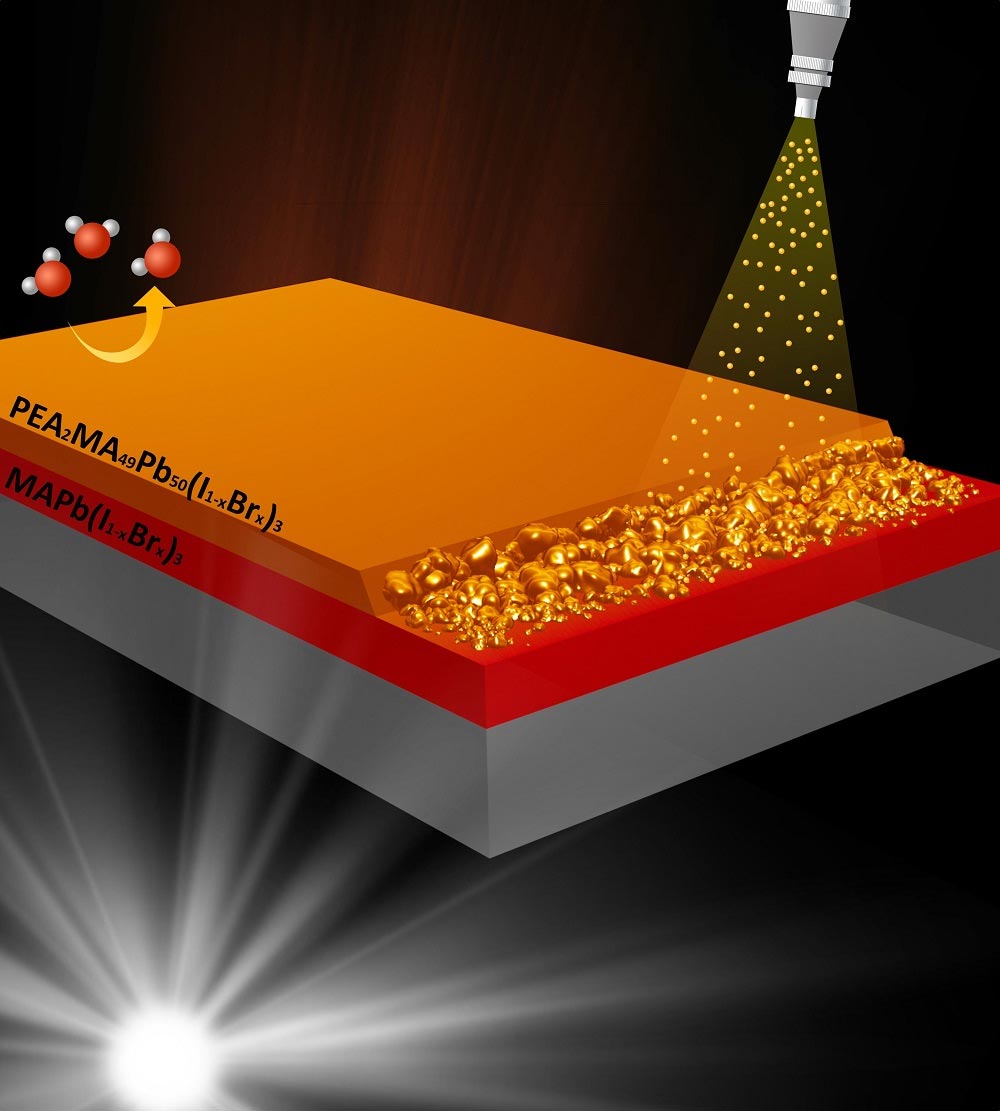
    (Click the image for full view.) Researchers have developed a new precision spray-coating method called sequential spray deposition that enables multilayer perovskite absorbers for advanced solar cell designs and could be scaled up for mass production. The technique could be used to create perovskite architectures with any number of layers. Credit: Pongsakorn Kanjanaboos, Mahidol University

    New approach offers practical way to make multilayer perovskite solar cells.

    Although perovskites are a promising alternative to the silicon used to make most of today’s solar cells, new manufacturing processes are needed to make them practical for commercial production. To help fill this gap, researchers have developed a new precision spray-coating method that enables more complex perovskite solar cell designs and could be scaled up for mass production.

    Perovskites are promising for next-generation solar cells because they absorb light and convert it to energy with better efficiency and potentially lower production costs than silicon. Perovskites can even be sprayed onto glass to create energy-producing windows.

    “Our work demonstrates a process to deposit perovskite layer by layer with controllable thicknesses and rates of deposition for each layer,” said research team leader Pongsakorn Kanjanaboos from the School of Materials Science and Innovation, Faculty of Science, Mahidol University in Thailand. “This new method enables stacked designs for solar cells with better performance and stability.”

    In the Optical Society (OSA) journal Optical Materials Express, Kanjanaboos, and colleagues describe their new spray coating method, called sequential spray deposition, and show that it can be used to create a multilayer perovskite design. Applying different perovskite materials in each layer can allow customization of a device’s function or the ability to meet specific performance and stability requirements.

    A better way to spray

    One of the advantages of perovskites is that they are solution processable, meaning that a solar cell is made by drying liquid perovskite into a solid at a low temperature. This fabrication process is much easier and less expensive than making a traditional silicon solar cell, a process that requires very high temperatures and cutting a solid material into wafers.
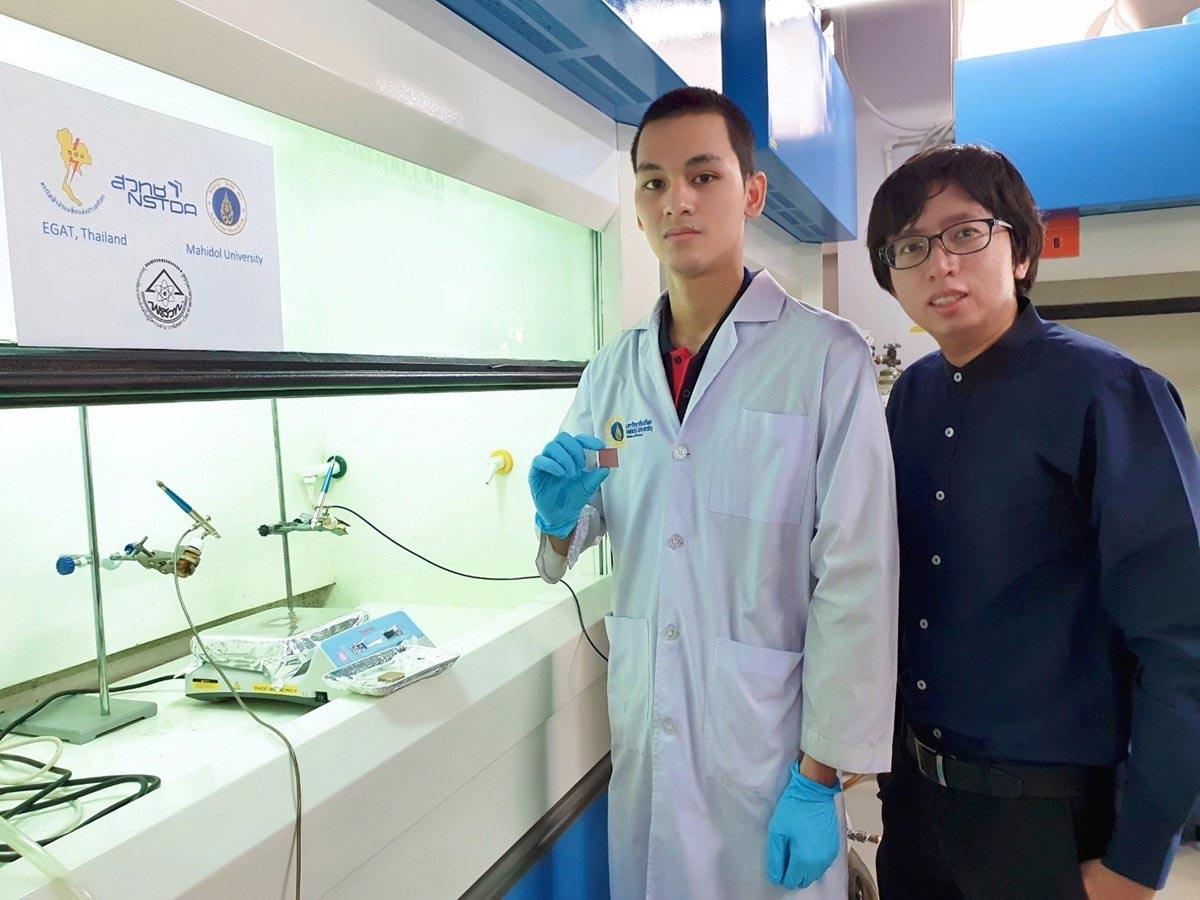
    Koth Amratisha and Pongsakorn Kanjanaboos
    The researchers demonstrated the technique by depositing a perovskite material with higher stability on different perovskite materials with better electrical properties. Applying different perovskite materials in each layer can be used to customize a device’s function or meet specific performance and stability requirements. Pictured are the paper’s first author undergraduate student Koth Amratisha (left) and his advisor Pongsakorn Kanjanaboos (right). Credit: Pongsakorn Kanjanaboos, Mahidol University

    However, the solution process typically used to make perovskites does not allow multilayer designs because the upper layer tends to dissolve the already-dried lower layer. To overcome this challenge, the researchers turned to a process known as sequential spray deposition in which tiny droplets of material are applied to a surface.

    After trying different spray coating methods, they found one that worked at temperatures around 100 °C. They then optimized the spray parameters to ensure that the tiny droplets dried and crystallized into solid perovskite immediately upon contact with the already-dried lower layer.

    Building a multi-layer device

    “With our spray coating process, the solution of the upper layer doesn’t disturb the solid film making up the first layer,” said Pongsakorn. “Endless combinations of stacked perovskite architectures with any number of layers can be designed and created with precise control of thicknesses and rates of deposition for each layer.”

    The researchers demonstrated the technique by depositing a perovskite material with high stability on different perovskite material with better electrical properties. This double-layer semi-transparent perovskite device showed clearly defined layers and simultaneously achieved high performance and good stability.

    The researchers plan to use the new approach to make multilayer perovskite devices with new functions and combinations of performance and stability that were not possible before.

    Reference: “Layer-by-layer spray coating of a stacked perovskite absorber for perovskite solar cells with better performance and stability under a humid environment” by Koth Amratisha, Jitprabhat Ponchai, Paphada Kaewurai, Pimsuda Pansa-ngat, Kusuma Pinsuwan, Pisist Kumnorkaew, Pipat Ruankham and Pongsakorn Kanjanaboos, 3 June 2020, Optical Materials Express.
    DOI: 10.1364/OME.391546

    Never miss a breakthrough: Join the SciTechDaily newsletter.
    Follow us on Google and Google News.

    Energy Green Energy Perovskite Solar Cell Solar Cells The Optical Society
    Share. Facebook Twitter Pinterest LinkedIn Email Reddit

    Related Articles

    “Molecular Glue” Boosts Efficiency and Makes Perovskite Solar Cells Dramatically More Reliable Over Time

    New Design Improves Efficiency of Next-Generation Perovskite Solar Cells

    World Record: Perovskite/Silicon Tandem Solar Cells on the Magic Threshold of 30% Efficiency

    Highly Efficient Eco-Friendly Perovskite Solar Cells With Enhanced Stability

    Next-Gen Solar Tech With the Stability and Efficiency to Transform the Solar Energy Industry

    Cheap Renewable Energy a Step Closer As Next-Generation Solar Cells Pass Strict International Tests

    Breakthrough Self-Assembly Innovation Enables Cheaper Solar Energy Production

    New Efficiency Record Set by Novel Multi-Material Solar Cells

    New High-Performance Photovoltaic Solar Cells That Work Indoors

    Leave A Reply Cancel Reply

    • Facebook
    • Twitter
    • Pinterest
    • YouTube

    Don't Miss a Discovery

    Subscribe for the Latest in Science & Tech!

    Trending News

    The Universe Is Expanding Too Fast and Scientists Can’t Explain Why

    “Like Liquid Metal”: Scientists Create Strange Shape-Shifting Material

    Early Warning Signals of Esophageal Cancer May Be Hiding in Plain Sight

    Common Blood Pressure Drug Shows Surprising Power Against Deadly Antibiotic-Resistant Superbug

    Scientists Uncover Dangerous Connection Between Serotonin and Heart Valve Disease

    Scientists Discover a “Protector” Protein That Could Help Reverse Hair Loss

    Bone-Strengthening Discovery Could Reverse Osteoporosis

    Scientists Uncover Hidden Trigger Behind Stem Cell Aging

    Follow SciTechDaily
    • Facebook
    • Twitter
    • YouTube
    • Pinterest
    • Newsletter
    • RSS
    SciTech News
    • Biology News
    • Chemistry News
    • Earth News
    • Health News
    • Physics News
    • Science News
    • Space News
    • Technology News
    Recent Posts
    • Scientists Create Improved Insulin Cells That Reverse Diabetes in Mice
    • Scientists Stunned After Finding Plant Thought Extinct for 60 Years
    • A Common Diabetes Drug May Hold the Key to Stopping HIV From Coming Back
    • Ancient “Syphilis-Like” Disease in Vietnam Challenges Key Scientific Assumptions
    • Drinking Alcohol To Cope in Your 20s Could Damage Your Brain for Life
    Copyright © 1998 - 2026 SciTechDaily. All Rights Reserved.
    • Science News
    • About
    • Contact
    • Editorial Board
    • Privacy Policy
    • Terms of Use

    Type above and press Enter to search. Press Esc to cancel.