
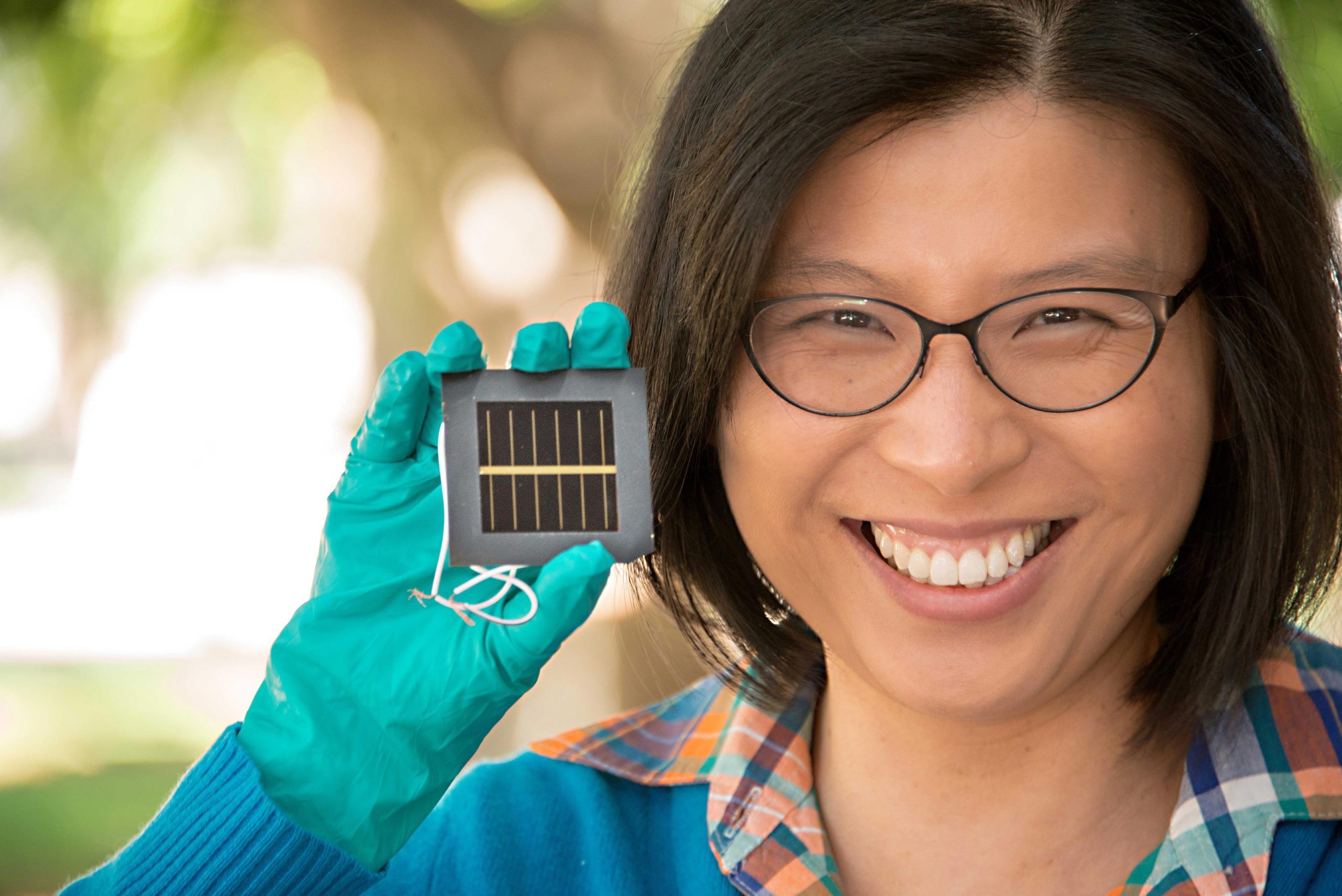
Perovskite crystals could underpin cheap renewable energy.
Australian scientists have for the first time produced a new generation of experimental solar energy cells that pass strict International Electrotechnical Commission testing standards for heat and humidity.
The research findings, an important step towards commercial viability of perovskite solar cells, are published today (May 21, 2020) in the journal Science.
Solar energy systems are now widespread in both industry and domestic housing. Most current systems rely on silicon to convert sunlight into useful energy.
However, the energy conversion rate of silicon in solar panels is close to reaching its natural limits. So, scientists have been exploring new materials that can be stacked on top of silicon in order to improve energy conversion rates. One of the most promising materials to date is a metal halide perovskite, which may even outperform silicon on its own.
“Perovskites are a really promising prospect for solar energy systems,” said Professor Anita Ho-Baillie, the inaugural John Hooke Chair of Nanoscience at the University of Sydney. “They are a very inexpensive, 500 times thinner than silicon and are therefore flexible and ultra-lightweight. They also have tremendous energy enabling properties and high solar conversion rates.”
In experimental form, the past 10 years has seen the performance of perovskites cells improve from low levels to being able to convert 25.2 percent of energy from the Sun into electricity, comparable to silicon-cell conversion rates, which took 40 years to achieve.
However, unprotected perovskite cells do not have the durability of silicon-based cells, so they are not yet commercially viable.
“Perovskite cells will need to stack up against the current commercial standards. That’s what is so exciting about our research. We have shown that we can drastically improve their thermal stability,” Professor Ho-Baillie said.

The scientists did this by suppressing the decomposition of the perovskite cells using a simple, low-cost polymer-glass blanket.
The work was led by Professor Ho-Baillie who joined the University of Sydney Nano Institute. Lead author Dr. Lei Shi conducted the experimental work in Ho-Baillie’s research group in the School of Photovoltaic and Renewable Energy Engineering at the University of New South Wales, where Professor Ho-Baillie remains an adjunct professor.
Under continual exposure to the Sun and other elements, solar panels experience extremes of heat and humidity. Experiments have shown that under such stress, unprotected perovskite cells become unstable, releasing gas from within their structures.
“Understanding this process, called ‘outgassing’, is a central part of our work to develop this technology and to improve its durability,” Professor Ho-Baillie said.
“I have always been interested in exploring how perovskite solar cells could be incorporated into thermal insulated windows, such as vacuum glazing. So, we need to know the outgassing properties of these materials.”
Low-cost solution
For the first time, the research team used gas chromatography-mass spectrometry (GC-MS) to identify the signature volatile products and decomposition pathways of the thermally stressed hybrid perovskites commonly used in high-performance cells. Using this method, they found that a low-cost polymer-glass stack with a pressure-tight seal was effective in suppressing the perovskite ‘outgassing’, the process that leads to its decomposition.
When put to strict international testing standards, the cells the team was working on outperformed expectations.
“Another exciting outcome of our research is that we are able to stabilize perovskite cells under the harsh International Electrotechnical Commission standard environmental testing conditions. Not only did the cells pass the thermal cycling tests, they exceeded the demanding requirements of damp-heat and humidity-freeze tests as well,” Professor Ho-Baillie said.
These tests help determine if solar cell modules can withstand the effects of outdoor operating conditions by exposing them to repeated temperature cycling between -40 degrees and 85 degrees, as well as exposure to 85 percent relative humidity.
Specifically, the perovskite solar cells survived more than 1800 hours of the IEC “Damp Heat” test and 75 cycles of “Humidity Freeze” test, exceeding the requirement of IEC61215:2016 standard for the first time.
“We expect this work will contribute to advances for stabilizing perovskite solar cells, increasing their commercialization prospects,” Professor Ho-Baillie said.
Reference: “Gas chromatography–mass spectrometry analyses of encapsulated stable perovskite solar cells” by Lei Shi, Martin P. Bucknall, Trevor L. Young, Meng Zhang, Long Hu, Jueming Bing, Da Seul Lee, Jincheol Kim, Tom Wu, Noboru Takamure, David R. McKenzie, Shujuan Huang, Martin A. Green and Anita W. Y. Ho-Baillie, 21 May 2020, Science.
DOI: 10.1126/science.aba2412
This research was supported by the Australian Government through the Australian Renewable Energy Agency (ARENA).
Never miss a breakthrough: Join the SciTechDaily newsletter.
Follow us on Google and Google News.
8 Comments
I assume there is no way of making solar cells that could use inferred light. I just thought could the solar cells be cooled and generate warm water? Could a thermocouple be sandwiched between the solar cell and the water to generate more electricity?
Check out Tractile solar (Gold Coast company in Australia located in Southport). They make solar cells with integrated water cooling which in turn is used as a heat coil.
There are many companies out there that use PVT hybrid (photovoltaic and thermal) where they use water to draw heat away and increase efficiency.
“Cheap Renewable Energy a Step Closer …”
Have you been under a rock the past 10 years? Cheap renewable energy is here and undercuts the cost of virtually all new generation as well as the majority of existing depreciated generation. Why would anyone read news from someone so clearly out of touch with reality?
Current photovoltaics are very dirty. Making them is resource-intensive then they need to be replaced in 20 years and end up in a landfill. New photovoltaics don’t merely need to meet the level of current technology, they need to far exceed it if they are truly going to be sustainable. Current tech is FAR from sustainable. Watch “Moore’s “Planet of the Humans.”
@Poftheh, Planet of the Humans is non-sense using very old data. Also, solar modules can, and do, last much longer than 20 years. They offset the energy used to produce them in short order. Building other types of electricity generating facilities uses the same if not more resources. New generating facilities need to be built, regardless of the type, to replace old pants and meet growing demand for electricity, and we need to stop emitting CO2 in our energy generation.
this solar cell was very good. thnks for this guys hping and promoting alternativd energy. hope you will not get any problem also dealing with big oil company’s.(energy freedom)
Typical solar modules today give back all the energy it took to make them (including the glass and metal frames) is less than a year, depending on technology and your local amount of sunshine. The typical warranty is at least 25 years, and early modules are still operating at almost full power after 30+ years. Module recycling is not yet a mature industry because there are not that many modules old enough to need retirement, but there are widespread international efforts to create recycling facilities so any precious metals plus the regular stuff (silicon, glass, metal, aluminum, etc.) can be recycled, we won’t be filling up landfills.