
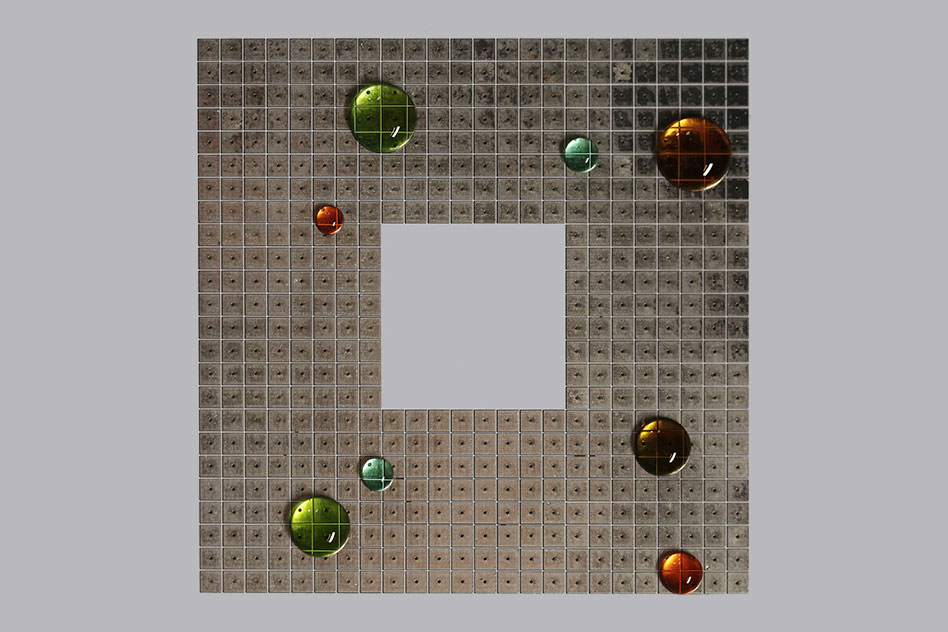
MIT researchers have developed hardware that uses electric fields to move droplets of chemical or biological solutions around a surface, mixing them in ways that could be used to test thousands of reactions in parallel.
The researchers view their system as an alternative to the microfluidic devices now commonly used in biological research, in which biological solutions are pumped through microscopic channels connected by mechanical valves. The new approach, which moves solutions around in computationally prescribed patterns, could enable experiments to be conducted more efficiently, cost-effectively, and at larger scales.
“Traditional microfluidic systems use tubes, valves, and pumps,” says Udayan Umapathi, a researcher at the MIT Media Lab, who led the development of the new system. “What this means is that they are mechanical, and they break down all the time. I noticed this problem three years ago, when I was at a synthetic biology company where I built some of these microfluidic systems and mechanical machines that interact with them. I had to babysit these machines to make sure they didn’t explode.”
“Biology is moving toward more and more complex processes, and we need technologies to manipulate smaller- and smaller-volume droplets,” Umapathi says. “Pumps, valves, and tubes quickly become complicated. In the machine that I built, it took me a week to assemble 100 connections. Let’s say you go from a scale of 100 connections to a machine with a million connections. You’re not going to be able to manually assemble that.”
With his new system, Umapathi explains, thousands of droplets could be deposited on the surface of his device, and they would automatically move around to carry out biological experiments.
The system includes software that allows users to describe, at a high level of generality, the experiments they wish to conduct. The software then automatically calculates droplets’ paths across the surface and coordinates the timing of successive operations.
“The operator specifies the requirements for the experiment — for example, reagent A and reagent B need to be mixed in these volumes and incubated for this amount of time, and then mixed with reagent C. The operator doesn’t specify how the droplets flow or where they mix. It is all precomputed by the software.”
Umapathi and his coauthors — Hiroshi Ishii, the Jerome B. Wiesner Professor of Media Arts and Sciences at MIT; Patrick Shin and Dimitris Koutentakis, MIT undergraduates working in Ishii’s lab; and Sam Gen Chin, a Wellesley undergrad in the lab — describe their new system in a paper appearing this month in the online journal MRS Advances.
In the past 10 years, other research groups have experimented with “digital microfluidics,” or electrical manipulation of droplets, to conduct biological experiments. But their chips were manufactured using high-end etching techniques that require controlled environments known as clean rooms. Umapathi and his colleagues have focused on getting costs down. Their prototype uses a printed circuit board, a commodity electronic device that consists of a plastic board with copper wiring deposited on top of it.
The researchers’ chief technical challenge was to design a coating for the surface of the circuit board that would reduce friction, enabling droplets to slide across it, and that would prevent biological or chemical molecules from sticking to it, so that they won’t contaminate future experiments. The circuit board is patterned with an array of electrodes. In the prototype, the researchers coat the board with a much denser array of tiny spheres, only a micrometer high, made from a hydrophobic (water-repellent) material. Droplets skate across the tops of the spheres. The researchers are also experimenting with structures other than spheres, which may work better with particular biological materials.
Because the device’s surface is hydrophobic, droplets deposited atop it naturally try to assume a spherical shape. Charging an electrode pulls the droplet downward, flattening it out. If the electrode below a flattened droplet is gradually turned off, while the electrode next to it is gradually turned on, the hydrophobic material will drive the droplet toward the charged electrode.
Moving droplets requires high voltages, somewhere between 95 and 200 volts. But 300 times a second, a charged electrode in the MIT researchers’ device alternates between a high-voltage, low-frequency (1-kilohertz) signal and a 3.3-volt high-frequency (200-kilohertz) signal. The high-frequency signal enables the system to determine a droplet’s location, using essentially the same technology that touch-screen phones do.
If the droplet isn’t moving rapidly enough, the system will automatically boost the voltage of the low-frequency signal. From the sensor signal, the system can also estimate a droplet’s volume, which, together with location information, allows it to track a reaction’s progress.
Umapathi believes that digital microfluidics could drastically cut the cost of experimental procedures common in industrial biology. Pharmaceutical companies, for instance, will frequently conduct many experiments in parallel, using robots equipped with dozens or even hundreds of pipettes, little measuring tubes that are rather like elongated eye droppers.
“If you look at drug discovery companies, one pipetting robot uses a million pipette tips in one week,” Umapathi says. “That is part of what is driving the cost of creating new drugs. I’m starting to develop some liquid assays that could reduce the number of pipetting operations 100-fold.”
“In the last 15, 20 years, the general trend in pharma has been to move toward smaller volumes, because they have greater multiplexing capability,” says Charles Fracchia, founder and CEO of BioBright, a company that develops information systems to manage the wealth of data generated by modern, high-volume biological experiments. “When it comes to digital microfluidics the way Udayan does it, it’s effectively a cheaper version, and it’s one-sided instead of being sandwiched between two electrodes. I don’t want to call it DIY bio, but it’s lower-cost, simpler instrumentation, easier access. He definitely hit that note a lot better than [earlier systems] did. It’s exciting that he’s managed to do it with lower voltage, and it’s exciting that he can do it with a single electrode.”
You can find more information here.
Publication: (In press)
Never miss a breakthrough: Join the SciTechDaily newsletter.
Follow us on Google and Google News.