
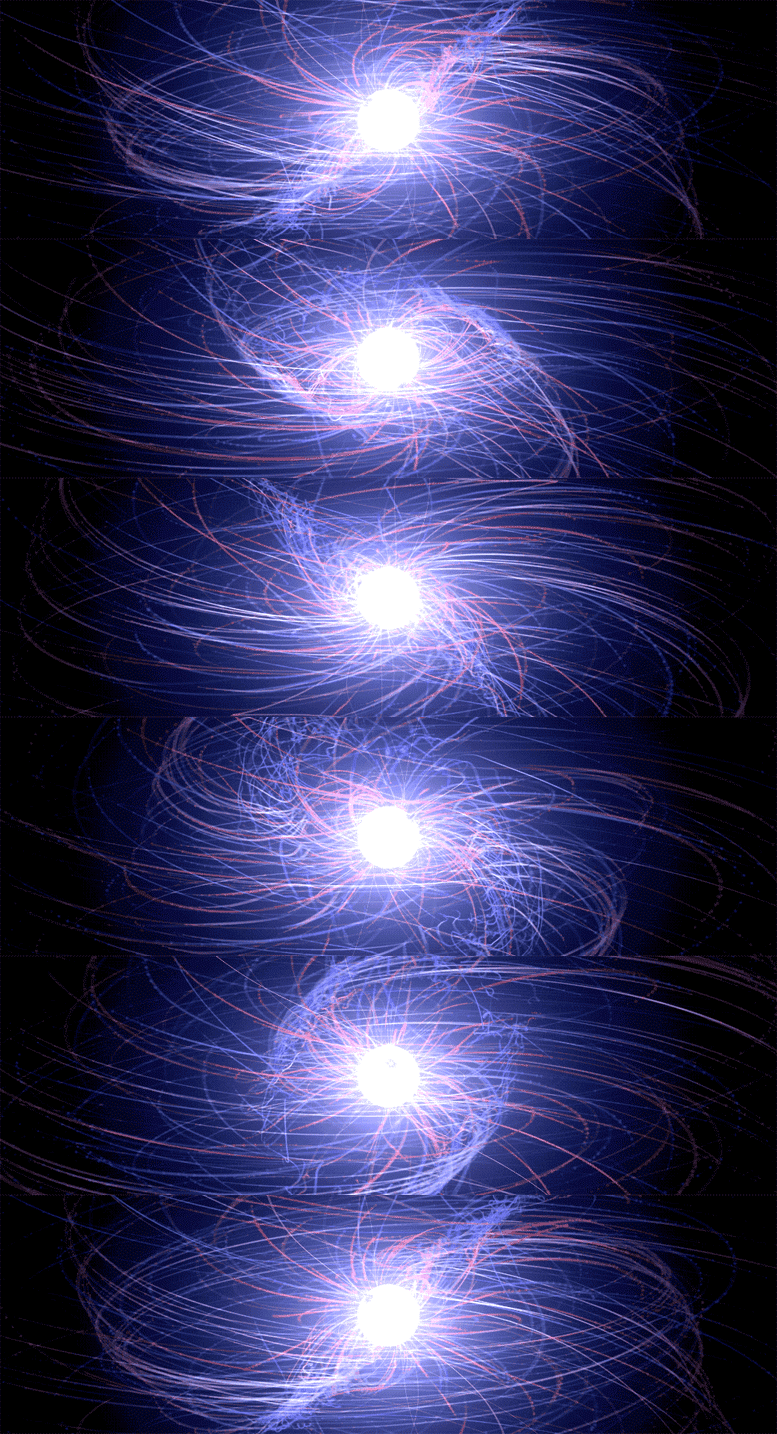
An international team of scientists studying what amounts to a computer-simulated “pulsar in a box” are gaining a more detailed understanding of the complex, high-energy environment around spinning neutron stars, also called pulsars. The model traces the paths of charged particles in magnetic and electric fields near the neutron star, revealing behaviors that may help explain how pulsars emit gamma-ray and radio pulses with ultraprecise timing.
“Efforts to understand how pulsars do what they do began as soon as they were discovered in 1967, and we’re still working on it,” said Gabriele Brambilla, an astrophysicist at NASA’s Goddard Space Flight Center in Greenbelt, Maryland, and the University of Milan who led a study of the recent simulation. “Even with the computational power available today, tracking the physics of particles in the extreme environment of a pulsar is a considerable challenge.”
A pulsar is the crushed core of a massive star that ran out of fuel, collapsed under its own weight, and exploded as a supernova. Gravity forces more mass than the Sun’s into a ball no wider than Manhattan Island in New York City while also revving up its rotation and strengthening its magnetic field. Pulsars can spin thousands of times a second and wield the strongest magnetic fields known.
Explore a new “pulsar in a box” computer simulation that tracks the fate of electrons (blue) and their antimatter kin, positrons (red), as they interact with powerful magnetic and electric fields around a neutron star. Lighter tracks indicate higher particle energies. Each particle seen in this visualization actually represents trillions of electrons or positrons. Better knowledge of the particle environment around neutron stars will help astronomers understand how they produce precisely timed radio and gamma-ray pulses. Credit: NASA’s Goddard Space Flight Center
These characteristics also make pulsars powerful dynamos, with super strong electric fields that can rip particles out of the surface and accelerate them into space.
NASA’s Fermi Gamma-ray Space Telescope has detected gamma rays from 216 pulsars. Observations show that the high-energy emission occurs farther away from the neutron star than the radio pulses. But exactly where and how these signals are produced remains poorly known.
Various physical processes ensure that most of the particles around a pulsar are either electrons or their antimatter counterparts, positrons.
“Just a few hundred yards above a pulsar’s magnetic pole, electrons pulled from the surface may have energies comparable to those reached by the most powerful particle accelerators on Earth,” said Goddard’s Alice Harding. “In 2009, Fermi discovered powerful gamma-ray flares from the Crab Nebula pulsar that indicate the presence of electrons with energies a thousand times greater.”
Speedy electrons emit gamma rays, the highest-energy form of light, through a process called curvature radiation. A gamma-ray photon can, in turn, interact with the pulsar’s magnetic field in a way that transforms it into a pair of particles, an electron, and a positron.
To trace the behavior and energies of these particles, Brambilla, Harding, and their colleagues used a comparatively new type of pulsar model called a “particle in cell” (PIC) simulation. Goddard’s Constantinos Kalapotharakos led the development of the project’s computer code. In the last five years, the PIC method has been applied to similar astrophysical settings by teams at Princeton University in New Jersey and Columbia University in New York.
“The PIC technique lets us explore the pulsar from first principles. We start with a spinning, magnetized pulsar, inject electrons and positrons at the surface, and track how they interact with the fields and where they go,” Kalapotharakos said. “The process is computationally intensive because the particle motions affect the electric and magnetic fields and the fields affect the particles, and everything is moving near the speed of light.”
The simulation shows that most of the electrons tend to race outward from the magnetic poles. The positrons, on the other hand, mostly flow out at lower latitudes, forming a relatively thin structure called the current sheet. In fact, the highest-energy positrons here — less than 0.1 percent of the total — are capable of producing gamma rays similar to those Fermi detects, confirming the results of earlier studies.
Some of these particles likely become boosted to tremendous energies at points within the current sheet where the magnetic field undergoes reconnection, a process that converts stored magnetic energy into heat and particle acceleration.
One population of medium-energy electrons showed truly odd behavior, scattering every which way — even back toward the pulsar.
The particles move with the magnetic field, which sweeps back and extends outward as the pulsar spins. Their rotational speed rises with increasing distance, but this can only go on so long because matter can’t travel at the speed of light.
The distance where the plasma’s rotational velocity would reach light speed is a feature astronomers call the light cylinder, and it marks a region of abrupt change. As the electrons approach it, they suddenly slow down and many scatter wildly. Others can slip past the light cylinder and out into space.
The simulation ran on the Discover supercomputer at NASA’s Center for Climate Simulation at Goddard and the Pleiades supercomputer at NASA’s Ames Research Center in Silicon Valley, California. The model actually tracks “macroparticles,” each of which represents many trillions of electrons or positrons. A paper describing the findings was published on May 9 in The Astrophysical Journal.
“So far, we lack a comprehensive theory to explain all the observations we have from neutron stars. That tells us we don’t yet completely understand the origin, acceleration, and other properties of the plasma environment around the pulsar,” Brambilla said. “As PIC simulations grow in complexity, we can expect a clearer picture.”
NASA’s Fermi Gamma-ray Space Telescope is an astrophysics and particle physics partnership, developed in collaboration with the U.S. Department of Energy and with important contributions from academic institutions and partners in France, Germany, Italy, Japan, Sweden, and the United States.
Reference: “Electron–Positron Pair Flow and Current Composition in the Pulsar Magnetosphere” by Gabriele Brambilla, Constantinos Kalapotharakos, Andrey N. Timokhin, Alice K. Harding and Demosthenes Kazanas, 9 May 2018, The Astrophysical Journal.
DOI: 10.3847/1538-4357/aab3e1
Never miss a breakthrough: Join the SciTechDaily newsletter.
Follow us on Google and Google News.