
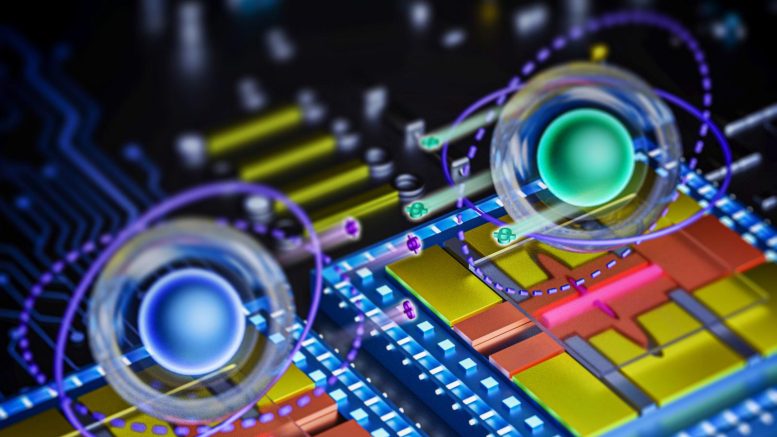
Breakthrough Realized for Retaining Quantum Information in a Single-Electron Quantum Bit
Argonne and partners attained a major milestone toward quantum computing based on single-electron qubits: nearly a thousand-fold increase in coherence time and a first demonstration of scale-up.
Quantum Coherence and Computing Advancements
Coherence stands as a pillar of effective communication, whether it is in writing, speaking or information processing. This principle extends to quantum bits, or qubits, the building blocks of quantum computing. A quantum computer could one day tackle previously insurmountable challenges in climate prediction, material design, drug discovery, and more.
A team led by the U.S. Department of Energy’s (DOE) Argonne National Laboratory has achieved a major milestone toward future quantum computing. They have extended the coherence time for their novel type of qubit to an impressive 0.1 milliseconds — nearly a thousand times better than the previous record.
“Rather than 10 to 100 operations over the coherence times of conventional electron charge qubits, our qubits can perform 10,000 with very high precision and speed.”
Dafei Jin, professor at the University of Notre Dame with a joint appointment at Argonne’s Center for Nanoscale Materials.
Significance in the Quantum Realm
In everyday life, 0.1 milliseconds is as fleeting as a blink of an eye. However, in the quantum world, it represents a long enough window for a qubit to perform many thousands of operations.
Unlike classical bits, qubits seemingly can exist in both states, 0 and 1. For any working qubit, maintaining this mixed state for a sufficiently long coherence time is imperative. The challenge is to safeguard the qubit against the constant barrage of disruptive noise from the surrounding environment.
The team’s qubits encode quantum information in the electron’s motional (charge) states. Because of that, they are called charge qubits.
“Among various existing qubits, electron charge qubits are especially attractive because of their simplicity in fabrication and operation, as well as compatibility with existing infrastructures for classical computers,” said Dafei Jin, a professor at the University of Notre Dame with a joint appointment at Argonne and the lead investigator of the project. “This simplicity should translate into low cost in building and running large-scale quantum computers.”
Jin is a former staff scientist at the Center for Nanoscale Materials (CNM), a DOE Office of Science user facility at Argonne. While there, he led the discovery of their new type of qubit, reported last year.
Innovations in Qubit Design
The team’s qubit is a single electron trapped on an ultraclean solid-neon surface in a vacuum. The neon is important because it resists disturbance from the surrounding environment. Neon is one of a handful of elements that do not react with other elements. The neon platform keeps the electron qubit protected and inherently guarantees a long coherence time.
“Thanks to the small footprint of single electrons on solid neon, qubits made with them are more compact and promising for scaling up to multiple linked qubits,” said Xu Han, an assistant scientist in CNM with a joint appointment at the Pritzker School of Molecular Engineering at the University of Chicago. “These attributes, along with coherence time, make our electron qubit exceptionally compelling.”
Following continued experimental optimization, the team not only improved the quality of the neon surface but also significantly reduced disruptive signals. As reported in Nature Physics, their work paid off with a coherence time of 0.1 milliseconds. That is about a thousand-fold increase from the initial 0.1 microseconds.
“The long lifetime of our electron qubit allows us to control and read out the single qubit states with very high fidelity,” said Xinhao Li, a postdoctoral appointee at Argonne and the co-first author of the paper. This time is well above the requirements for quantum computing.
“Rather than 10 to 100 operations over the coherence times of conventional electron charge qubits, our qubits can perform 10,000 with very high precision and speed,” Jin said.
Future Prospects and Achievements
Yet another important attribute of a qubit is its scalability to link with many other qubits. The team achieved a significant milestone by showing that two-electron qubits can couple to the same superconducting circuit such that information can be transferred between them through the circuit. This marks a pivotal stride toward two-qubit entanglement, a critical aspect of quantum computing.
The team has not yet fully optimized their electron qubit and will continue to work on extending the coherence time even further as well as entangling two or more qubits.
This research was published in Nature Physics.
Reference: “Electron charge qubit with 0.1 millisecond coherence time” by Xianjing Zhou, Xinhao Li, Qianfan Chen, Gerwin Koolstra, Ge Yang, Brennan Dizdar, Yizhong Huang, Christopher S. Wang, Xu Han, Xufeng Zhang, David I. Schuster and Dafei Jin, 26 October 2023, Nature Physics.
DOI: 10.1038/s41567-023-02247-5
The work was funded by the DOE Office of Basic Energy Sciences; a Laboratory Directed Research and Development award from Argonne; and Q-NEXT, a DOE Energy National Quantum Information Science Research Center headquartered at Argonne. Additional funding came from the Julian Schwinger Foundation for Physics Research and National Science Foundation.
In addition to Jin, Han, and Li, Argonne contributors include postdocs Xianjing Zhou (co-first author) and Qianfan Chen. Other contributors include co-corresponding author David I. Schuster, a former physics professor at the University of Chicago now at Stanford University, and Xufeng Zhang, a former staff scientist at CNM and now a professor at Northeastern University. Also listed as authors are Gerwin Koolstra, Ge Yang, Brennan Dizdar, Yizhong Huang, and Christopher S. Wang.
The collaborating institutions include Lawrence Berkeley National Laboratory, Massachusetts Institute of Technology, Northeastern University, Stanford University, the University of Chicago, and the University of Notre Dame.
Never miss a breakthrough: Join the SciTechDaily newsletter.
Follow us on Google and Google News.
3 Comments
test
Use the Monty Carlo algorithms to simulate real world data using the small amount of data you have now.100k times or more. Your welcome. And wow what a discovery!!!
Working together worldwide 365 days 24/7 hours.