
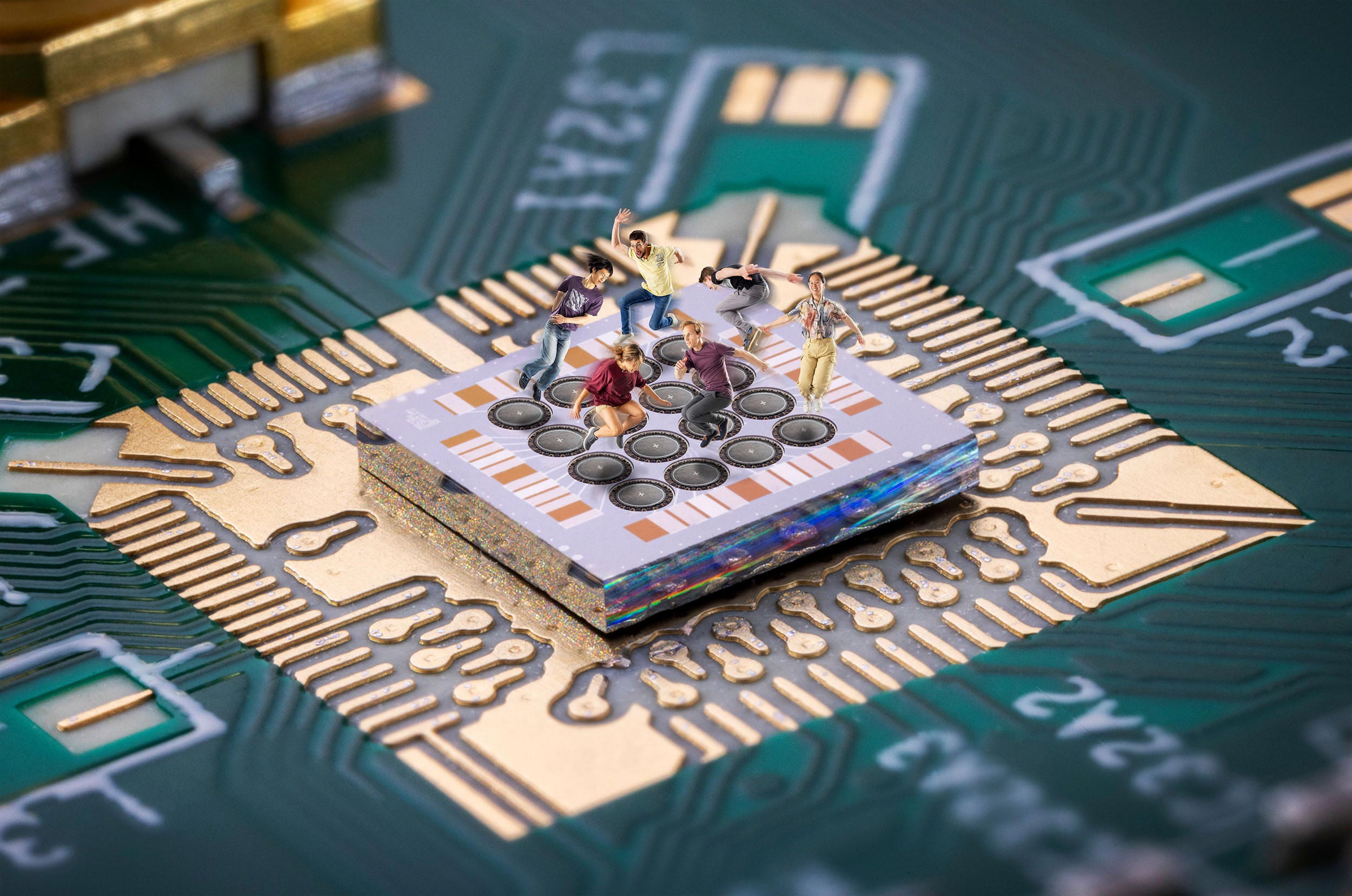
Researchers at QuTech developed somersaulting spin qubits for universal quantum logic. This achievement may enable efficient control of large semiconductor qubit arrays.
Over twenty years after Loss and DiVincenzo’s proposal for quantum computation with quantum dots, QuTech researchers have realized these concepts using germanium to facilitate spin control. This approach simplifies the electronics needed for quantum computing, demonstrating effective control over extended quantum dot arrays.
Quantum Dot Qubits
In 1998, Loss and DiVincenzo published the seminal work ‘quantum computation with quantum dots’. In their original work, hopping of spins was proposed as a basis for qubit logic, but an experimental implementation has remained lacking. After more than 20 years, experiments have caught up with theory. Researchers at QuTech —a collaboration between the TU Delft and TNO— have demonstrated that the original ‘hopping gates’ are indeed possible, with state-of-the-art performance.
Advancements in Qubit Control
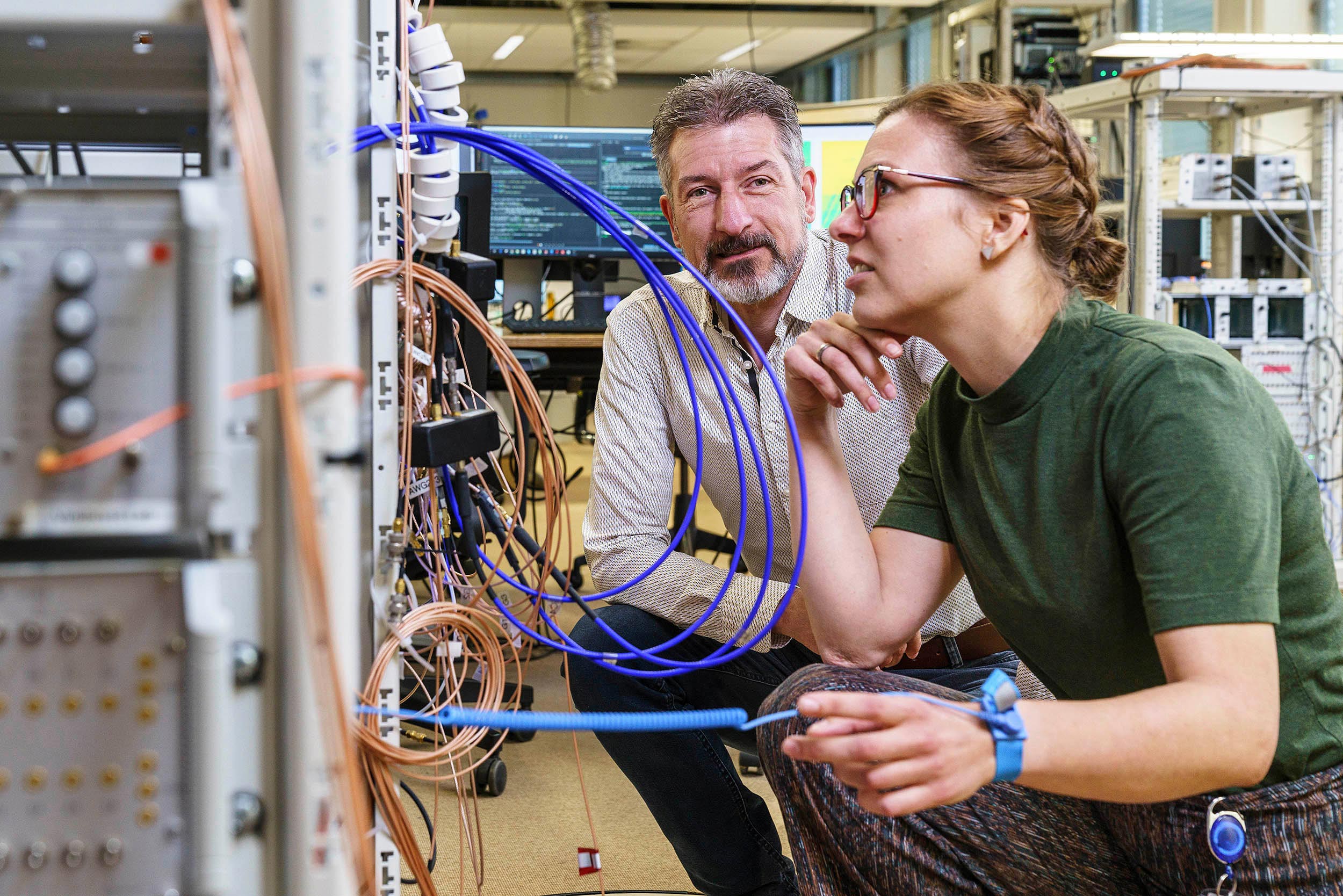
Qubits based on quantum dots are studied worldwide as they are considered a compelling platform for the construction of a quantum computer. The most popular approach is to trap a single electron and to apply a sufficiently large magnetic field, allowing the spin of the electron to be used as a qubit and controlled by microwave signals.
In this work, however, the researchers demonstrate that no microwave signals are needed. Instead, baseband signals and small magnetic fields are sufficient to achieve universal qubit control. This is beneficial because it can significantly simplify the control electronics required to operate future quantum processors.
From Hopping to Somersaulting Qubits
Controlling the spin requires hopping from dot to dot and a physical mechanism capable of rotating it. Initially, the proposal of Loss and DiVincenzo uses a specific type of magnet, which proved difficult to realize experimentally. Instead, the group at QuTech pioneered germanium. This semiconductor conveniently may by itself already allow for spin rotations. This is motivated by work published in Nature Communications, where Floor van Riggelen-Doelman and Corentin Déprez of the same group show that germanium can serve as a platform for hopping of spin qubits as a basis to make quantum links. They observed first indications of spin rotations.
When considering the difference between hopping and somersaulting qubits, think of quantum dot arrays as a trampoline park, where electron spins are like people jumping. Typically, each person has a dedicated trampoline, but they can hop over to neighboring trampolines if available. Germanium has a unique property: just by jumping from one trampoline to the next, a person experiences a torque that makes them somersault. This property allows researchers to control the qubits effectively.
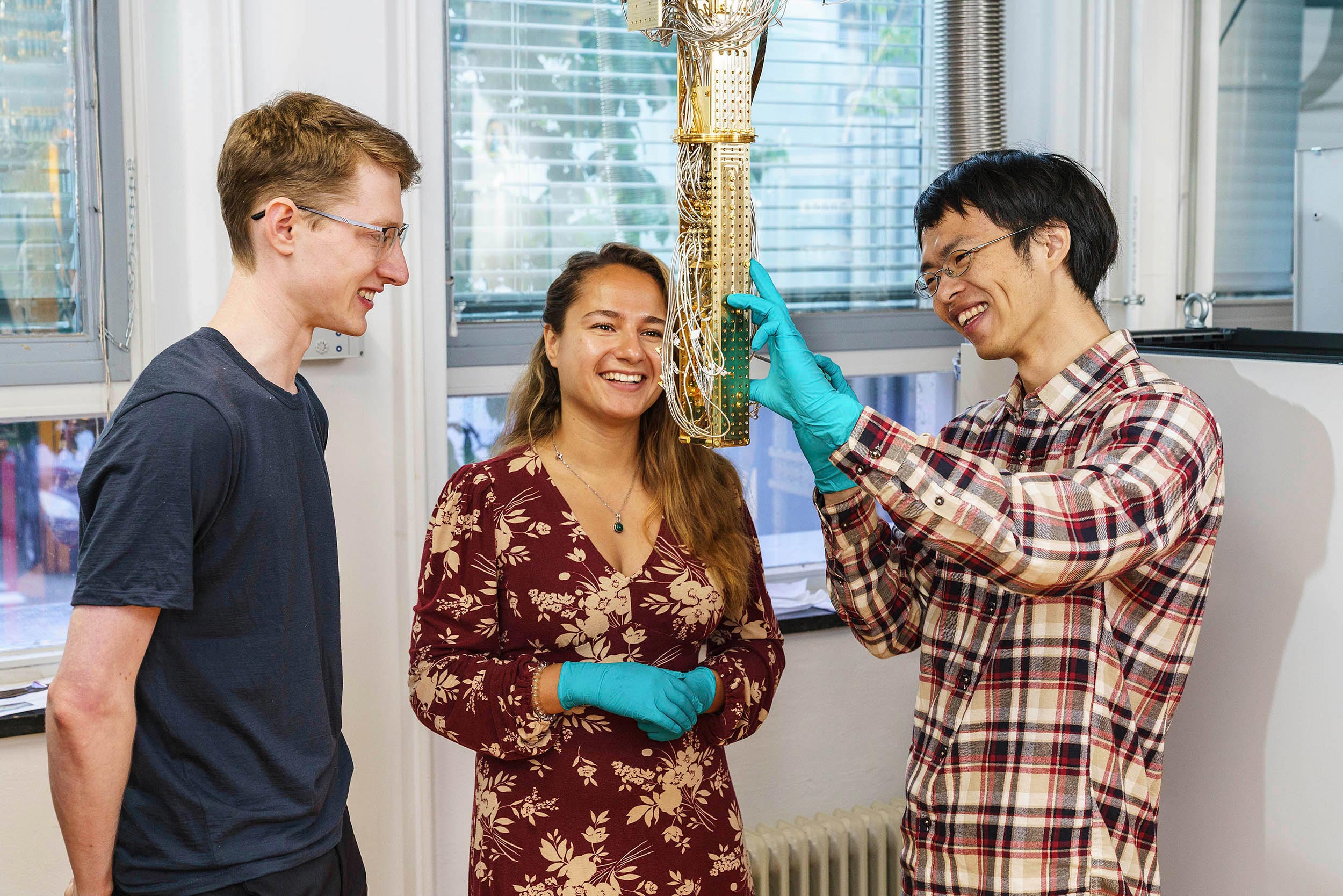
Chien-An Wang, first-author of the Science paper, specifies: “Germanium has the advantage of aligning spins along different directions in different quantum dots.” It turned out that very good qubits can be made by hopping spins between such quantum dots. “We measured error rates less than a thousand for one-qubit gates and less than a hundred for two-qubit gates.”
Somersaulting Qubits in a Trampoline Park
Having established control over two spins in a four-quantum dot system, the team took it a step further. Instead of hopping spins between two quantum dots, the team also investigated hopping through several quantum dots. Analogously, this would correspond to a person that is hopping and somersaulting over many trampolines. Co-author Valentin John explains: “For quantum computing, it is necessary to operate and couple large numbers of qubits with high precision.”
Different trampolines make people experience different torques when jumping, and similarly, hopping spins between quantum dots also result in unique rotations. It is thus important to characterize and understand the variability. Co-author Francesco Borsoi adds: “We established control routines that enables to hop spins to any quantum dot in a 10-quantum dot array, which allows us to probe key qubit metrics in extended systems.”
Team Effort
“I am proud to see all the teamwork” principal investigator Menno Veldhorst sums up. “In a time span of a year, the observation of qubit rotations due to hopping became a tool that is used by the entire group. We believe it is critical to develop efficient control schemes for the operation of future quantum computers and this new approach is promising.”
References:
“Coherent spin qubit shuttling through germanium quantum dots” by Floor van Riggelen-Doelman, Chien-An Wang, Sander L. de Snoo, William I. L. Lawrie, Nico W. Hendrickx, Maximilian Rimbach-Russ, Amir Sammak, Giordano Scappucci, Corentin Déprez and Menno Veldhorst, 8 July 2024, Nature Communications.
DOI: 10.1038/s41467-024-49358-y
“Operating semiconductor quantum processors with hopping spins” by Chien-An Wang, Valentin John, Hanifa Tidjani, Cécile X. Yu, Alexander S. Ivlev, Corentin Déprez, Floor van Riggelen-Doelman, Benjamin D. Woods, Nico W. Hendrickx, William I. L. Lawrie, Lucas E. A. Stehouwer, Stefan D. Oosterhout, Amir Sammak, Mark Friesen, Giordano Scappucci, Sander L. de Snoo, Maximilian Rimbach-Russ, Francesco Borsoi and Menno Veldhorst, 25 July 2024, Science.
DOI: 10.1126/science.ado5915
Never miss a breakthrough: Join the SciTechDaily newsletter.
Follow us on Google and Google News.
2 Comments
Do you get spin loss over time?
Does the spin / hopping go off the plate in random directions?
Can you build a wall to stop edge loss?
Would the wall need to have it’s own spin variables to put the bits back in play in the same spin state it had when it left the plate?
Do you get spin loss over time?
Does the spin / hopping go off the plate in random directions?
Can you build a wall to stop edge loss?
Would the wall need to have it’s own spin variables to put the bits back in play in the same spin state it had when it left the plate?