

Harvard scientists have developed a groundbreaking photon router that connects optical signals to superconducting microwave qubits, the building blocks of many quantum computers.
This innovation could overcome one of quantum computing’s biggest hurdles: getting different quantum systems to “talk” to each other efficiently. The key lies in using light, not bulky wires, to control and connect qubits, enabling faster, more scalable, and more robust quantum networks. The tiny chip-sized device could help bring distributed, fiber-optic-based quantum computers closer to reality.
Toward Modular Quantum Networks
Applied physicists at the Harvard John A. Paulson School of Engineering and Applied Sciences (SEAS) have developed a photon router that could one day link quantum computers through existing fiber-optic networks. The device creates a robust optical interface for quantum systems that rely on microwave signals, especially those sensitive to electrical noise.
This advance brings researchers closer to building modular, distributed quantum computing networks. These networks would send quantum information over today’s global telecommunications infrastructure, which already moves data as pulses of light, called photons, through millions of miles of optical fiber.
Bridging the Quantum Gap
The research team, led by Marko Lončar, the Tiantsai Lin Professor of Electrical Engineering and Applied Physics at SEAS, designed a new type of microwave-optical quantum transducer. The device enables communication between microwave-based superconducting qubits, the quantum equivalent of classical bits, and optical signals. Their findings were published today (April 2) in Nature Physics.
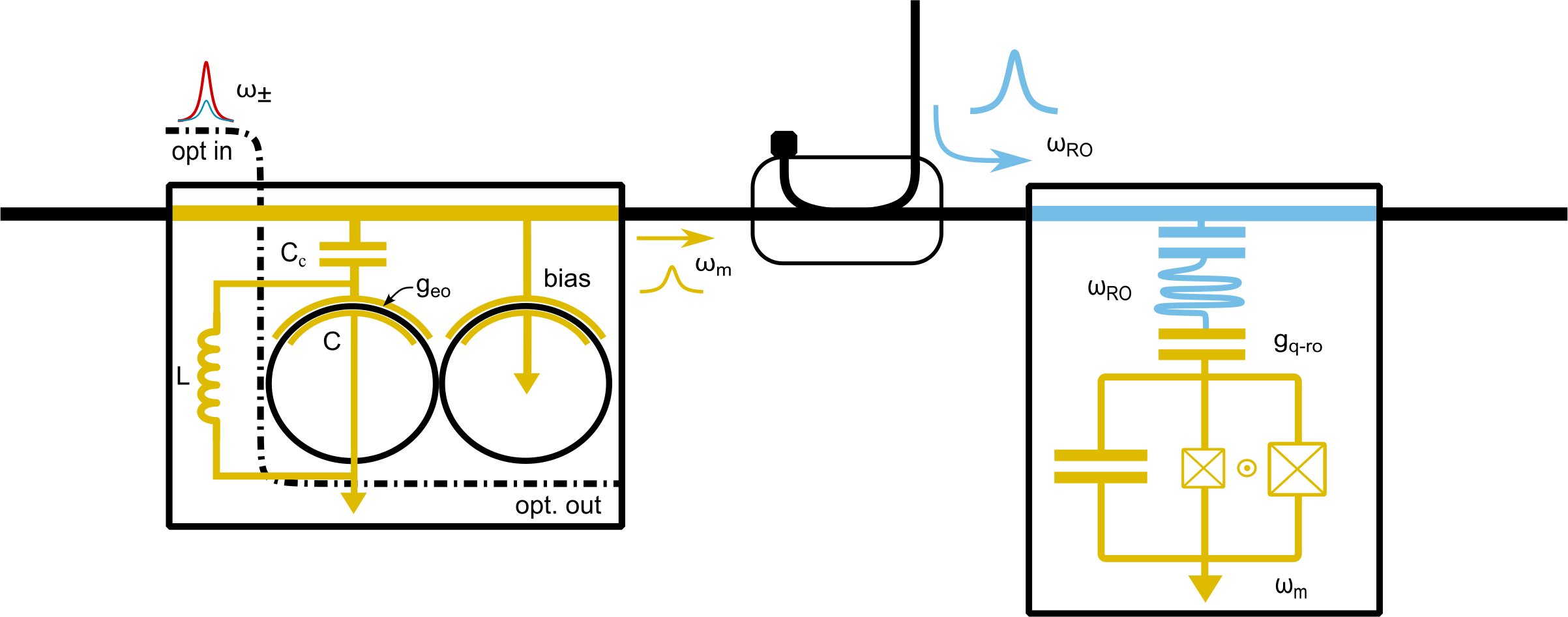
Effectively a router for photons, the transducer bridges the large energy gap between microwave and optical photons, thus enabling control of microwave qubits with optical signals generated many miles away. The device is the first of its kind to demonstrate control of a superconducting qubit using only light.
Optical Power for Scalable Quantum Systems
Paper first author and graduate student Hana Warner said the transducer offers a way to tap the power of optics when dreaming up quantum networks. “The realization of these systems is still a ways out, but in order to get there, we need to figure out practical ways to scale and interface with the different components,” Warner said. “Optical photons are one of the best ways you can do that, because they’re very good carriers of information, with low loss, and high bandwidth.”
Superconducting qubits, which are nanofabricated circuits engineered for different energy states, are an emerging quantum computing platform due to their scalability, compatibility with existing manufacturing processes, and ability to maintain quantum superposition long enough to perform calculations.
Overcoming Low-Temperature Bottlenecks
But one of the major bottlenecks to deploying superconducting microwave qubit platforms is the extremely low temperatures at which they must operate, necessitating large cooling systems called dilution refrigerators. Since future quantum computing will require millions of qubits to operate, scaling these systems only on microwave-frequency signals is challenging. The solution lies in using microwave qubits to do the quantum operations, but to use optical photons as efficient and scalable interfaces.
That’s where the transducer comes in.
A Compact Light-Matter Interface
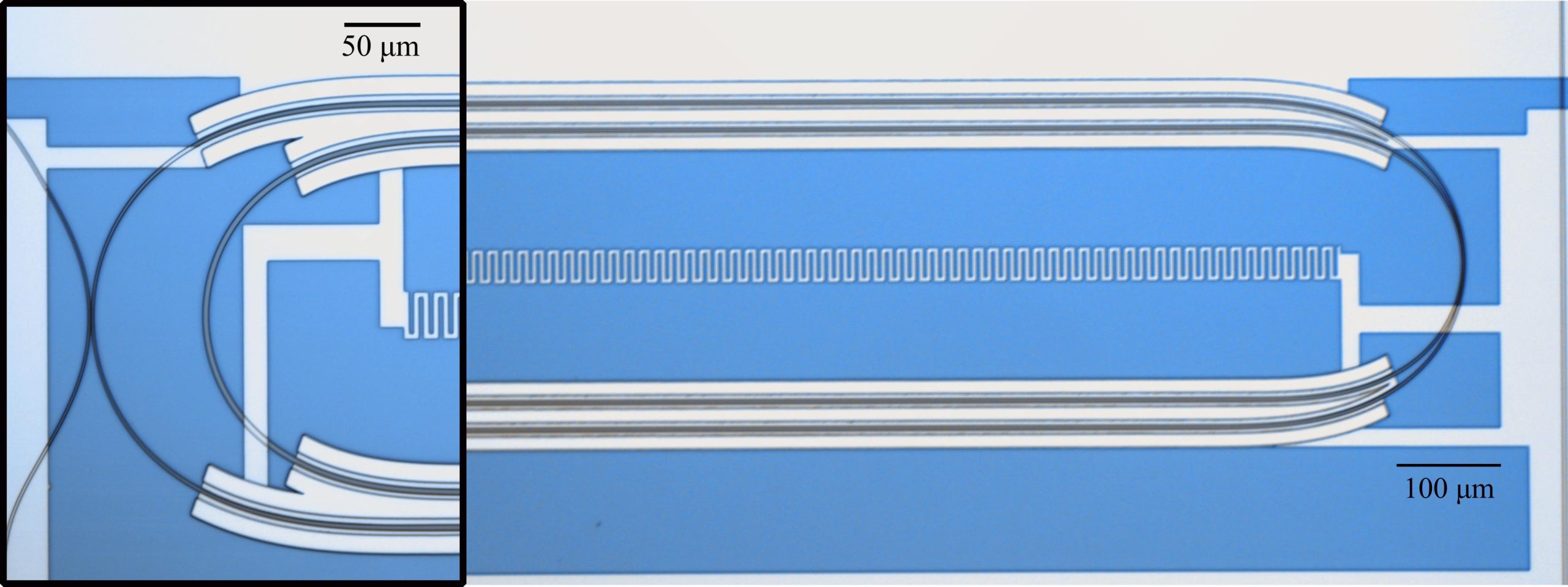
The Harvard team’s 2-millimeter optical device resembles a paper clip and sits on a chip that’s about 2 centimeters in length. It works by linking a microwave resonator with two optical resonators, allowing back-and-forth exchange of energy enabled by the properties of their base material, lithium niobate. The team leveraged this exchange to eliminate the need for bulky, hot microwave cables for controlling qubit states.
The same devices used for control could be used for qubit state readout, or for forming direct links to convert finicky quantum information into sturdy packets of light between quantum computing nodes. The breakthrough brings us closer to a world with superconducting quantum processors connected by low-loss, high-powered optical networks.
Entangling the Future
“The next step for our transducer could be reliable generation and distribution of entanglement between microwave qubits using light,” Lončar said.
Reference: “Coherent control of a superconducting qubit using light” by Hana K. Warner, Jeffrey Holzgrafe, Beatriz Yankelevich, David Barton, Stefano Poletto, C. J. Xin, Neil Sinclair, Di Zhu, Eyob Sete, Brandon Langley, Emma Batson, Marco Colangelo, Amirhassan Shams-Ansari, Graham Joe, Karl K. Berggren, Liang Jiang, Matthew J. Reagor and Marko Lončar, 2 April 2025, Nature Physics.
DOI: 10.1038/s41567-025-02812-0
The Harvard team combined their expertise in optical systems with collaborators at Rigetti Computing, who provided the superconducting qubit platform on which the researchers tested their transducer and mapped out different experiments. Other collaborators were from the University of Chicago and the Massachusetts Institute of Technology.
Fabrication of the chips was performed at Harvard’s Center for Nanoscale Systems, a member of the National Nanotechnology Coordinated Infrastructure Network, which is supported by National Science Foundation Award No. 1541959.
The work was further supported by the Air Force Research Laboratory under award RCP06360; the National Science Foundation under awards EEC-1914583, OMA-2137723, OMA-1936118, ERC-1941583, and OMA-2137642; the Defense Advanced Research Projects Agency under award HR01120C0137; the Department of Defense under award FA8702-15-D-000; the Department of Energy under award DE-SC0020376; the Air Force Office of Scientific Research under awards FA9550-20-1, FA9550-19-1-0399, and FA9550-21-1-0209; the Army Research Office under awards W911NF-20-1-0248, W911NF-23-1- 0077, and W911NF-21-1-0325; and NTT Research, Packard Foundation under award 2020-71479.
Never miss a breakthrough: Join the SciTechDaily newsletter.
Follow us on Google and Google News.