

Researchers at Rice University have developed a sophisticated 3D photonic-crystal cavity that can trap and control light in unprecedented ways, unlocking powerful light-matter interactions. Their work explores how photons and electrons interact under intense conditions — revealing exotic quantum states like polaritons and entering the realm of “ultrastrong coupling.”
What started as a study of confined light turned into a breakthrough discovery of photon-photon coupling mediated by matter, opening doors to new types of quantum circuits, superfast computing, and ultra-secure communication.
Unlocking Light with 3D Photonic Crystals
Researchers at Rice University have developed a new way to control how light interacts with matter, using a specially designed structure known as a 3D photonic-crystal cavity. Their findings, published in Nature Communications, could help pave the way for major advances in quantum computing, quantum communication, and other emerging quantum technologies.
“Imagine standing in a room surrounded by mirrors,” said Fuyang Tay, an alumnus of Rice’s Applied Physics Graduate Program and first author of the study. “If you shine a flashlight inside, the light will bounce back and forth, reflecting endlessly. This is similar to how an optical cavity works — a tailored structure that traps light between reflective surfaces, allowing it to bounce around in specific patterns.”
From Simple Cavities to Complex Light-Matter Interactions
These trapped light patterns, known as cavity modes, have distinct frequencies and can amplify interactions between light and matter. This makes them useful for developing ultra-precise lasers and sensors, improving photonic circuits, and enabling quantum information systems. However, building optical cavities is challenging, and most use simpler one-dimensional designs.
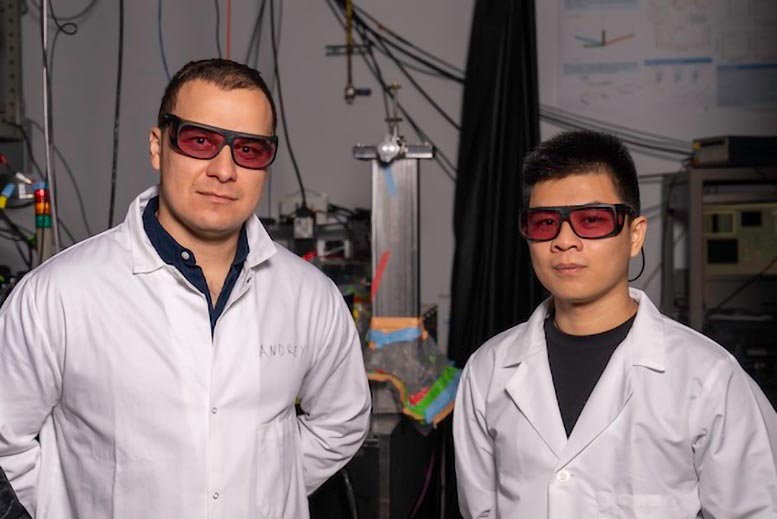
In this study, Tay and co-author Ali Mojibpour, along with their Rice colleagues, constructed a more complex three-dimensional optical cavity. They used it to explore how multiple cavity modes interact with a thin sheet of free-moving electrons placed in a steady magnetic field. Their central question: What happens when several cavity modes engage with electrons at the same time?
Quantum Superpositions Through Light Confinement
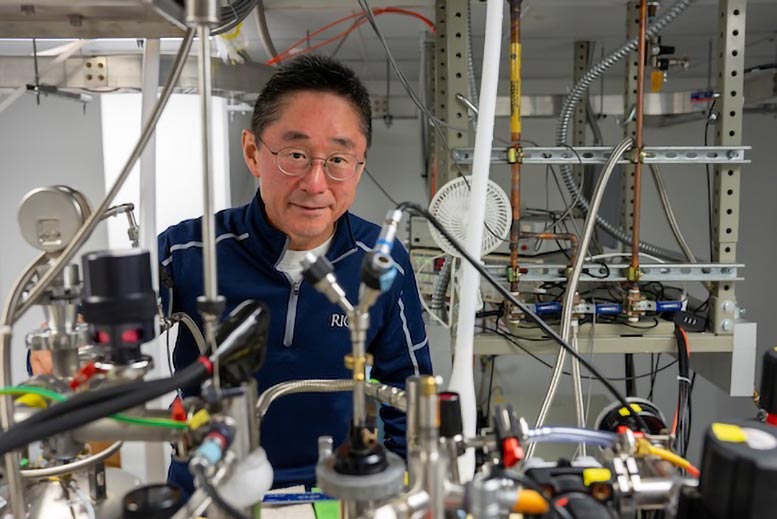
“It is well known that electrons strongly interact with each other, but photons do not,” said Junichiro Kono, the Karl F. Hasselmann Professor in Engineering, professor of electrical and computer engineering and materials science and nanoengineering and the study’s corresponding author. “This cavity confines light, which strongly enhances the electromagnetic fields and leads to strong coupling between light and matter, creating quantum superposition states ⎯ so-called polaritons.”
Polaritons, also known as hybrid light-matter states, present a way to control and manipulate light at very small scales, which could enable faster and more energy-efficient quantum computing and communication technologies. Polaritons can also behave collectively, giving rise to states of quantum entanglement that could be used for new types of quantum circuits and sensors.
Entering the Ultrastrong Coupling Regime
If the interaction binding photons and electrons into polaritons is extremely intense ⎯ to the point where the exchange of energy between light and matter happens so fast it resists dissipation ⎯ a new regime comes into effect known as ultrastrong coupling.
“Ultrastrong coupling describes an unusual mode of interaction between light and matter where the two become deeply hybridized,” said Tay, who is currently a postdoctoral researcher at Columbia University.
Watching Coupling Happen with Terahertz Light
The researchers used terahertz radiation to observe how the cavity modes and electrons couple inside the 3D optical cavity, navigating experimental challenges such as the need for ultracold temperatures and strong magnetic fields.
They found not only that different cavity modes interact with moving electrons in an ultrastrong coupling regime but also that this multimodal light-matter coupling is dependent on the polarization of the incoming light, which triggers one of two forms of interaction.
“Depending on the polarization of the light, the cavity modes either remain independent, or they mix together, forming completely new hybrid modes,” Tay said. “This suggests we can engineer materials where different cavity modes ‘talk’ to each other through the electrons in a magnetic field, creating new correlated states.”
The “Aha” Moment: Photon-Photon Coupling
If initially the researchers were mainly focused on how the 3D photonic crystal cavity served to increase light-matter coupling, the realization that the setup could be used to induce matter-mediated photon-photon coupling came as an “aha moment” in the research, said Andrey Baydin, an assistant research professor of electrical and computer engineering at Rice and study co-author.
“This matter-mediated photon-photon coupling can lead to new protocols and algorithms in quantum computation and quantum communications,” Kono said.
Simulation Meets Experiment
Alessandro Alabastri, assistant professor of electrical and computer engineering, together with Stephen Sanders, a postdoctoral researcher in his lab, developed a simulation of the cavity structure, replicating the material properties and electromagnetic field dynamics observed during the experiment.
Alabastri praised Tay for his interest in understanding the simulation side of the work in addition to the experimental side.
“He is an experimentalist, but what I found really interesting is that he was really willing to learn the computational part as well,” Alabastri said.
Paving the Way for Next-Gen Quantum Tech
By providing a new approach to engineering light-matter interactions and ultrastrong photon-photon couplings, the research findings pave the way for the development of hyperefficient quantum processors, high-speed data transmission and next-generation sensors.
“Quantum phenomena or states are famously fragile,” said Kono, who serves as the director of Rice’s Smalley-Curl Institute. “Cavity quantum electrodynamics is an emerging field of research for quantum technology, where the cavity setting provides a controlled environment for protecting and harnessing quantum states. At Rice, we have been very active in quantum science research ⎯ we are tackling some of the biggest challenges in the field.”
Reference: “Multimode ultrastrong coupling in three-dimensional photonic-crystal cavities” by Fuyang Tay, Ali Mojibpour, Stephen Sanders, Shuang Liang, Hongjing Xu, Geoff C. Gardner, Andrey Baydin, Michael J. Manfra, Alessandro Alabastri, David Hagenmüller and Junichiro Kono, 16 April 2025, Nature Communications.
DOI: 10.1038/s41467-025-58835-x
The work was supported by the U.S. Army Research Office (W911NF2110157), the Gordon and Betty Moore Foundation (11520), the W.M. Keck Foundation (995764) and the Robert A. Welch Foundation (C-1509). The content herein is solely the responsibility of the authors and does not necessarily represent the official views of the funding organizations and institutions.
Never miss a breakthrough: Join the SciTechDaily newsletter.
Follow us on Google and Google News.
3 Comments
“This cavity confines light, which strongly enhances the electromagnetic fields and leads to strong coupling between light and matter, creating quantum superposition states ⎯ so-called polaritons.”
Ask the researchers:
Is this your understanding of superposition?
According to the topological vortex theory (TVT), the superposition of topological vortices is more diverse and colorful than the so-called quantum superposition states.
https://vt.tiktok.com/ZSrvLoDbT/
Themed content, SEG, ufology goemetry
That’s nuts. !