

A new integrated chip demonstrates how quantum networks could communicate using today’s internet protocols over existing commercial fiber-optic cables.
In a groundbreaking experiment, engineers at the University of Pennsylvania successfully extended quantum networking beyond the laboratory by transmitting signals over commercial fiber-optic cables using the same Internet Protocol (IP) that drives today’s web. Published in Science, the study demonstrates that delicate quantum signals can travel on the same infrastructure that carries routine online traffic. The tests were carried out on Verizon’s campus fiber-optic network.
At the center of the effort is the Penn team’s compact “Q-chip,” designed to coordinate quantum and classical information while operating in full compatibility with modern internet protocols. This innovation could serve as a foundation for a future “quantum internet,” a network that researchers expect may be as transformative as the emergence of the web itself.
Quantum communication depends on entangled particles, which are so strongly connected that altering one instantly changes the other. Leveraging this phenomenon could allow quantum computers to interconnect and share resources, enabling breakthroughs such as more efficient artificial intelligence and the development of novel drugs and materials beyond the capabilities of current supercomputers.
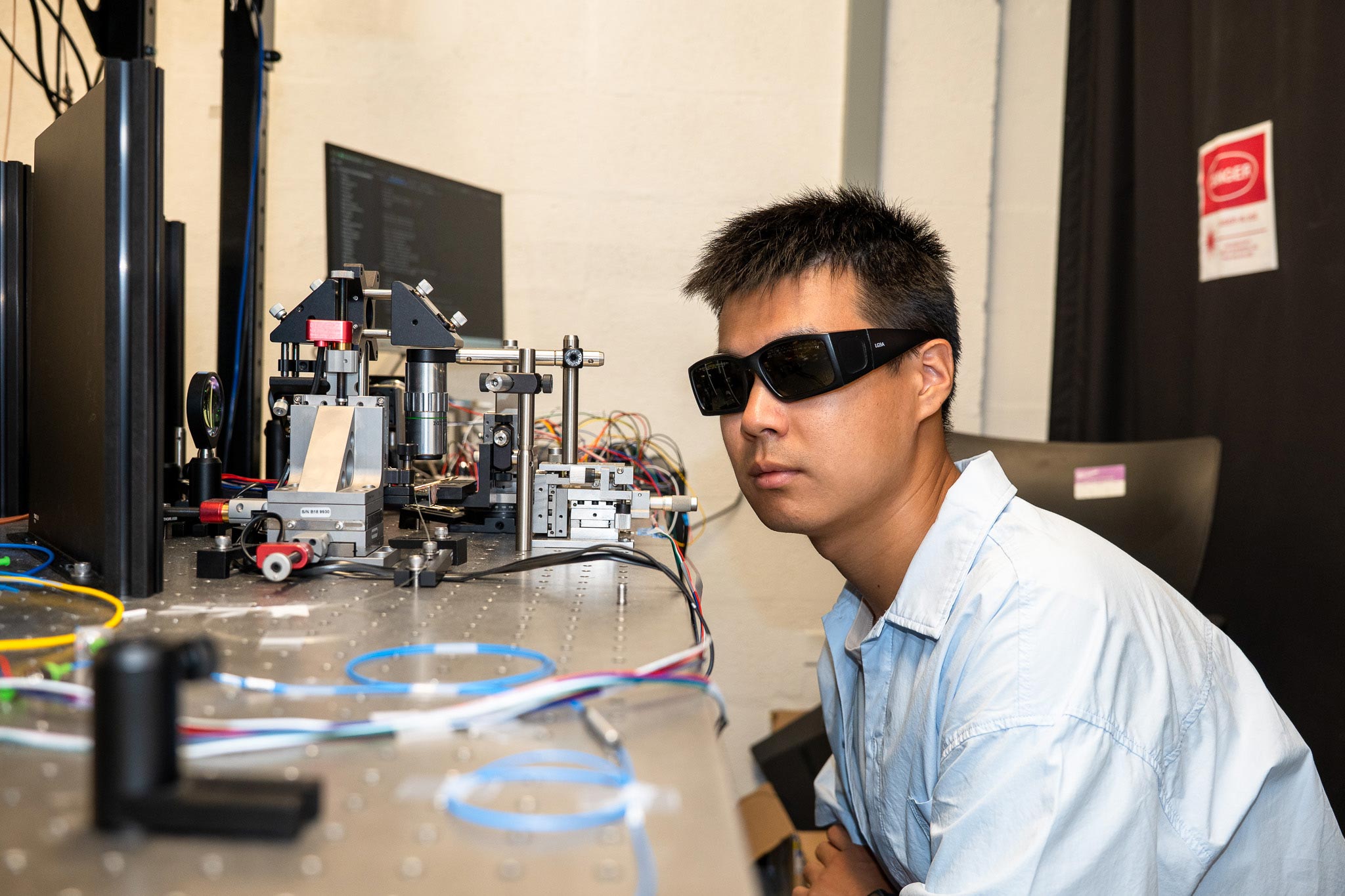
For the first time on an active commercial fiber network, the Penn study showed that a chip can transmit quantum signals while automatically correcting noise, packaging quantum and classical data into standard internet-style packets, and routing them through the same addressing and management systems used by everyday online devices.
“By showing an integrated chip can manage quantum signals on a live commercial network like Verizon’s, and do so using the same protocols that run the classical internet, we’ve taken a key step toward larger-scale experiments and a practical quantum internet,” says Liang Feng, Professor in Materials Science and Engineering (MSE) and in Electrical and Systems Engineering (ESE), and the Science paper’s senior author.
The Challenges of Scaling the Quantum Internet
Erwin Schrödinger, who introduced the term “quantum entanglement,” illustrated the idea with his well-known thought experiment involving a cat in a sealed box. Inside, along with radioactive material, the cat’s fate is uncertain—until the box is opened, the animal can be considered both alive and dead. The act of observation alone reveals the outcome.
This paradox offers a parallel to the behavior of quantum particles. When measured, they shed their special properties, a challenge that makes building large-scale quantum networks especially difficult.
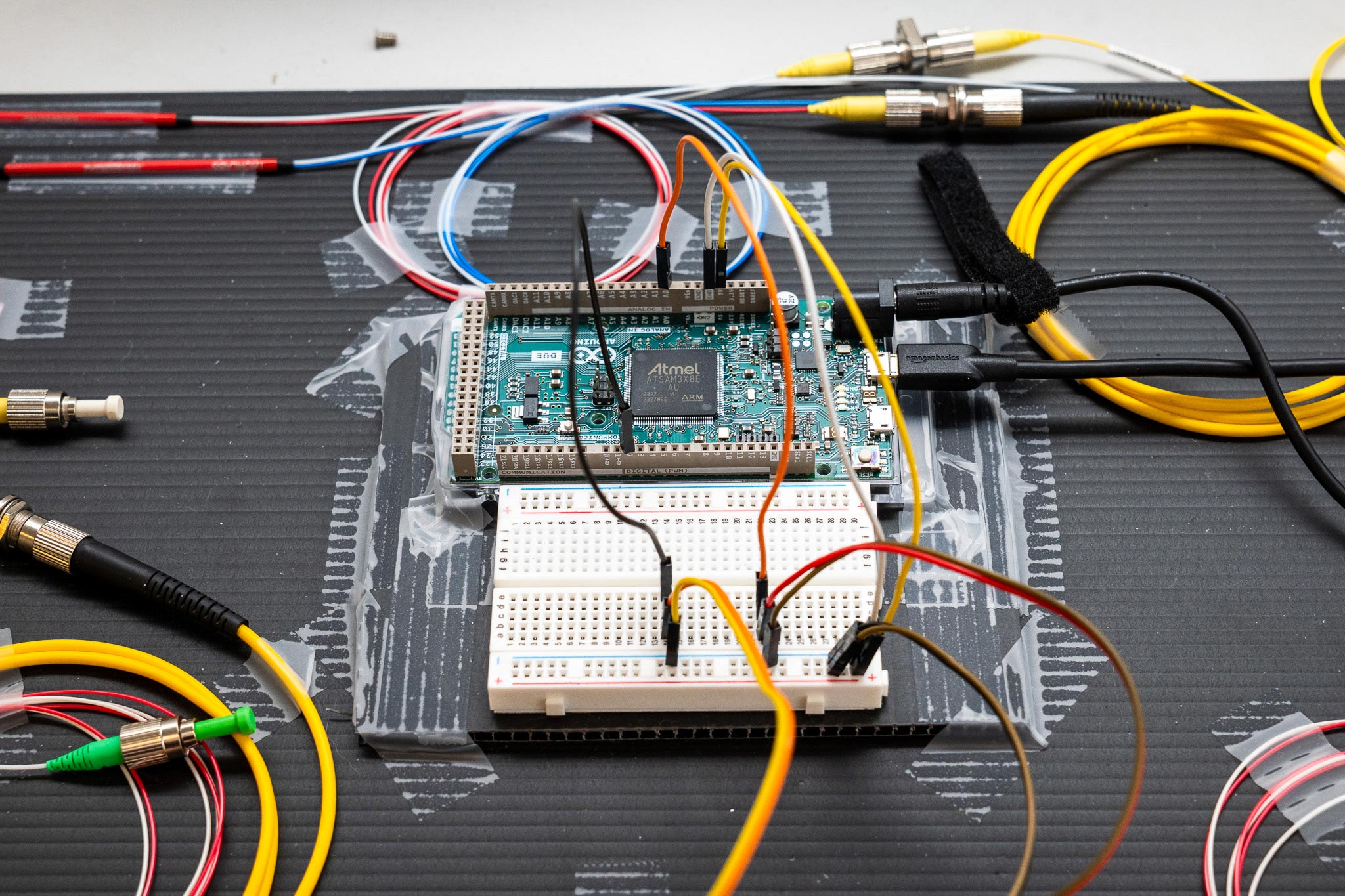
“Normal networks measure data to guide it towards the ultimate destination,” says Robert Broberg, a doctoral student in ESE and coauthor of the paper. “With purely quantum networks, you can’t do that, because measuring the particles destroys the quantum state.”
Coordinating Classical and Quantum Signals
To get around this obstacle, the team developed the “Q-Chip” (short for “Quantum-Classical Hybrid Internet by Photonics”) to coordinate “classical” signals, made of regular streams of light, and quantum particles. “The classical signal travels just ahead of the quantum signal,” says Yichi Zhang, a doctoral student in MSE and the paper’s first author. “That allows us to measure the classical signal for routing, while leaving the quantum signal intact.”
In essence, the new system works like a railway, pairing regular light locomotives with quantum cargo. “The classical ‘header’ acts like the train’s engine, while the quantum information rides behind in sealed containers,” says Zhang. “You can’t open the containers without destroying what’s inside, but the engine ensures the whole train gets where it needs to go.”
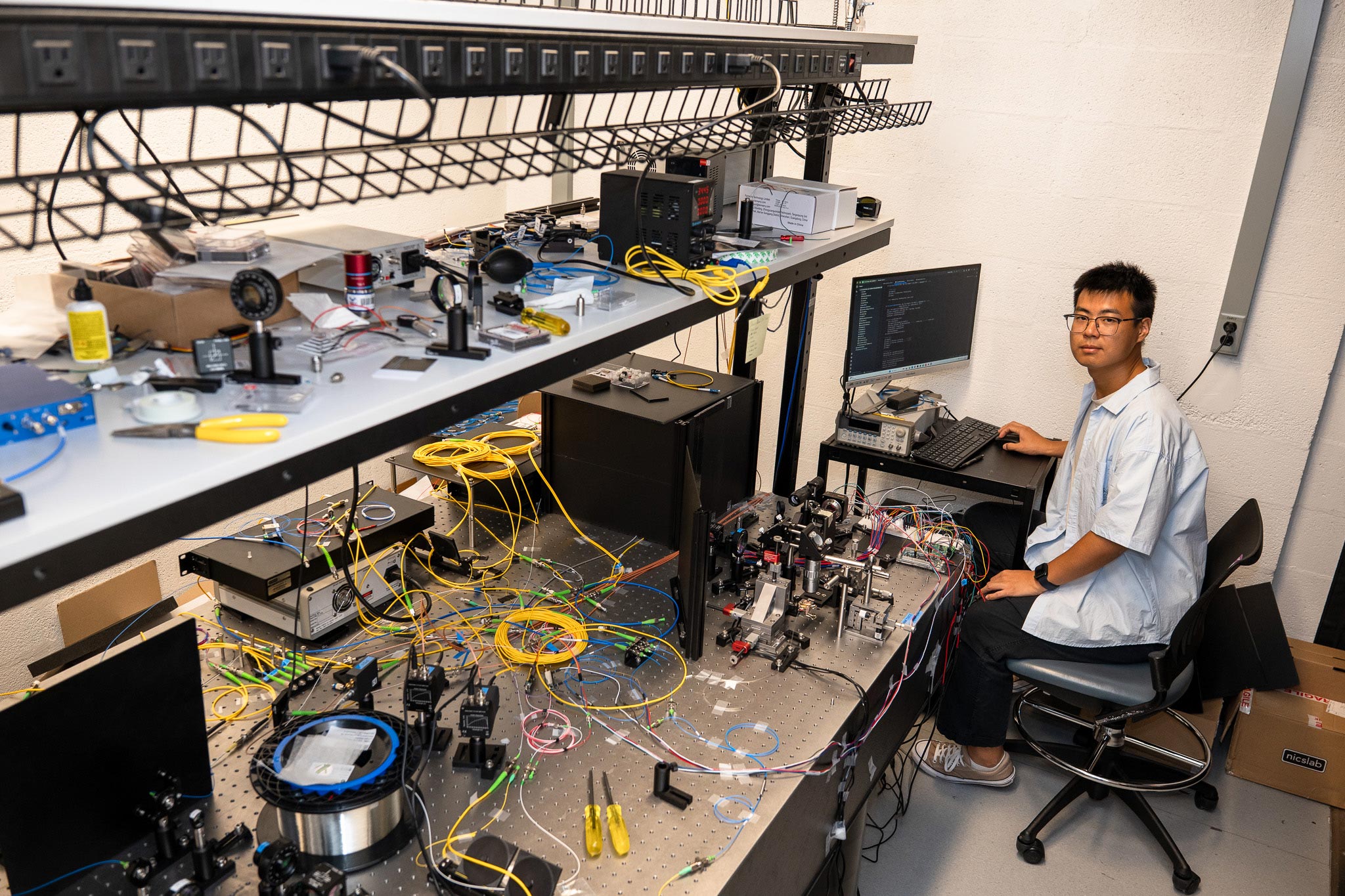
Because the classical header can be measured, the entire system can follow the same “IP” or “Internet Protocol” that governs today’s internet traffic. “By embedding quantum information in the familiar IP framework, we showed that a quantum internet could literally speak the same language as the classical one,” says Zhang. “That compatibility is key to scaling using existing infrastructure.”
Adapting Quantum Technology to the Real World
One of the greatest challenges to transmitting quantum particles on commercial infrastructure is the variability of real-world transmission lines. Unlike laboratory environments, which can maintain ideal conditions, commercial networks frequently encounter changes in temperature, thanks to weather, as well as vibrations from human activities like construction and transportation, not to mention seismic activity.
To counteract this, the researchers developed an error-correction method that takes advantage of the fact that interference to the classical header will affect the quantum signal in a similar fashion. “Because we can measure the classical signal without damaging the quantum one,” says Feng, “we can infer what corrections need to be made to the quantum signal without ever measuring it, preserving the quantum state.”
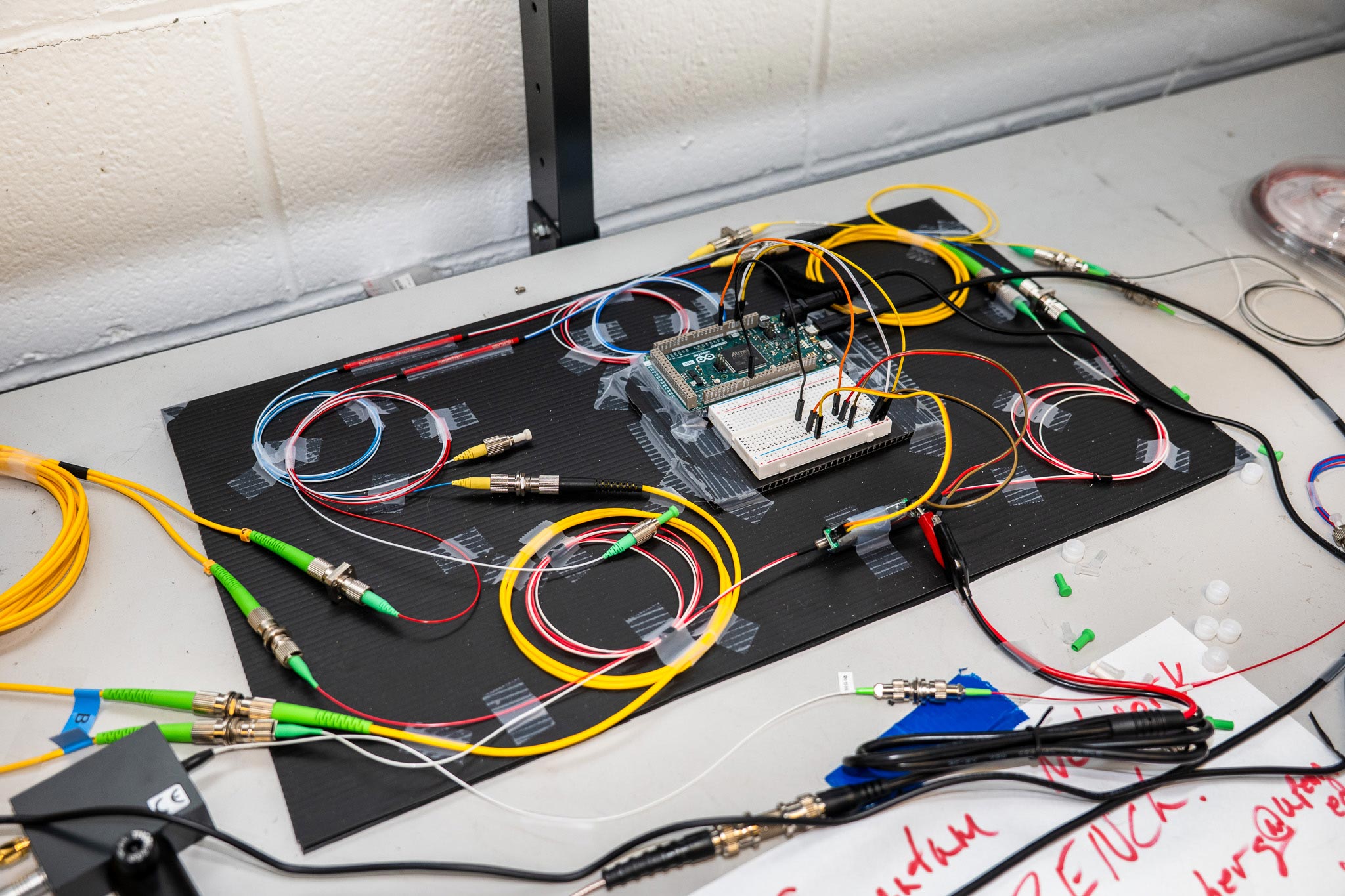
In testing, the system maintained transmission fidelities above 97%, showing that it could overcome the noise and instability that usually destroy quantum signals outside the lab. And because the chip is made of silicon and fabricated using established techniques, it could be mass produced, making the new approach easy to scale.
“Our network has just one server and one node, connecting two buildings, with about a kilometer of fiber-optic cable installed by Verizon between them,” says Feng. “But all you need to do to expand the network is fabricate more chips and connect them to Philadelphia’s existing fiber-optic cables.”
The Future of the Quantum Internet
The main barrier to scaling quantum networks beyond a metro area is that quantum signals cannot yet be amplified without destroying their entanglement.
While some teams have shown that “quantum keys,” special codes for ultra-secure communication, can travel long distances over ordinary fiber, those systems use weak coherent light to generate random numbers that cannot be copied, a technique that is highly effective for security applications but not sufficient to link actual quantum processors.
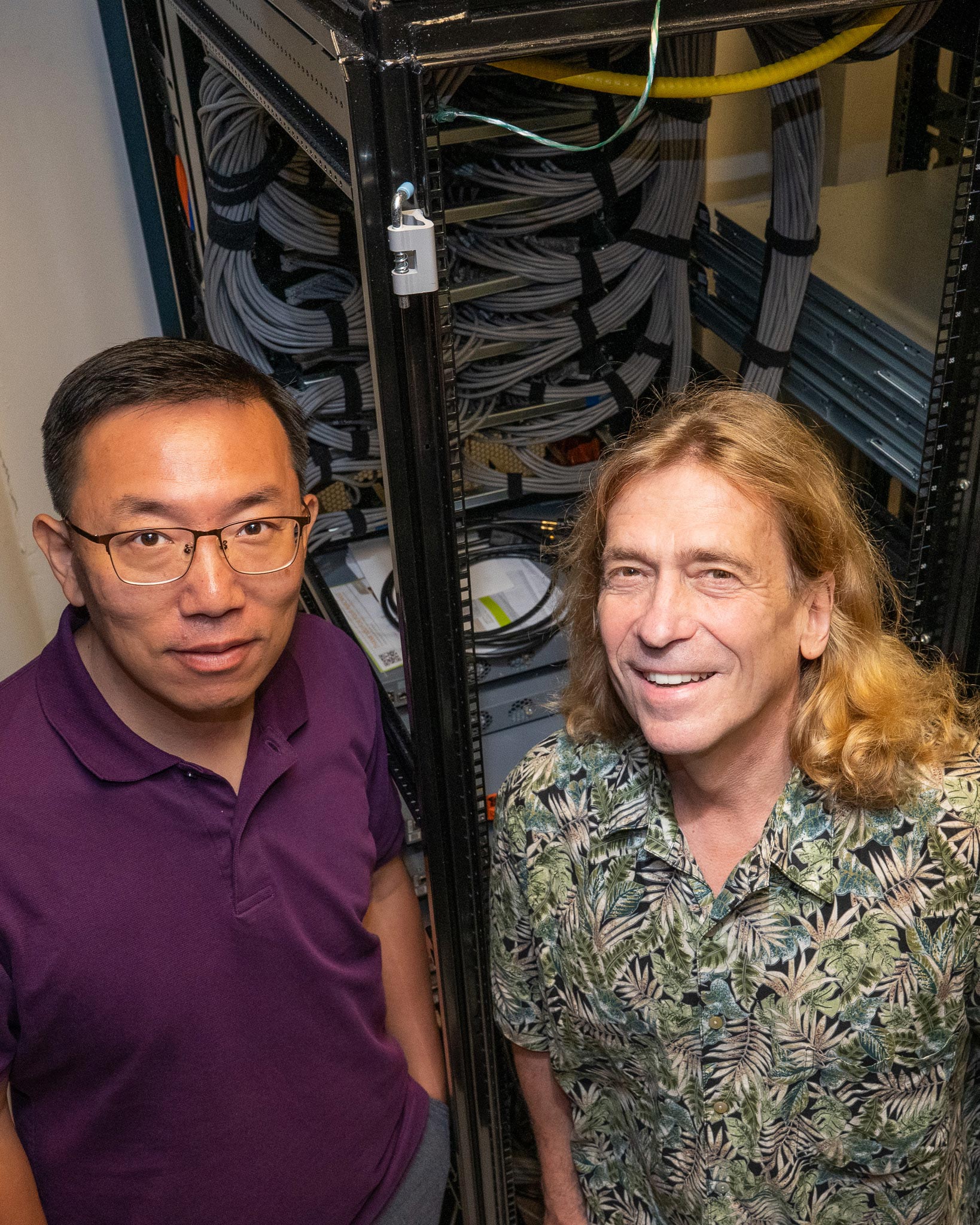
Overcoming this challenge will require new devices, but the Penn study provides an important early step: showing how a chip can run quantum signals over existing commercial fiber using internet-style packet routing, dynamic switching and on-chip error mitigation that work with the same protocols that manage today’s networks.
“This feels like the early days of the classical internet in the 1990s, when universities first connected their networks,” says Broberg. “That opened the door to transformations no one could have predicted. A quantum internet has the same potential.”
Reference: “Classical-decisive quantum internet by integrated photonics” by Yichi Zhang, Robert Broberg, Alan Zhu, Gushu Li, Li Ge, Jonathan M. Smith and Liang Feng, 28 August 2025, Science.
DOI: 10.1126/science.adx6176
This study was conducted at the University of Pennsylvania School of Engineering and Applied Science and was supported by the Gordon and Betty Moore Foundation (GBMF12960 and DOI 10.37807), Office of Naval Research (N00014-23-1-2882), National Science Foundation (DMR-2323468), Olga and Alberico Pompa endowed professorship, and PSC-CUNY award (ENHC-54-93).
Never miss a breakthrough: Join the SciTechDaily newsletter.
Follow us on Google and Google News.
1 Comment
In testing, the system maintained transmission fidelities above 97%, showing that it could overcome the noise and instability that usually destroy quantum signals outside the lab.
very good!
Symmetries are power, and govern the laws of nature. The laws of nature remain unaltered by human imagination. For centuries, symmetries have allowed physicists to find underlying connections and fundamental relationships throughout the universe. CP violation is typical pseudoscience. Using statistical errors (governed by the uncertainty principle) to negate natural laws is bound to plunge physics into an inescapable abyss of pseudoscience.