
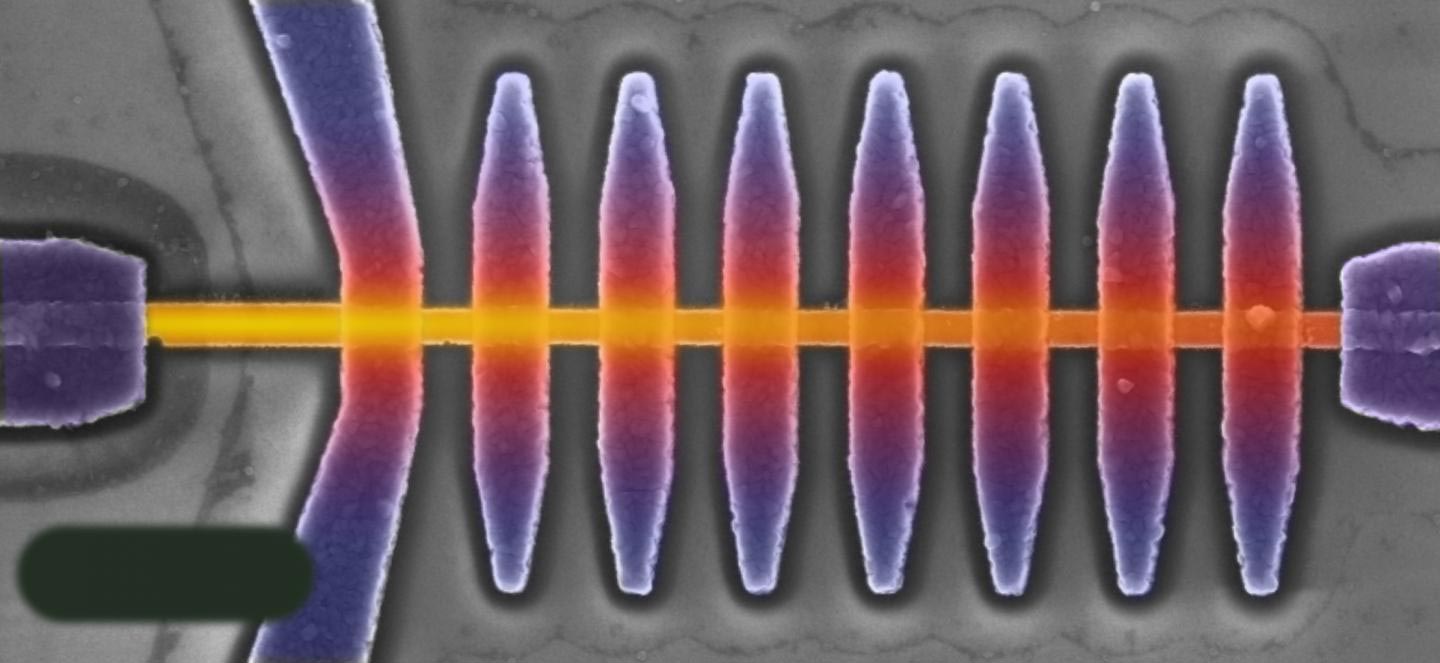
Radiation detector with the lowest noise in the world boosts quantum work. The nanoscale radiation detector is a hundred times faster than its predecessors, and can function without interruption.
Researchers from Aalto University and VTT Technical Research Centre of Finland have built a super-sensitive bolometer, a type of thermal radiation detector. The new radiation detector, made of a gold-palladium mixture makes it easier to measure the strength of electromagnetic radiation in real-time. Bolometers are used widely in thermal cameras in the construction industry and in satellites to measure cosmic radiation.
The new developments may help bolometers find their way to quantum computers. If the new radiation detector manages to function as well in space as it does in the laboratory, it can also be used to measure cosmic microwave background radiation in space more accurately.
“The new detector is extremely sensitive, and its noise level — how much the signal bounces around the correct value, is only one-tenth of the noise of any other bolometer. It is also a hundred times faster than previous low-noise radiation detectors,” says Mikko Möttönen, who works as a joint Professor of Quantum Technology at Aalto University and VTT.
At first, the research group built a radiation detector out of gold, but it broke in a few weeks, because gold is not compatible with the aluminum which is used as a superconductor in the detector. To overcome this, the group started to use a mixture of gold and palladium, which is very durable but a rare material in bolometers.
“In addition to the material, the secret of the new radiation detector lies in its really small scale. The nanowire running through the middle of the radiation detector is only about a micrometer long, two hundred nanometers wide, and a few tens of nanometers thick,” says Roope Kokkoniemi, who studied the bolometer at Aalto University.
A bolometer works by measuring the heating effect of radiation. When a bolometer heats up, its electrical characteristics change, and this can be measured with high precision. The smaller the bolometer, the less radiation is required to heat it.
“A small radiation detector has a low heat capacity, so weak radiation provides a stronger signal,” Kokkoniemi explains.
Better protection
“Quantum computers operate in cryostats, extremely cold super-freezers, in which even the smallest amount of excess radiation causes a lot of disturbance. As nanobolometers are very sensitive, they could conveniently measure the level of excess radiation in the cryostat in order to reduce the radiation through better protection,” Möttönen says.
The bolometer could also be used to read the value of quantum bits, or qubits. However, for this purpose, the bolometer would need to be even faster.
“In order to read quantum information in superconducting quantum computers several times in a row without it degrading in between, the bolometer would have to be about a hundred times faster,” Möttönen says.
Microwave amplifiers were also developed in the research. Their task is to strengthen the signal, but they also add noise. The superconducting microwave amplifier developed by VTT succeeded to halve the bolometer noise in comparison to the best commercial amplifier used.
The bolometer was developed in the Quantum Computing and Devices research group led by Mikko Möttönen. The article was published in the Communications Physics journal on the 11th of October, 2019.
Reference: “Nanobolometer with ultralow noise equivalent power” by Lamminen, Olli-Pentti Saira and Mikko Möttönen, 11 October 2019, Communications Physics.
DOI: 10.1038/s42005-019-0225-6
Never miss a breakthrough: Join the SciTechDaily newsletter.
Follow us on Google and Google News.