
Close Menu
    Facebook X (Twitter) Instagram
    SciTechDaily
    • Biology
    • Chemistry
    • Earth
    • Health
    • Physics
    • Science
    • Space
    • Technology
    Facebook X (Twitter) Pinterest YouTube RSS
    SciTechDaily
    Home»Earth»Total Solar Eclipse: The Moon’s Shadow Races Across North America in Stunning Satellite View
    Earth

    Total Solar Eclipse: The Moon’s Shadow Races Across North America in Stunning Satellite View

    By Emily Cassidy, NASA Earth ObservatoryApril 10, 2024No Comments3 Mins Read
    Facebook Twitter Pinterest Telegram LinkedIn WhatsApp Email Reddit
    Share
    Facebook Twitter LinkedIn Pinterest Telegram Email Reddit
    Lunar Shadow Over Earth 2024 Annotated
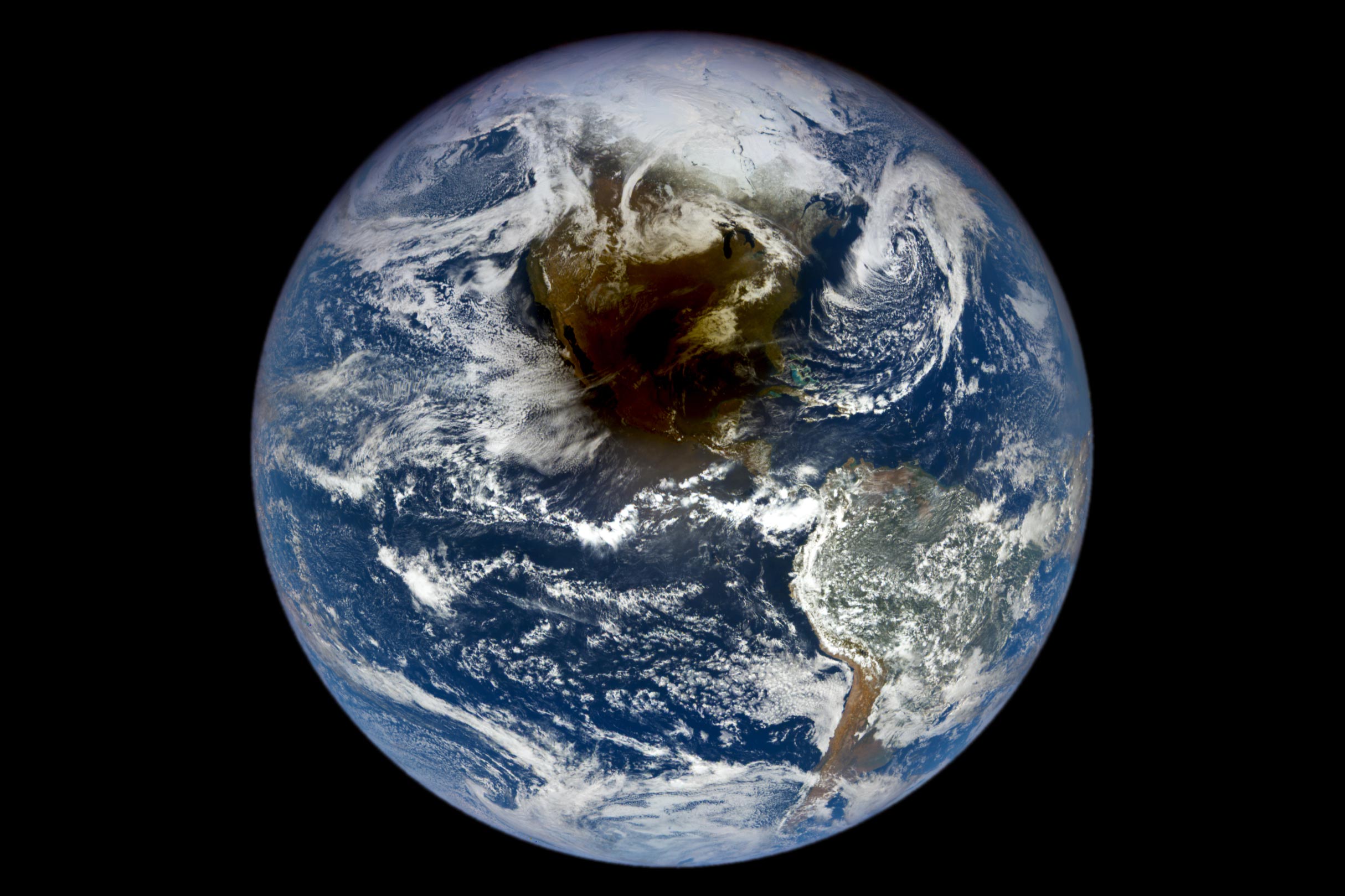
    View of the Moon’s shadow over North America captured during the total solar eclipse on April 8, 2024, using the NASA’s EPIC imager on the DSCOVR satellite.

    Satellites gathered striking views of the Moon’s shadow from above as observers on the ground were awed by the Sun’s corona.

    On April 8, 2024, millions of Americans saw day turn temporarily to night as the Moon passed between the Sun and Earth to create a total solar eclipse.

    As people in the 115-mile-wide (185-kilometer-wide) path of totality looked up and saw the Moon conceal the bright orb of the Sun and obscure all but its wispy corona, Earth-observing satellites captured imagery of the Moon’s shadow as it raced eastward over North America.

    About 1 million miles from Earth, NASA’s EPIC (Earth Polychromatic Imaging Camera) imager on the DSCOVR (Deep Space Climate Observatory) satellite, captured the above views of Earth between 16:02 and 20:32 Universal Time (12:02 and 4:32 p.m. Eastern Time). DSCVR is a joint NASA, NOAA, and U.S. Air Force satellite built to observe our planet from Lagrange Point 1, a gravitationally stable position between the Sun and Earth.

    The Moon’s shadow swept over North America, from the Pacific coast of Mexico, through Texas, and over the Great Lakes before crossing the Atlantic coast of Newfoundland, Canada.

    Observers on the ground had a rare view of the Sun’s active outer atmosphere, or corona. Glowing loops of plasma called solar prominences could also be seen extending into the corona. Plasma is super-hot ionized gas that flows along the tangled and twisted structure of the Sun’s magnetic fields.

    “This view of the corona will never happen again, ever,” said Michael Kirk, a research scientist in the Heliophysics Division at NASA’s Goddard Space Flight Center during a live broadcast of the eclipse from Dallas, Texas. During the broadcast, Kirk noted that the spiky and asymmetrical nature of the corona was a sign that the Sun’s magnetic field was active and approaching solar maximum.
    Lunar Shadow Total Solar Eclipse 2024 Annotated
    April 8, 2024

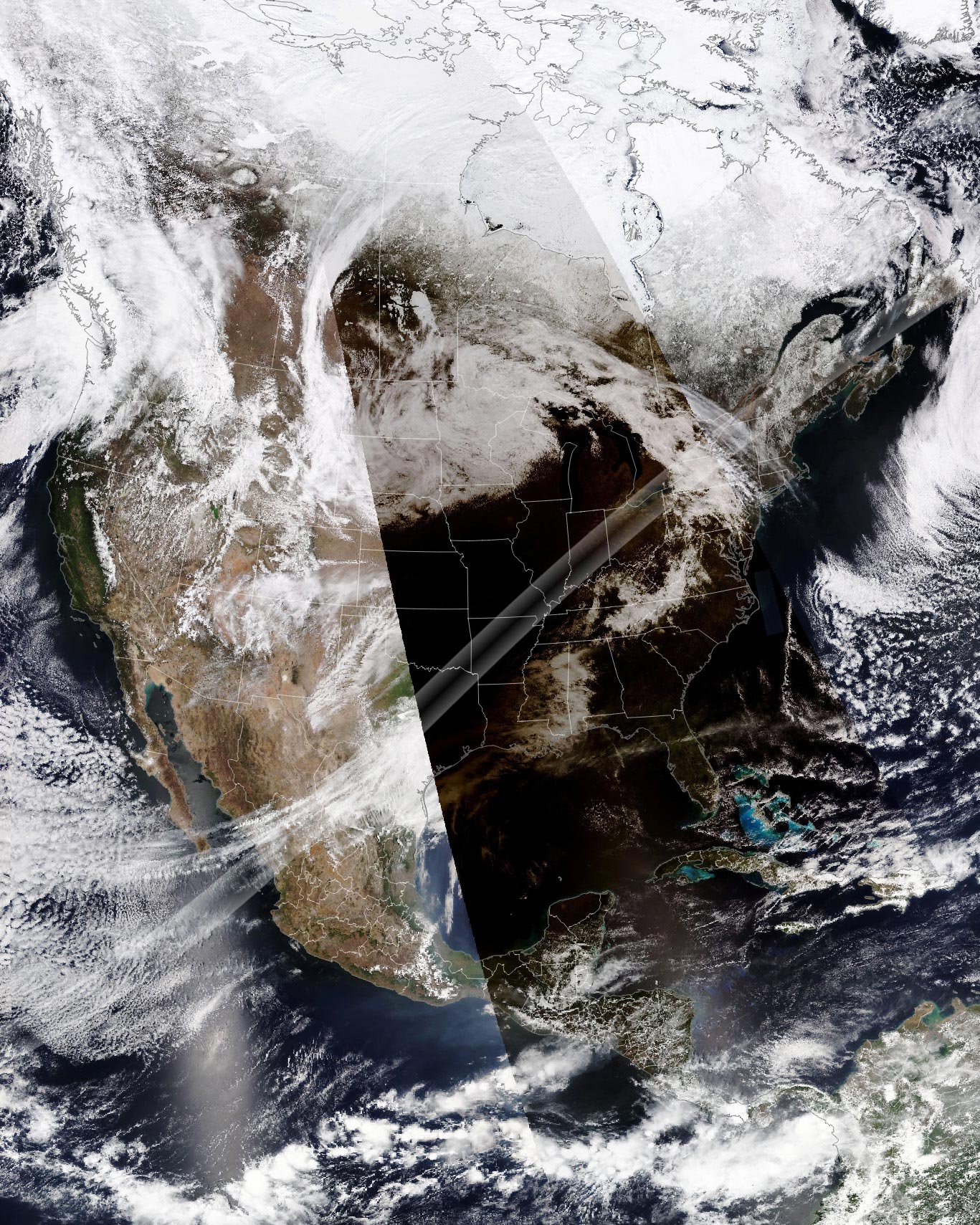
    As the Moon’s shadow moved east across North America, the NOAA-20 satellite orbited the Earth from pole to pole and captured images of Earth from east to west. The image above is a mosaic comprised of swaths of images collected by the satellite at three different times on April 8. The right third of the image shows the eastern United States at about 1:10 p.m. Eastern Time (17:10 Universal Time), before the eclipse had begun. The middle part was captured at about 1:50 p.m. Central Time (18:50 Universal Time), when the eclipse was in progress in the center of the country. Even outside of the path of totality, skies were much darker throughout the U.S. The left third of the image was collected at about 1:30 p.m. Pacific Time (20:30 Universal Time), after the Moon’s shadow had moved out over the Atlantic Ocean.

    The path of totality included portions of Texas, Oklahoma, Arkansas, Missouri, Illinois, Kentucky, Indiana, Ohio, Pennsylvania, New York, Vermont, New Hampshire, and Maine. The next total solar eclipse to travel across the lower 48 states from coast to coast will be in 2045.

    NASA Earth Observatory images by Michala Garrison and Wanmei Liang, using data from DSCOVR EPIC and VIIRS data from NASA EOSDIS LANCE, GIBS/Worldview, and the Joint Polar Satellite System (JPSS).

    Never miss a breakthrough: Join the SciTechDaily newsletter.
    Follow us on Google and Google News.

    Eclipse NASA NASA Earth Observatory Popular Solar Eclipse
    Share. Facebook Twitter Pinterest LinkedIn Email Reddit

    Related Articles

    Cloudy With a Chance of Eclipse: NASA’s GLOBE Project Illuminates 2024’s Celestial Phenomenon

    NASA’s Lunar Reconnaissance Orbiter Captures 2024 Solar Eclipse Shadow From 223,000 Miles Away

    Stunning Views From Earth and Space During the Total Solar Eclipse

    Chasing the Shadow: NASA’s Jet-Fueled Quest for Solar Secrets

    When Day Turns to Night: The Best Places to View the Total Solar Eclipse

    Breathtaking View of Moon’s Shadow Over the U.S. During the Annular Solar Eclipse

    Antarctica Eclipsed: Moon Blots Out the Sun in Stunning Space Photo of the Total Solar Eclipse

    Incredible Satellite View of the Moon’s Shadow Crossing the Surface of Earth During the Total Solar Eclipse

    Incredible Astronaut’s View of an Annular “Ring of Fire” Eclipse

    Leave A Reply Cancel Reply

    • Facebook
    • Twitter
    • Pinterest
    • YouTube

    Don't Miss a Discovery

    Subscribe for the Latest in Science & Tech!

    Trending News

    Beyond Pain Relief: Scientists Discover a Protein That Could Stop Osteoarthritis in Its Tracks

    Scientists Discover Why Alcohol Prevents the Liver From Healing, Even After You Quit

    Scientists Stunned As Volcano Removes Methane From the Air

    Scientists Discover Signs Africa May Be Splitting Apart Beneath Zambia

    Common Blood Pressure Drug Supercharges Cancer Treatment in Surprising New Study

    540-Million-Year-Old Fossils Reveal a Huge Surprise About Early Life on Earth

    Scientists Reverse Stroke Damage Using Stem Cells in Breakthrough Study

    Eating One Egg a Day Could Cut Alzheimer’s Risk by 27%

    Follow SciTechDaily
    • Facebook
    • Twitter
    • YouTube
    • Pinterest
    • Newsletter
    • RSS
    SciTech News
    • Biology News
    • Chemistry News
    • Earth News
    • Health News
    • Physics News
    • Science News
    • Space News
    • Technology News
    Recent Posts
    • Scientists Challenge a Long-Held Belief About Why Human Childbirth Is So Difficult
    • Too Much Sleep May Age Your Body Faster, New Study Warns
    • Scientists Uncover Promising New Strategy To Stop Parkinson’s in Its Tracks
    • New Study Reveals How Vitamin D Could Calm Gut Inflammation
    • Experts Reveal the Surprising Cancer Link Behind a Common Vitamin
    Copyright © 1998 - 2026 SciTechDaily. All Rights Reserved.
    • Science News
    • About
    • Contact
    • Editorial Board
    • Privacy Policy
    • Terms of Use

    Type above and press Enter to search. Press Esc to cancel.