
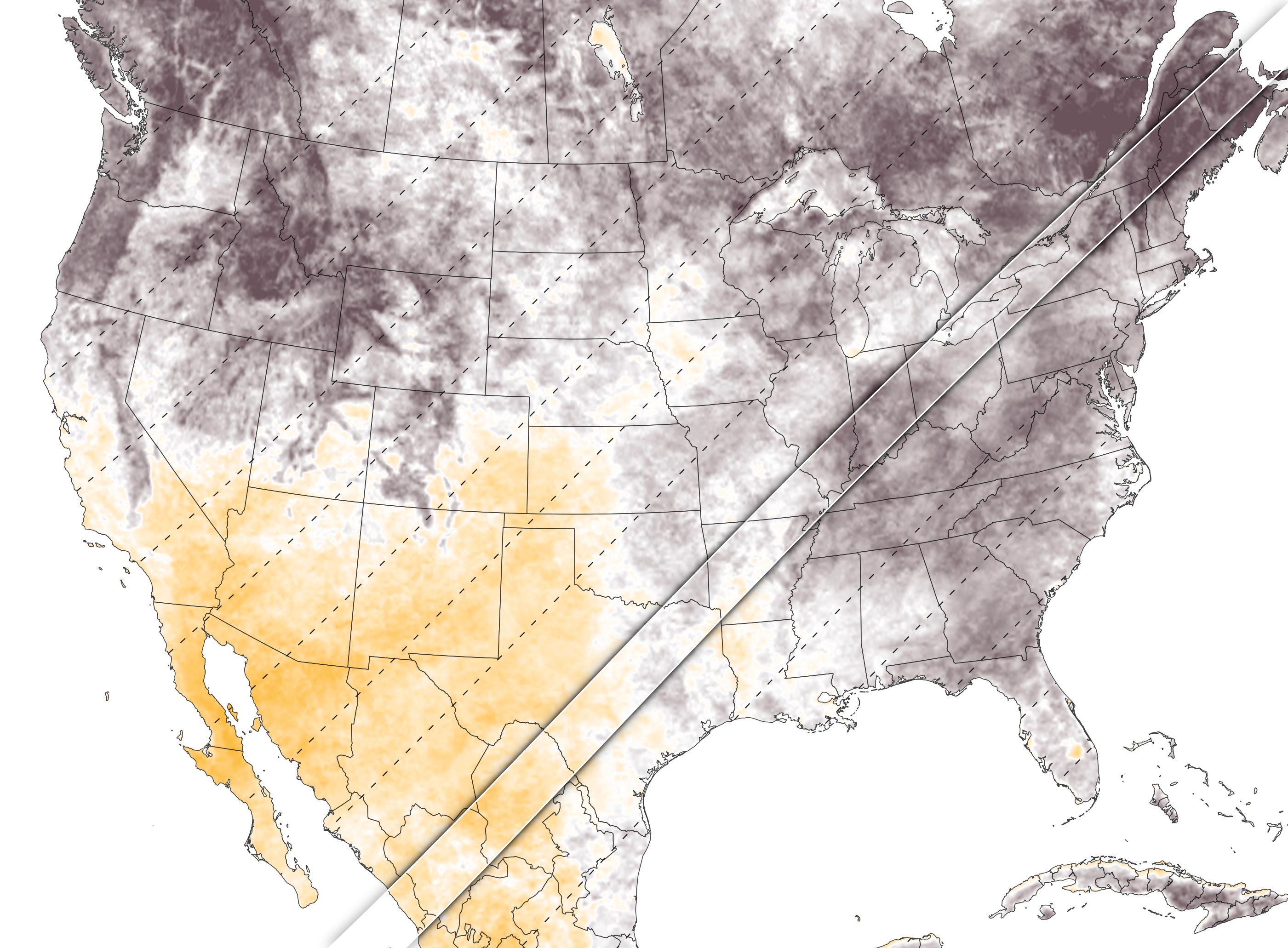
It’s not a forecast, but this map of historical cloud cover will tell you how often skies on April 8 have been cloudy in the past.
On April 8, 2024, the Moon will cross between the Earth and Sun during a total solar eclipse, darkening skies for millions of people in North America. Total solar eclipses occur on average about once every 360 years in a given location. But to see this rare event, weather conditions need to be just right.
Weather’s Impact on Eclipse Viewing
Cloud coverage significantly affects eclipse visibility. At any given time, about 70 percent of Earth’s surface is covered by clouds. These particles of water or ice in the atmosphere regulate temperatures and play a major role in the water cycle. But they can also block our ground-based view of stars and the solar system. Although it is too early for forecasters to reliably predict the weather for the 2024 eclipse, satellites have mapped where clouds have occurred in the past.
This map shows the average cloud cover, or cloud fraction, on April 8 from 2003 to 2023. It is based on observations from the MODIS (Moderate Resolution Imaging Spectroradiometer) instrument on NASA’s Aqua satellite. Like a digital camera, MODIS collects information in gridded boxes or pixels. Cloud fraction is the portion of each 1-square-kilometer pixel that is covered by clouds, using data processed by NEO (NASA Earth Observations), which provides daily and monthly composites of cloud fraction and other environmental parameters observed by satellites.
The Path of Totality
Depending on the weather, a partial eclipse will be visible throughout the contiguous United States on April 8. About 31 million people live along the 115-mile-wide path of totality where the Moon will completely cover the Sun. The path of totality arcs from the Pacific coast of Mexico, where totality will begin at 11:07 a.m. Pacific Daylight Time, through Maine, where it will begin at 3:30 p.m. Eastern Daylight Time.
Experiences and Effects of Eclipses
Those in the path will experience the moment of totality—the period that the Moon completely blocks the Sun’s surface. This “moment” of totality could last up to four minutes. During past eclipses, people have reported changes in wind direction and dropping air temperatures, as well as visual and acoustic changes in animals and insects. For instance, in a pioneering study on the 1932 eclipse, several participants noted that near totality, crickets began chirping as they do at dusk.
During the 2017 total solar eclipse, Marilé Colón Robles, an atmospheric scientist with the NASA-sponsored GLOBE Program, had a similar experience. “Just before totality, the wind shifted, everything got quiet. The clouds parted, allowing us to get a good view,” said Colón Robles, who watched the event from South Carolina.
Because total solar eclipses are rare, scientists are still researching how these events affect our planet. Observations from citizen scientists with thermometers and cell phone cameras can help fill the knowledge gap. Colón Robles analyzed such observations of the 2017 total solar eclipse and found that near-surface air temperatures dropped by about 7 degrees Fahrenheit (4 degrees Celsius). Areas with more cloud cover saw less of a temperature drop.
Eclipses can also affect cloudiness, at least temporarily, according to Colón Robles. As the Moon blocks the Sun’s radiation, atmospheric convection is reduced, which can lead to dissipation or disappearance of shallow convective clouds. Other researchers have also noted that clouds can disappear as the land surface cools during eclipses.
Cloud Influence and Visibility
In addition to the amount of cloud cover, cloud type can affect visibility during an eclipse. Big fluffy cumulus clouds or thick stratus clouds that are lower in the atmosphere may be more likely to block observers’ view than icy cirrus clouds in the upper atmosphere that are thinner.
Even in cloudy conditions, observers will see a sudden plunge into darkness as the Moon blocks out radiation from the Sun. However, some of the details of the eclipse will be hidden. With clear skies, viewers should be able to see the outermost part of the Sun’s atmosphere (the corona). This delicate, wispy feature shows the Sun’s normally invisible magnetic-field lines. During the 2024 total eclipse, the Sun will be in or near solar maximum, when the magnetic field is tangled up. Streamers will likely be visible throughout the corona. Observers will also have a better chance of seeing prominences—which appear as bright, pink curls or loops coming off the Sun.
Citizen Science Contributions
The GLOBE Program invites eclipse viewers to participate in the natural experiment provided by the event by recording changes in cloud conditions and in temperature everywhere (both inside and outside the path of totality). When users make observations of clouds in the GLOBE Observer app, these observations are compared to available satellite imagery shared via e-mail to the citizen scientist.
Colón Robles helps scientists use these citizen observations to enhance research on clouds and aerosols. “Total solar eclipses don’t always get captured with scientific instruments,” she said, “which is why citizen science observations are so important.” For those in the contiguous United States and Canada, this will be the last opportunity to see a total solar eclipse until 2044.
NASA Earth Observatory image by Michala Garrison, using cloud fraction data provided by NASA Earth Observations (NEO).
Never miss a breakthrough: Join the SciTechDaily newsletter.
Follow us on Google and Google News.