
Close Menu
    Facebook X (Twitter) Instagram
    SciTechDaily
    • Biology
    • Chemistry
    • Earth
    • Health
    • Physics
    • Science
    • Space
    • Technology
    Facebook X (Twitter) Pinterest YouTube RSS
    SciTechDaily
    Home»Earth»Stunning Views From Earth and Space During the Total Solar Eclipse
    Earth

    Stunning Views From Earth and Space During the Total Solar Eclipse

    By Lindsey Doermann, NASA Earth ObservatoryApril 15, 2024No Comments4 Mins Read
    Facebook Twitter Pinterest Telegram LinkedIn WhatsApp Email Reddit
    Share
    Facebook Twitter LinkedIn Pinterest Telegram Email Reddit
    2024 Total Solar Eclipse ISS Annotated
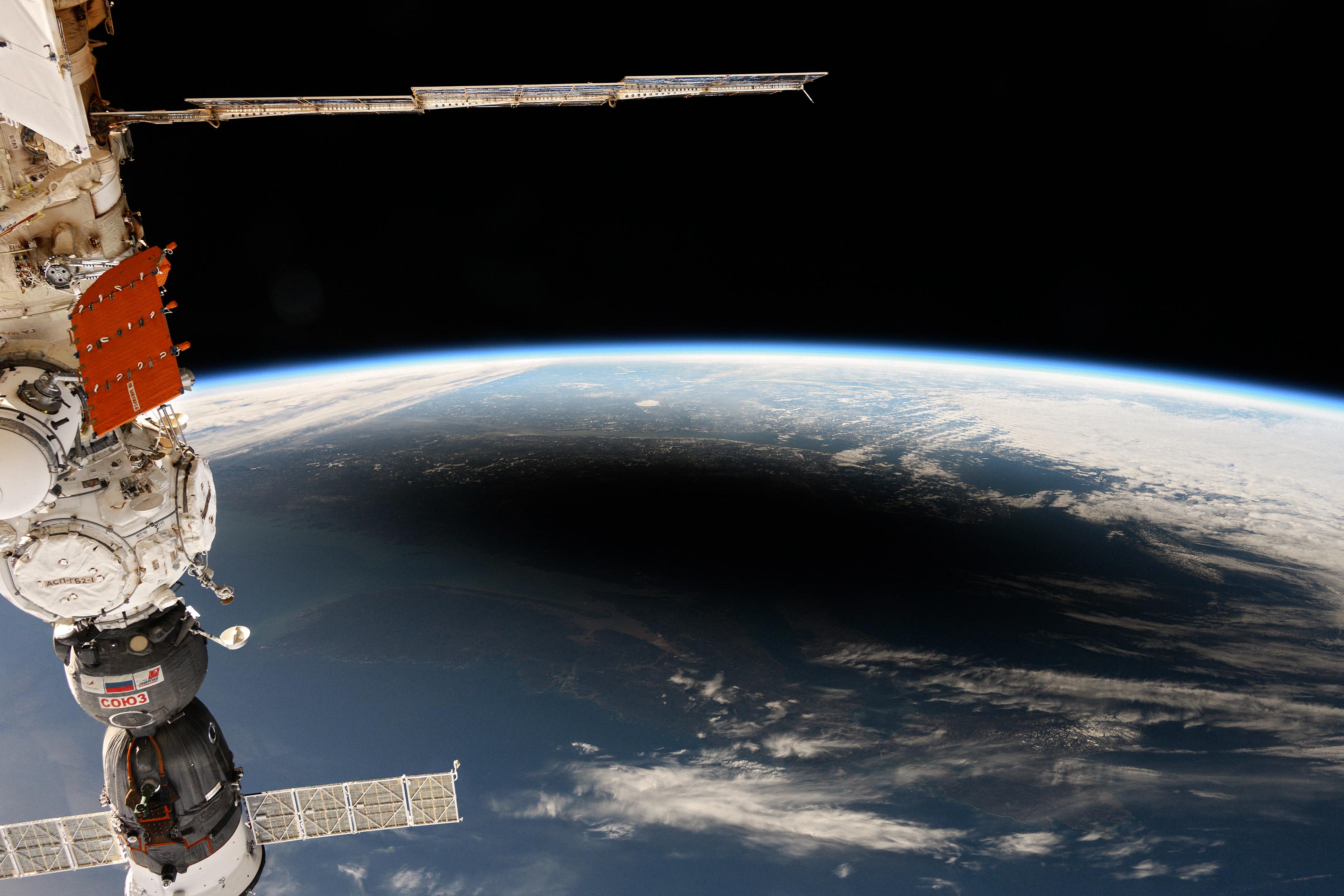
    A stunning view of the April 8, 2024, solar eclipse photographed by an astronaut aboard the International Space Station.

    Astronauts and photographers captured unforgettable views of Earth and the Sun as the Moon’s shadow swept across North America.

    A total solar eclipse passed over parts of Mexico, the United States, and Canada on April 8, 2024. Millions of people witnessed skies darken as the Moon passed between Earth and the Sun, obscuring its bright light.

    Astronauts aboard the International Space Station (ISS) got a top-down view of the Moon’s shadow as it traversed North America. The image above, taken as the space station orbited above the North Atlantic, shows the eclipse’s dark shadow along with Earth’s bright horizon, or limb, at the boundary between the atmosphere and space. A crew ship docked to the space station is visible in the lower-left corner of the image.

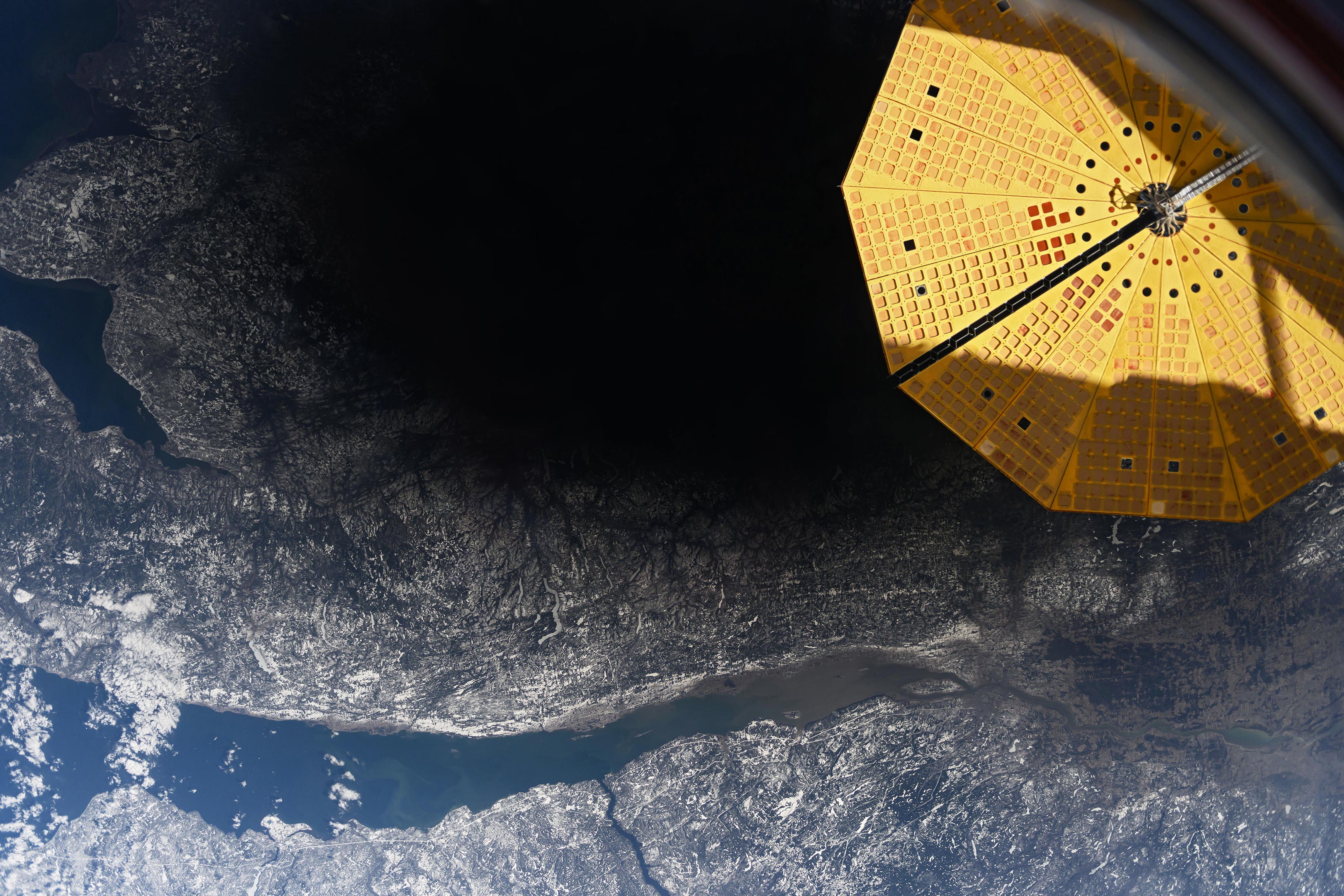
    The photograph below, also taken by an astronaut, captures the Moon’s shadow as it darkened portions of Quebec and New Brunswick in Canada and Maine in the United States. The gold-colored feature in the upper-right corner is part of a solar array on a resupply spacecraft.
    2024 Total Solar Eclipse ISS Solar Array Annotated
    A photograph of the April 8, 2024, solar eclipse captured by an astronaut aboard the International Space Station as the moon darkened portions of Quebec and New Brunswick in Canada and Maine in the United States.

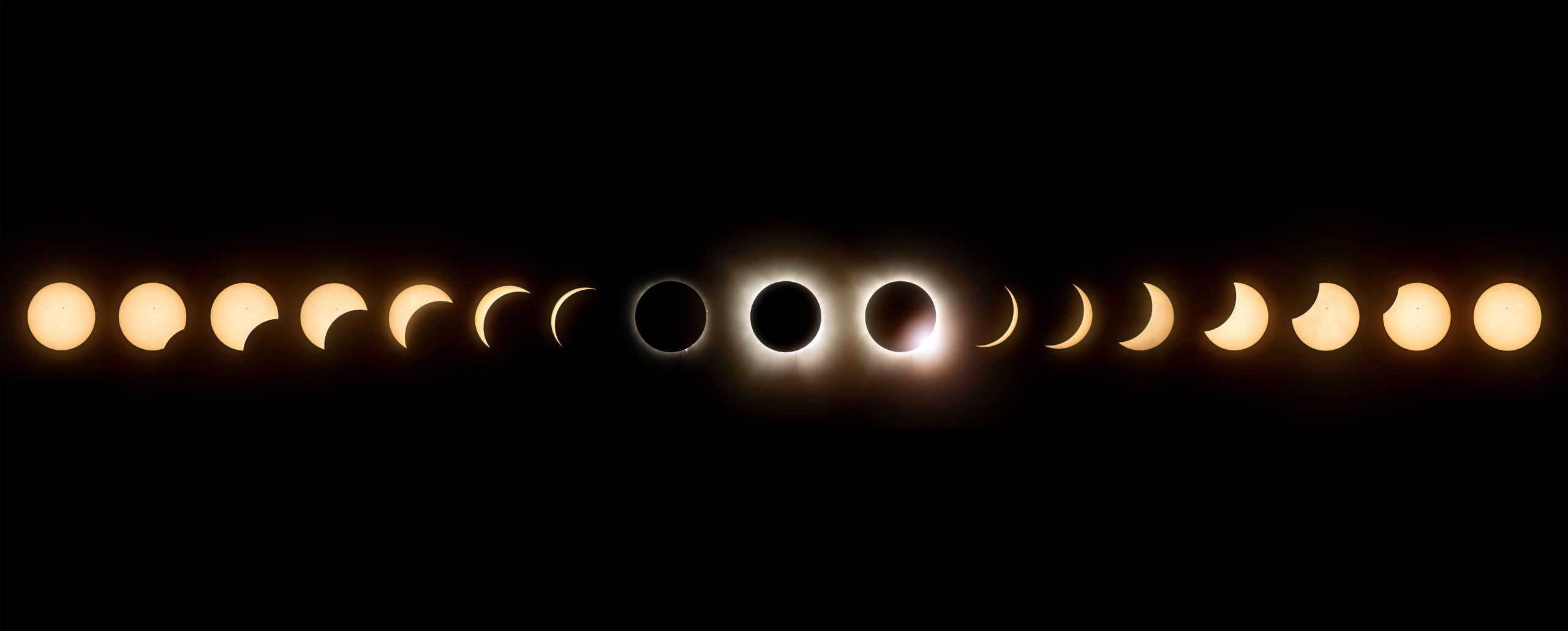
    A total solar eclipse offers a unique opportunity to view and study the Sun’s active outer atmosphere, or corona. During totality, seen in the center of the composite photo below, the Moon perfectly blocks the bright face of the Sun, leaving the much dimmer solar corona visible. This composite was captured in Cleveland, Ohio, over the course of the approximately 2.5 hours it took for the Moon to move across the face of the Sun.
    2024 Solar Eclipse Composite
    2024 solar eclipse composite. Credit: NASA/Jordan Salkin

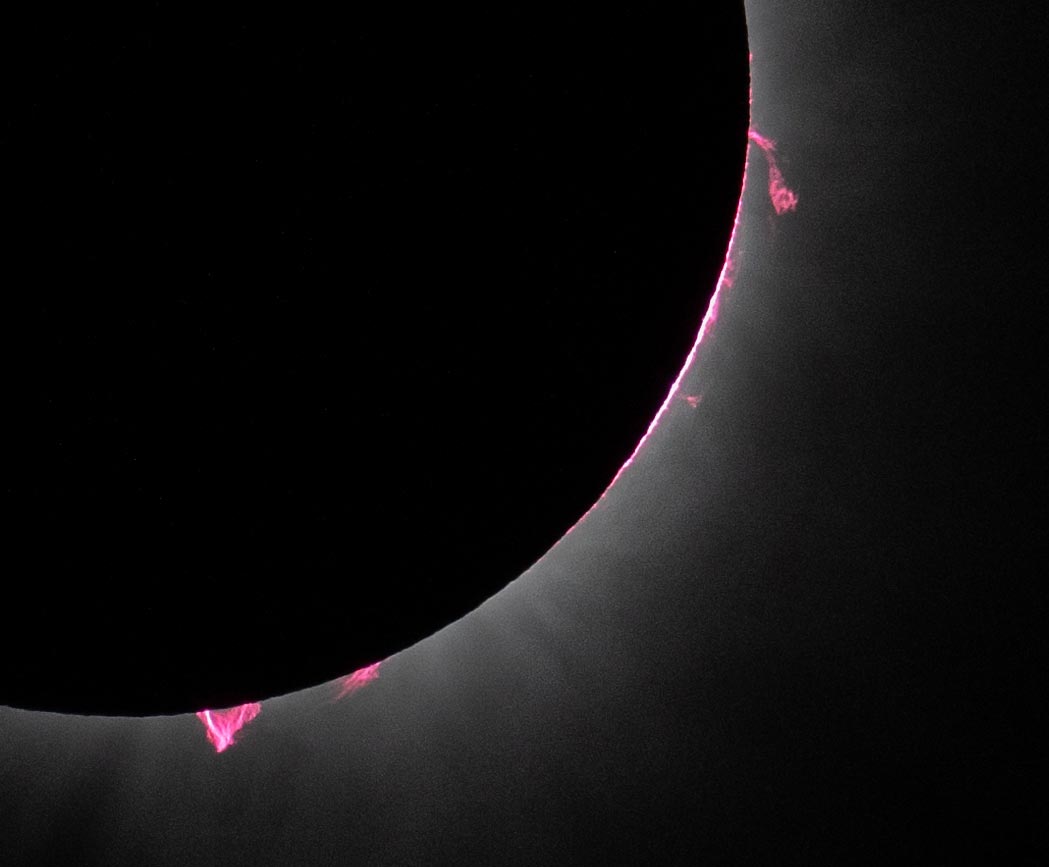
    During totality, glowing loops of plasma called solar prominences could be seen extending into the corona. Plasma is super-hot ionized gas that flows along the tangled and twisted structure of the Sun’s magnetic fields. Some observers on the ground noticed spots of pink appearing within the corona’s light. The detailed photo below reveals that pink-tinged streamers were erupting into the corona.
    2024 Total Solar Eclipse 6
    Solar prominences are seen during a total solar eclipse in Dallas, Texas on Monday, April 8, 2024. A total solar eclipse swept across a narrow portion of the North American continent from Mexico’s Pacific coast to the Atlantic coast of Newfoundland, Canada. A partial solar eclipse was visible across the entire North American continent along with parts of Central America and Europe. Credit: NASA/Keegan Barber

    At the time of the eclipse, the Sun was near a solar maximum, a period of heightened activity that occurs about every 11 years when the Sun’s magnetic field flips. The Sun’s activity was much different during the 2017 total solar eclipse. At that time, it was nearing a solar minimum. As a result, the magnetic field was less tangled then and streamers were restricted to the Sun’s equatorial region.

    Astronaut photographs ISS071-E-003390 and ISS071-E-002856 were acquired on April 8, 2024, with a Nikon Z 9 digital camera using 28 and 24 millimeter lenses, respectively, and are provided by the ISS Crew Earth Observations Facility and the Earth Science and Remote Sensing Unit, Johnson Space Center. The images were taken by members of the Expedition 71 crew. The images have been cropped and enhanced to improve contrast, and lens artifacts have been removed. The International Space Station Program supports the laboratory as part of the ISS National Lab to help astronauts take pictures of Earth that will be of the greatest value to scientists and the public, and to make those images freely available on the Internet. Additional images taken by astronauts and cosmonauts can be viewed at the NASA/JSC Gateway to Astronaut Photography of Earth.

    Never miss a breakthrough: Join the SciTechDaily newsletter.
    Follow us on Google and Google News.

    Eclipse International Space Station NASA NASA Earth Observatory Solar Eclipse
    Share. Facebook Twitter Pinterest LinkedIn Email Reddit

    Related Articles

    Cloudy With a Chance of Eclipse: NASA’s GLOBE Project Illuminates 2024’s Celestial Phenomenon

    Total Solar Eclipse: The Moon’s Shadow Races Across North America in Stunning Satellite View

    When Day Turns to Night: The Best Places to View the Total Solar Eclipse

    Breathtaking View of Moon’s Shadow Over the U.S. During the Annular Solar Eclipse

    Incredible Satellite View of the Moon’s Shadow Crossing the Surface of Earth During the Total Solar Eclipse

    NASA Picturing Earth: Astronaut Photography In Focus [Video]

    Coloring the Great Salt Lake – Astronaut Takes Beautiful Photograph From Space Station

    Aurora, Meet Airglow: Two of Earth’s Most Colorful Atmospheric Phenomena Meet in Stunning Photo From Space Station

    Incredible Astronaut’s View of an Annular “Ring of Fire” Eclipse

    Leave A Reply Cancel Reply

    • Facebook
    • Twitter
    • Pinterest
    • YouTube

    Don't Miss a Discovery

    Subscribe for the Latest in Science & Tech!

    Trending News

    Scientists Discover How Coffee Impacts Memory, Mood, and Gut Health

    Why Did the Neanderthals Disappear? Scientists Reveal Humans Had a Hidden Advantage

    Physicists Propose Strange Experiment Where Time Goes Quantum

    Magnesium Magic: New Drug Melts Fat Even on a High-Fat, High-Sugar Diet

    Weight-Loss Drugs Like Ozempic May Come With an Unexpected Cost

    Mezcal “Worm” in a Bottle Mystery: DNA Testing Reveals a Surprise

    New Research Reveals That Your Morning Coffee Activates an Ancient Longevity Switch

    This Is What Makes You Irresistible to Mosquitoes

    Follow SciTechDaily
    • Facebook
    • Twitter
    • YouTube
    • Pinterest
    • Newsletter
    • RSS
    SciTech News
    • Biology News
    • Chemistry News
    • Earth News
    • Health News
    • Physics News
    • Science News
    • Space News
    • Technology News
    Recent Posts
    • This New Memory Technology Could Make Devices Last Months on One Charge
    • Scientists Turn Cancer’s Own Bacteria Against It in Breakthrough Therapy
    • Cannabis Can Make You Remember Things That Never Happened
    • Doctors Are Surprised by What This Vaccine Is Doing to the Heart
    • Quantum Breakthrough Turns Simple Forces Into Powerful New Interactions
    Copyright © 1998 - 2026 SciTechDaily. All Rights Reserved.
    • Science News
    • About
    • Contact
    • Editorial Board
    • Privacy Policy
    • Terms of Use

    Type above and press Enter to search. Press Esc to cancel.