
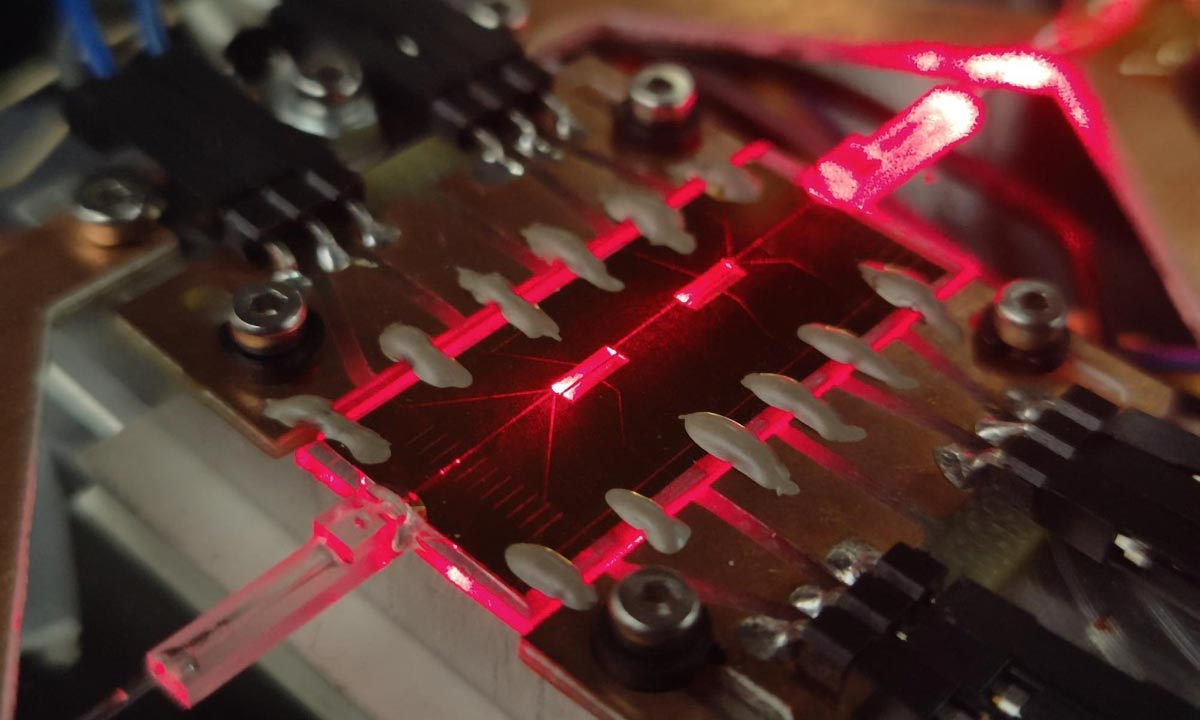
A laser-written glass chip shows how fragile quantum signals can be decoded with high stability and low loss, offering a new path toward practical quantum communication systems.
As progress in quantum computing accelerates, many of the encryption methods used today could eventually be rendered ineffective. Quantum cryptography offers a fundamentally different approach to security by relying on the physical properties of nature rather than mathematical complexity. However, making quantum communication practical outside the laboratory depends on the development of small, dependable devices capable of reading extremely delicate quantum signals transmitted through light.
Researchers from the University of Padua, Politecnico di Milano, and the CNR Institute for Photonics and Nanotechnologies have now demonstrated a promising solution built from an unexpected material: borosilicate glass.
Their findings, reported in Advanced Photonics, describe a high-performance quantum coherent receiver that is written directly into glass using femtosecond laser technology. The resulting device combines low optical losses, long-term stability, and seamless compatibility with existing fiber-optic networks, all of which are essential for expanding quantum systems into real-world applications.
Why glass?
Continuous-variable (CV) quantum information processing, which underpins technologies such as quantum key distribution (QKD) and quantum random number generation (QRNG), depends on accurately measuring the phase and amplitude of light. To do this, a coherent receiver is required. This component mixes a very weak quantum signal with a stronger reference beam and extracts information from the way the two interfere.
To date, most integrated coherent receivers have been built using silicon-based platforms. Silicon technology is mature and supports dense integration, but it is sensitive to polarization and typically introduces higher optical losses. These drawbacks can limit both the reliability and performance of quantum communication systems.
Glass provides a different set of advantages. It is inherently insensitive to polarization, highly stable over time, and supports the creation of three-dimensional waveguides with minimal signal loss. By using femtosecond laser micromachining, researchers can directly inscribe light-guiding paths inside the glass itself. This method enables compact and complex photonic circuits to be produced without the manufacturing challenges associated with conventional semiconductor fabrication.
Inside the laser‑written quantum receiver
The team fabricated a fully tunable heterodyne receiver—an essential component for CV‑QKD and CV‑QRNG—by writing the optical circuit directly into the volume of borosilicate glass. The chip includes:
- Fixed and tunable beam splitters
- Thermo‑optic phase shifters for precise electrical control
- Three‑dimensional waveguide crossings
- Polarization‑independent directional couplers
These elements allow the quantum signal and reference beam to interfere in a controlled manner so that two conjugate quadratures can be measured at once. The device also demonstrates:
- Extremely low insertion loss (≈1 dB)
- Polarization‑independent operation
- Common‑mode rejection ratio above 73 dB, indicating strong suppression of classical noise
- High signal‑to‑noise stability over at least 8 hours of operation
These characteristics meet or exceed those of many silicon‑based photonic receivers
Two quantum technologies on one chip
The combination of low optical loss, electrical tunability, and long-term stability allows the chip to perform several quantum communication functions without any physical modifications.
When operated as a heterodyne detector, the device was used to demonstrate a source-device-independent QRNG, a security approach in which the system remains protected even if the incoming optical signal cannot be trusted. Owing to strong noise suppression and highly stable quadrature measurements, the chip generated secure random numbers at a rate of 42.7 Gbit/s, setting a record for this type of security framework.
The researchers also employed the same hardware to realize a QPSK-based CV-QKD protocol, in which information is encoded using a four-state quantum constellation. In tests over a simulated 9.3-km fiber link, the system achieved a secret key rate of 3.2 Mbit/s. These results show that a glass-based photonic interface can deliver state-of-the-art CV-QKD performance while avoiding the constraints commonly associated with silicon-based platforms.
Platform ready for real‑world deployment
Beyond performance metrics, the work underscores the inherent advantages of glass for integrated quantum photonics:
- Environmental stability: Glass is inert and resistant to thermal and mechanical fluctuations.
- Low‑loss fiber coupling: Waveguides closely match the size of standard telecom fibers.
- 3D design freedom: Circuits can include crossings and complex routing without added scattering.
- Scalability and cost‑effectiveness: Femtosecond laser writing enables rapid prototyping without expensive semiconductor processing steps.
These features support long‑term stability and resilience—qualities that could enable future use in field systems and even space‑based quantum communication missions. The authors emphasize that glass‑based integrated photonics may help bridge the gap between laboratory‑grade experiments and deployable quantum networks.
Leveraging these advantageous properties, the team demonstrated two core applications on the same chip: a source-device-independent QRNG, achieving a record-high secure generation rate of 42.7 Gbit/s, and a QPSK-based CV-QKD system, achieving a 3.2 Mbit/s secure key rate over a simulated 9.3-kilometer fiber link.
Beyond these achievements, the work highlights the potential of glass-based integrated photonics as a robust and versatile platform for quantum technologies. Glass is inert, stable, and cost-effective, enabling the fabrication of devices inherently resistant to harsh environmental conditions. This novel approach could bridge the gap between laboratory prototypes and deployable quantum communication systems, marking a significant step toward a real-world quantum network infrastructure.
Reference: “High-performance heterodyne receiver for quantum information processing in a laser-written integrated photonic platform” by Andrea Peri, Giulio Gualandi, Tommaso Bertapelle, Mattia Sabatini, Giacomo Corrielli, Yoann Piétri, Davide Giacomo Marangon, Giuseppe Vallone, Paolo Villoresi, Roberto Osellame and Marco Avesani, 4 February 2026, Advanced Photonics.
DOI: 10.1117/1.AP.8.1.016009
Never miss a breakthrough: Join the SciTechDaily newsletter.
Follow us on Google and Google News.
1 Comment
This novel approach could bridge the gap between laboratory prototypes and deployable quantum communication systems, marking a significant step toward a real-world quantum network infrastructure.
VERY GOOD.
Please ask researchers to think deeply:
Which is easier to understand, quantum networks or topological networks?