
Close Menu
    Facebook X (Twitter) Instagram
    SciTechDaily
    • Biology
    • Chemistry
    • Earth
    • Health
    • Physics
    • Science
    • Space
    • Technology
    Facebook X (Twitter) Pinterest YouTube RSS
    SciTechDaily
    Home»Space»Quasar Microlensing Reveals Planets in Extragalactic Galaxies
    Space

    Quasar Microlensing Reveals Planets in Extragalactic Galaxies

    By University of OklahomaFebruary 2, 20181 Comment2 Mins Read
    Facebook Twitter Pinterest Telegram LinkedIn WhatsApp Email Reddit
    Share
    Facebook Twitter LinkedIn Pinterest Telegram Email Reddit
    Astronomers Use Quasar Microlensing to Probe Planets in Extragalactic Galaxies
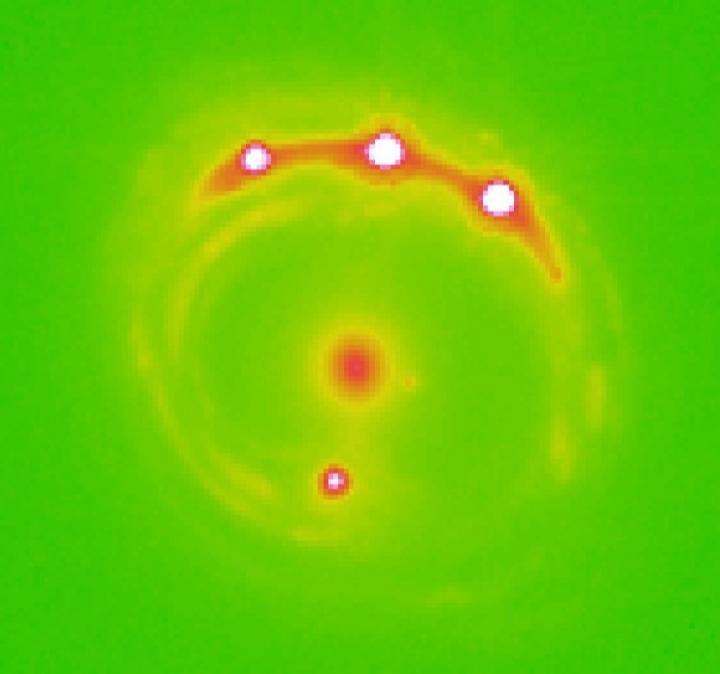
    Image of the gravitational lens RX J1131-1231 galaxy with the lens galaxy at the center and four lensed background quasars. It is estimated that there are trillions of planets in the center elliptical galaxy in this image. Credit: University of Oklahoma

    A University of Oklahoma astrophysics team has discovered for the first time a population of planets beyond the Milky Way galaxy. Using microlensing–an astronomical phenomenon and the only known method capable of discovering planets at truly great distances from the Earth among other detection techniques–OU researchers were able to detect objects in extragalactic galaxies that range from the mass of the Moon to the mass of Jupiter.

    Xinyu Dai, professor in the Homer L. Dodge Department of Physics and Astronomy, OU College of Arts and Sciences, with OU postdoctoral researcher Eduardo Guerras, made the discovery with data from the National Aeronautics and Space Administration’s Chandra X-ray Observatory, a telescope in space that is controlled by the Smithsonian Astrophysical Observatory.

    “We are very excited about this discovery. This is the first time anyone has discovered planets outside our galaxy,” said Dai. “These small planets are the best candidate for the signature we observed in this study using the microlensing technique. We analyzed the high frequency of the signature by modeling the data to determine the mass.”

    While planets are often discovered within the Milky Way using microlensing, the gravitational effect of even small objects can create high magnification leading to a signature that can be modeled and explained in extragalactic galaxies. Until this study, there has been no evidence of planets in other galaxies.

    “This is an example of how powerful the techniques of analysis of extragalactic microlensing can be. This galaxy is located 3.8 billion light years away, and there is not the slightest chance of observing these planets directly, not even with the best telescope one can imagine in a science fiction scenario,” said Guerras. “However, we are able to study them, unveil their presence and even have an idea of their masses. This is very cool science.”

    For this study, OU researchers used the NASA Chandra X-ray Observatory at the Smithsonian Astrophysical Observatory. The microlensing models were calculated at the OU Supercomputing Center for Education and Research.

    Reference: “Probing Planets in Extragalactic Galaxies Using Quasar Microlensing” by Xinyu Dai and Eduardo Guerras, 2 February 2018, The Astrophysical Journal Letters.
    DOI: 10.3847/2041-8213/aaa5fb

    Never miss a breakthrough: Join the SciTechDaily newsletter.
    Follow us on Google and Google News.

    Astronomy Astrophysics Exoplanet Planetary Science Quasars University of Oklahoma
    Share. Facebook Twitter Pinterest LinkedIn Email Reddit

    Related Articles

    NASA’s Webb Just Found a Hidden Moon Factory Beyond Our Solar System

    These Giant Planets Are So Weird They’re Making Astronomers Rewrite the Rules

    Mysterious “Soot Planets” May Be Hiding in Plain Sight Among the Stars

    Astronomers Discover Potentially Habitable Earth-Like Planet Just 35 Light-Years Away

    Cosmic Death Spiral: Astronomers Catch Planet in Final Orbit Before Destruction

    A Super-Earth Stripped Bare: Astronomers Uncover One of the Densest Planets Ever Found

    “Truly Remarkable” – Scientists Discover Record-Breaking Super-Earth That Is As Dense as Lead

    Astronomers Uncover Vast Array of Strange Alien Worlds

    International Planet Hunters Discover Dozens of Strange New Worlds

    1 Comment

    1. Jock Campbell on February 2, 2018 10:19 am

      This begs the question; Would some degree of microlensing not be evident close to the visible surfaces of large Solar System bodies like Jupiter or Saturn? If we focus our most powerful telescopes towards these planetary surface whilst they are in deep shadow, we might be able to use any gravitational distortion of light to detect and study Milky Way exoplanets in detail. The same might be true of the Sun *if* we can successfully filter out light pollution from the stellar surface from the microlensed light.

      Reply
    Leave A Reply Cancel Reply

    • Facebook
    • Twitter
    • Pinterest
    • YouTube

    Don't Miss a Discovery

    Subscribe for the Latest in Science & Tech!

    Trending News

    Breakthrough Bowel Cancer Trial Leaves Patients Cancer-Free for Nearly 3 Years

    Natural Compound Shows Powerful Potential Against Rheumatoid Arthritis

    100,000-Year-Old Neanderthal Fossils in Poland Reveal Unexpected Genetic Connections

    Simple “Gut Reset” May Prevent Weight Gain After Ozempic or Wegovy

    2.8 Days to Disaster: Scientists Warn Low Earth Orbit Could Suddenly Collapse

    Common Food Compound Shows Surprising Power Against Superbugs

    5 Simple Ways To Remember More and Forget Less

    The Atomic Gap That Could Cost the Semiconductor Industry Billions

    Follow SciTechDaily
    • Facebook
    • Twitter
    • YouTube
    • Pinterest
    • Newsletter
    • RSS
    SciTech News
    • Biology News
    • Chemistry News
    • Earth News
    • Health News
    • Physics News
    • Science News
    • Space News
    • Technology News
    Recent Posts
    • Scientists Print Artificial Neurons That Can Talk to the Brain
    • Bowel and Ovarian Cancers Are Dramatically Rising in Young Adults and Scientists Aren’t Sure Why
    • Alzheimer’s May Begin Decades Earlier Than You Think, New Mayo Clinic Study Finds
    • The Hidden Risk of Taking Breaks From Weight-Loss Drugs Like Ozempic
    • Total Solar Eclipse Made Cities Go Eerily Quiet Beneath the Surface
    Copyright © 1998 - 2026 SciTechDaily. All Rights Reserved.
    • Science News
    • About
    • Contact
    • Editorial Board
    • Privacy Policy
    • Terms of Use

    Type above and press Enter to search. Press Esc to cancel.