
Close Menu
    Facebook X (Twitter) Instagram
    SciTechDaily
    • Biology
    • Chemistry
    • Earth
    • Health
    • Physics
    • Science
    • Space
    • Technology
    Facebook X (Twitter) Pinterest YouTube RSS
    SciTechDaily
    Home»Space»Hubble Image of the Week – Spiral Galaxy NGC 1559
    Space

    Hubble Image of the Week – Spiral Galaxy NGC 1559

    By SciTechDailyFebruary 5, 20183 Comments2 Mins Read
    Facebook Twitter Pinterest Telegram LinkedIn WhatsApp Email Reddit
    Share
    Facebook Twitter LinkedIn Pinterest Telegram Email Reddit
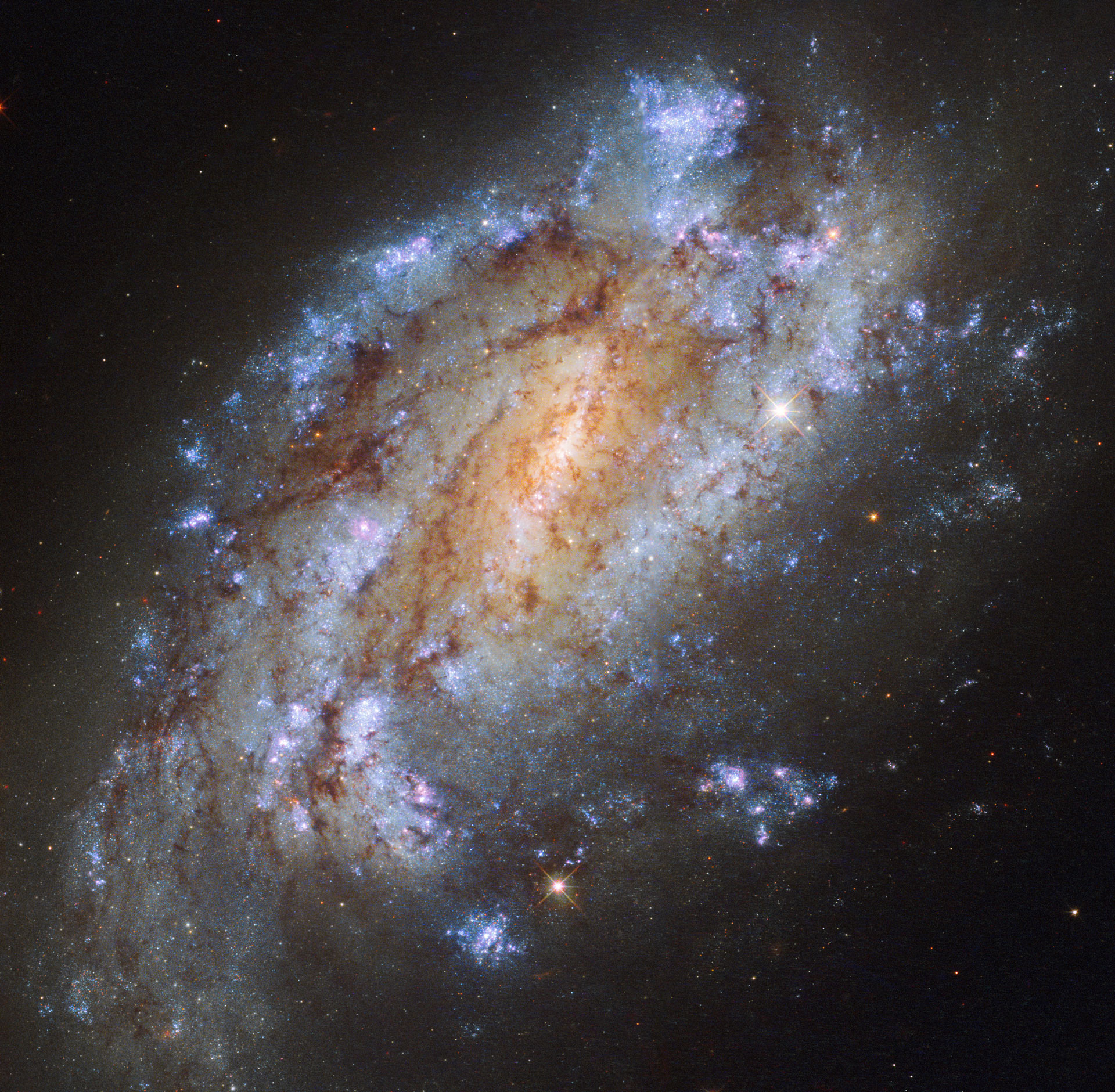
    Newly Released Hubble Image of NGC 1559
    NGC 1559 is located in the southern constellation of Reticulum. Its spiral arms are filled with star formation. Credit: Mathias Jäge, ESA/Hubble & NASA

    Roughly 50 million light-years away lies a somewhat overlooked little galaxy named NGC 1559. Pictured here by Hubble’s Wide Field Camera 3, this barred spiral lies in the little-observed southern constellation of Reticulum (The Reticule).

    NGC 1559 has massive spiral arms chock-full of star formation and is receding from us at a speed of about 1300 km/s. The galaxy contains the mass of around ten billion Suns — while this may sound like a lot, that is almost 100 times less massive than the Milky Way. Although NGC 1559 appears to sit near one of our nearest neighbors in the sky — the Large Magellanic Cloud (LMC), this is just a trick of perspective. In reality, NGC 1559 is physically nowhere near the LMC in space — in fact, it truly is a loner, lacking the company of any nearby galaxies or membership of any galaxy cluster.

    Despite its lack of cosmic companions, when this lonely galaxy has a telescope pointed in its direction, it puts on quite a show! NGC 1559 has hosted a variety of spectacular exploding stars called supernovae, four of which we have observed — in 1984, 1986, 2005, and 2009 (SN 1984J, 1986L, 2005df [a Type Ia], and 2009ib [a Type II-P, with an unusually long plateau]).

    NGC 1559 may be alone in space, but we are watching and admiring from far away.


    Never miss a breakthrough: Join the SciTechDaily newsletter.
    Follow us on Google and Google News.

    Astronomy Cosmology Hubble Space Telescope
    Share. Facebook Twitter Pinterest LinkedIn Email Reddit

    Related Articles

    Hubble Image of the Week: Starburst Galaxy Messier 94

    ESO and Hubble Reveal Fast-Moving, Wave-Like Features in the Debris Disk Around AU Microscopii

    New Phoenix Cluster Observations Provide A Fresh Perspective

    Hubble Image of Arp 194 – Cosmic Optical Illusions in Ursa Major

    Hubble Image of the Week – Evolution in Slow Motion

    Hubble Explores the Wings of the Twin Jet Nebula

    Astronomers Discover Supernovae in ‘Wrong Place at Wrong Time’

    Hubble Reveals Diffusion of Stars Through the Core of the Globular Cluster 47 Tucanae

    Study Suggest Spiral Galaxies Are Larger Than Previously Thought

    3 Comments

    1. Valeriy on February 5, 2018 11:30 am

      The main idea of the formation of celestial bodies was actually given by Sir Isaac Newton. Once upon a time, the world was filled with a homogeneous cloud of neutral hydrogen. If we look very far back in time, we will see how condensations appear in this cloud which, under the influence of gravitation, do not turn into a single huge mass, but transform into beautiful structured galaxies in which beautiful constellations appear by condensation. Unfortunately, this remarkable picture does not correspond to observations. We do not see gas clouds in which galactic structures gradually appear. There is no any gas reservoirs. The most distant observations demonstrate ready-made galaxies with all their structures and stellar populations. So, the new cosmogony only added dark matter and dark energy, which unfortunately are not observed.

      Reply
    2. Wm.Scott Dean on February 5, 2018 5:13 pm

      I think all galaxies are beautiful.

      Reply
    3. Russell H. on February 5, 2018 5:48 pm

      We are very alone in this galaxy aren’t we?

      Reply
    Leave A Reply Cancel Reply

    • Facebook
    • Twitter
    • Pinterest
    • YouTube

    Don't Miss a Discovery

    Subscribe for the Latest in Science & Tech!

    Trending News

    Bone-Strengthening Discovery Could Reverse Osteoporosis

    Scientists Uncover Hidden Trigger Behind Stem Cell Aging

    Scientists Find Way to Reverse Fatty Liver Disease Without Changing Diet

    Could Humans Regrow Limbs? New Study Reveals Promising Genetic Pathway

    Scientists Reveal Eating Fruits and Vegetables May Increase Your Risk of Lung Cancer

    Scientists Reverse Brain Aging With Simple Nasal Spray

    Scientists Uncover Potential Brain Risks of Popular Fish Oil Supplements

    Scientists Discover a Surprising Way To Make Bread Healthier and More Nutritious

    Follow SciTechDaily
    • Facebook
    • Twitter
    • YouTube
    • Pinterest
    • Newsletter
    • RSS
    SciTech News
    • Biology News
    • Chemistry News
    • Earth News
    • Health News
    • Physics News
    • Science News
    • Space News
    • Technology News
    Recent Posts
    • Europe’s Most Active Volcano Just Got Stranger – Here’s Why Scientists Are Rethinking It
    • Why Are Giant Ants Letting Tiny Ants Crawl All Over Them?
    • Revolutionary Technique Sends Healthy Mitochondria Exactly Where They’re Needed
    • This Student Recreated the Universe in a Bottle. What She Discovered Could Help Reveal How Life Started on Earth
    • Alzheimer’s Symptoms May Start Outside the Brain, Study Finds
    Copyright © 1998 - 2026 SciTechDaily. All Rights Reserved.
    • Science News
    • About
    • Contact
    • Editorial Board
    • Privacy Policy
    • Terms of Use

    Type above and press Enter to search. Press Esc to cancel.