

Close Menu
    Facebook X (Twitter) Instagram
    SciTechDaily
    • Biology
    • Chemistry
    • Earth
    • Health
    • Physics
    • Science
    • Space
    • Technology
    Facebook X (Twitter) Pinterest YouTube RSS
    SciTechDaily
    Home»Biology»Rabbits the Size of Horses – Why Not?
    Biology

    Rabbits the Size of Horses – Why Not?

    By Kyoto UniversityOctober 29, 20211 Comment3 Mins Read
    Facebook Twitter Pinterest Telegram LinkedIn WhatsApp Email Reddit
    Share
    Facebook Twitter LinkedIn Pinterest Telegram Email Reddit
    Brown Belgian Giant Rabbit
    Researchers investigated the external forces that prevent wild lagomorphs worldwide from evolving larger body sizes.

    Kyoto University examines the lack of size diversity in rabbits and hares.

    Next to cat videos, watching small and cuddly rabbits is probably one of the most popular internet pastimes. Plus they appear in literature as well as in traditional folklore spanning numerous cultures, thanks likely to the fact that rabbits reside on every continent except Antarctica.

    Yet despite their ubiquity, lagomorphs — including rabbits, hares, and pikas — are rather limited in their size diversity. Compare this to their evolutionary sisters, the rodents, which vary in size from the four-gram pygmy mouse to capybaras weighing as much as 50 kilograms (110 pounds).

    So why don’t we see rabbits rivaling the sizes of horses?

    To answer this question, a research team led by Kyoto University’s Primate Research Institute investigated the fossil record and evolutionary history of lagomorphs. In a study in the journal Evolution, the team reports that larger herbivore competitors were one evolutionary constraint limiting rabbits’ size.
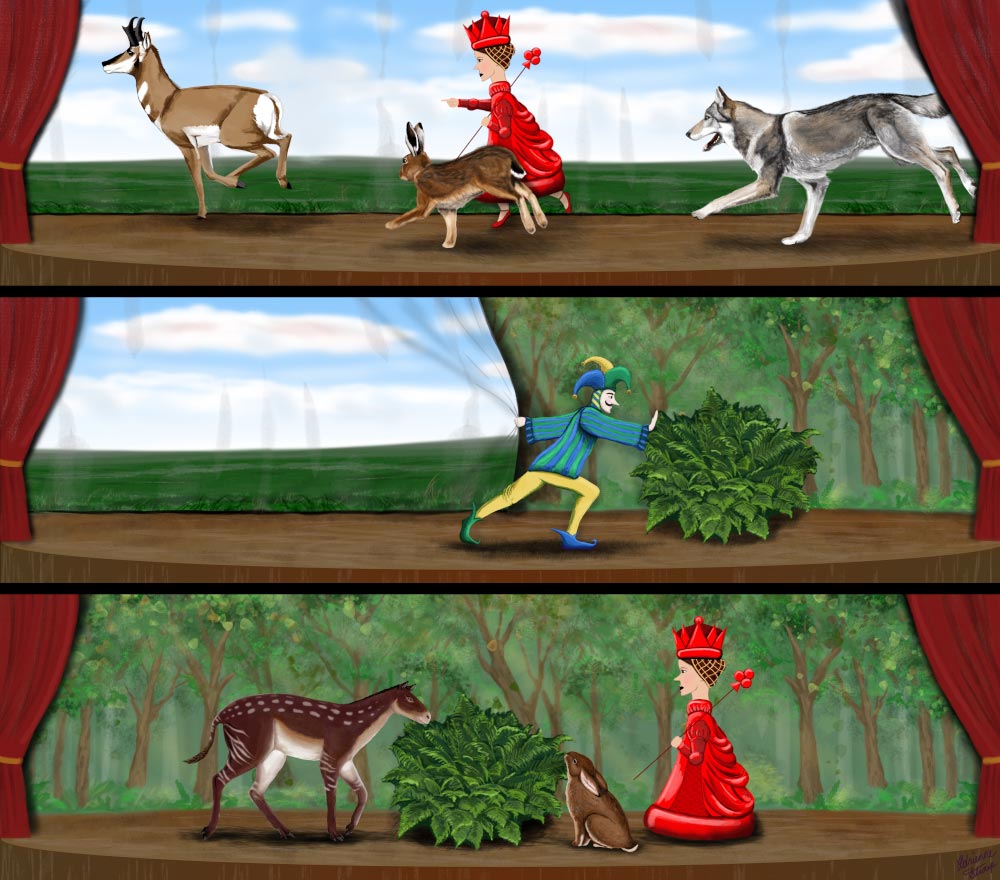
     The Red Queen and the Court Jester
    Depiction of both biotic (Red Queen) and abiotic (Court Jester) models of lagomorph body size evolution. Metaphorically unfolding as an evolutionary play in an ecological theater as might have been envisioned by ecologist G. Evelyn Hutchinson. Credit: Adrienne Stroup

    “The largest living wild lagomorphs weigh only about 5 kg (11 lb) on average, a tenth of the largest living rodent, the capybara,” says first author Susumu Tomiya.

    “But some breeds of domestic rabbits and other extinct species can weigh up to 8 kg (18 lb). We were surprised by this, and so began to investigate what sort of external forces keep wild lagomorphs across the world from evolving larger body sizes.”

    Ungulates as Competitive Limiters

    The scientists began by analyzing ecological factors, discovering that the body sizes of ungulates — hoofed animals — are the most influential predictor.

    “We next compared how much energy is used by populations of lagomorphs and ungulates relative to their body sizes,” continues Tomiya, “finding that lagomorphs weighing more than six kilograms are energetically at a competitive disadvantage to ungulates of the same size.”

    The team lastly went through the lagomorph fossil record in North America, discovering that the best predictor for maximum body size was that of the smallest contemporaneous ungulate.

    “We see this pattern today across numerous eco-regions, suggesting that there is an evolutionary ‘ceiling’ placed on lagomorphs by their ungulate competitors,” explains Tomiya.

    Biotic vs. Abiotic Evolutionary Forces

    These findings suggest that competitive biotic processes can play an important role in shaping the evolutionary history of mammalian orders, acting in hand with abiotic processes such as changes in climate.

    “An ongoing debate in evolutionary biology concerns whether biological or environmental processes are more important in shaping biological diversity,” states Tomiya, “as characterized by the ‘red queen’ and ‘court jester’ hypotheses.”

    “For some time, the court jester model — ascribing diversity to abiotic forces such as the climate — has been dominant, due to the difficulty of studying biological interactions in the fossil record.”

    The team’s results show that biotic interactions do play an important role in guiding the evolutionary trajectories of some species, within the larger context of abiotic influences.

    Reference: “Why aren’t rabbits and hares larger?” by Susumu Tomiya and Lauren K. Miller, 18 February 2021, Evolution.
    DOI: 10.1111/evo.14187

    Never miss a breakthrough: Join the SciTechDaily newsletter.
    Follow us on Google and Google News.

    Evolution Fossils Kyoto University Popular Rabbit
    Share. Facebook Twitter Pinterest LinkedIn Email Reddit

    Related Articles

    Snapshot of Evolution Captured by Newly Discovered 400 Million-Year-Old Plant

    Paleontologists Reveal Jurassic Park in Eastern Morocco

    Evolutionary Origin of the Human Hand Revealed by Ancient Fish Fossil

    “Wonderchicken” – Origin of Modern Birds Revealed by Fossil From the Age of Dinosaurs

    Ancient Sea-Worm Mystery Solved by Student After 50 Years in “Wastebasket”

    New Fossils of Ancient Snake With Hind Legs Reveals Tantalizing Details of Evolution

    New Insight Into the Evolution of Sight From 54 Million Year-Old Fossil

    Newly Discovered Dinosaur (Mansourasaurus shahinae) Links Africa and Europe

    Calcified Bacteria Sheds Light on the Health Consequences of the Evolving Diet

    1 Comment

    1. Joe on October 31, 2021 3:11 pm

      You mean ‘Night of the Lepus’ wasn’t a documentary..

      The Year of the Angry Rabbit by Russell Braddon

      Reply
    Leave A Reply Cancel Reply

    • Facebook
    • Twitter
    • Pinterest
    • YouTube

    Don't Miss a Discovery

    Subscribe for the Latest in Science & Tech!

    Trending News

    First-of-Its-Kind Discovery: Homer’s Iliad Found Embedded in a 1,600-Year-Old Egyptian Mummy

    Beyond Inflammation: Scientists Uncover New Cause of Persistent Rheumatoid Arthritis

    A Simple Molecule Could Unlock Safer, Easier Weight Loss

    Scientists Just Built a Quantum Battery That Charges Almost Instantly

    Researchers Unveil Groundbreaking Sustainable Solution to Vitamin B12 Deficiency

    Millions of People Have Osteopenia Without Realizing It – Here’s What You Need To Know

    Researchers Discover Boosting a Single Protein Helps the Brain Fight Alzheimer’s

    World-First Study Reveals Human Hearts Can Regenerate After a Heart Attack

    Follow SciTechDaily
    • Facebook
    • Twitter
    • YouTube
    • Pinterest
    • Newsletter
    • RSS
    SciTech News
    • Biology News
    • Chemistry News
    • Earth News
    • Health News
    • Physics News
    • Science News
    • Space News
    • Technology News
    Recent Posts
    • This Simple Exercise Trick Builds Muscle With Less Effort, Study Finds
    • Middle Age Is Becoming a Breaking Point in America, Study Reveals
    • Scientists Discover How Coffee Impacts Memory, Mood, and Gut Health
    • How Cells Copy DNA Might Matter More Than We Ever Realized
    • Scientists Just Solved the Mystery of the Twelve Apostles
    Copyright © 1998 - 2026 SciTechDaily. All Rights Reserved.
    • Science News
    • About
    • Contact
    • Editorial Board
    • Privacy Policy
    • Terms of Use

    Type above and press Enter to search. Press Esc to cancel.